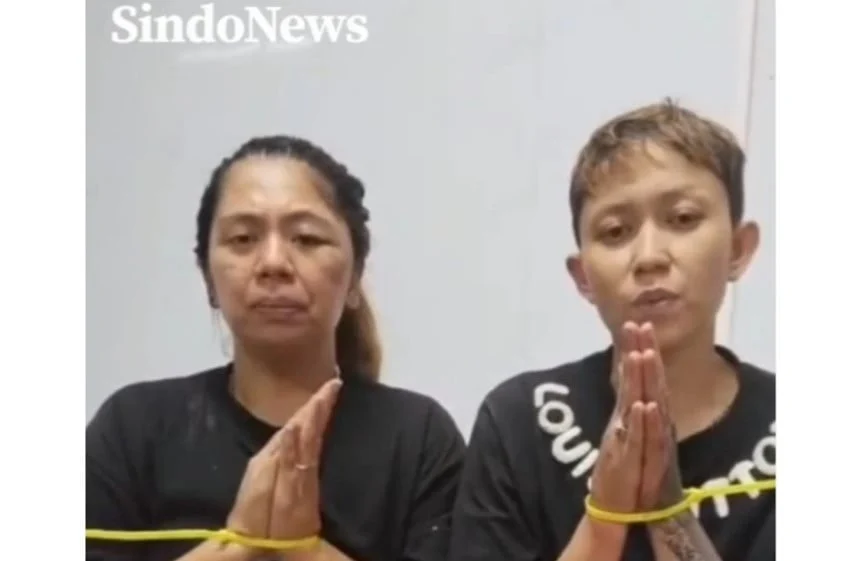
A disturbing video depicting two Indonesian women (WNI) allegedly held captive and handcuffed in Myanmar has recently gone viral across social media platforms, igniting widespread concern and prompting immediate action from Indonesian authorities. The women claim to be victims of abduction, torture, and extortion, with their captors demanding a ransom of up to Rp220 million (approximately USD 14,000) from their families in Indonesia for their release. This incident underscores the escalating crisis of human trafficking and online scam operations flourishing in lawless zones within Southeast Asia, particularly in Myanmar’s volatile border regions.
The video, which circulated rapidly, shows the two women in distress, appealing for help and detailing their ordeal. Their testimony highlights the brutal tactics employed by transnational criminal syndicates that lure unsuspecting individuals with false promises of lucrative jobs, only to trap them in forced labor, often compelling them to participate in elaborate online fraud schemes. The alleged location of their captivity, Myawaddy, is a region notorious for its instability and as a haven for such illicit activities, further complicating rescue efforts.
Immediate Response and Official Statements
Responding to the alarming footage, Brigadier General Dr. Untung Widyatmoko, Secretary of NCB Interpol Indonesia, confirmed that his agency has been actively monitoring the situation. "Yes, it has been monitored. We have established communication with security authorities in Myanmar," Untung stated when contacted recently on a Sunday, acknowledging the gravity of the situation. However, Brig. Gen. Untung refrained from divulging specific details regarding ongoing liberation efforts, citing the extreme sensitivity and inherent dangers associated with the location. He emphasized that the two WNI are believed to be held in a conflict-prone area, specifically the Myawaddy border region, which is largely outside the control of the Myanmar military.
Myawaddy is a critical flashpoint in Myanmar’s complex internal conflicts, located in Karen State along the border with Thailand. This area is predominantly controlled not by the central government’s military junta but by various armed ethnic groups, most notably the Karen National Union (KNU). The KNU, through its armed wing, the Karen National Liberation Army (KNLA), has a long history of resistance against the Myanmar state. The post-2021 military coup has further destabilized the region, creating a power vacuum that has been exploited by criminal organizations, turning it into a sanctuary for illegal enterprises including online scam centers and human trafficking networks. Untung explicitly linked the victims’ predicament to their alleged employment by a "scamming company" operating within this rebel-held territory, underscoring the pervasive nature of these criminal operations in the region.
The Dark Underbelly of Digital Scams and Human Trafficking
The case of these two Indonesian women is not an isolated incident but rather a grim reflection of a broader, rapidly expanding transnational crime phenomenon engulfing Southeast Asia. Regions bordering Myanmar, Cambodia, and Laos have become epicenters for sophisticated online fraud syndicates, often referred to as "scam farms" or "call centers," that prey on victims globally. These operations are typically staffed by individuals who themselves are victims of human trafficking.
Recruitment and Deception: The modus operandi of these syndicates involves luring individuals, predominantly from developing countries in Southeast Asia, with enticing job offers posted on social media platforms or through seemingly legitimate recruitment agencies. These offers promise high salaries for roles in customer service, IT support, online marketing, or cryptocurrency trading, often requiring little to no prior experience. Young, educated individuals seeking better economic opportunities are particularly vulnerable targets. Once recruited, often through clandestine routes across borders, their passports are confiscated, and their freedom of movement is severely restricted.
Forced Labor and Extortion: Upon arrival at the scam compounds, the reality is starkly different from the promises. Victims are forced to work long hours, often under constant surveillance, intimidation, and threats of violence or torture. Their task is to defraud people worldwide through various schemes, including "pig butchering" scams (where scammers cultivate a relationship with a victim over time before convincing them to invest in fraudulent cryptocurrency schemes), romance scams, and technical support scams. Those who fail to meet daily quotas or refuse to cooperate face severe punishment, including physical abuse, food deprivation, and financial penalties. When families become aware of their loved ones’ plight and attempt to secure their release, the syndicates then pivot to extortion, demanding exorbitant ransoms. The Rp220 million demanded for the Indonesian women aligns with typical ransom figures reported in similar cases.
The Geopolitical Landscape of Myawaddy and Karen State
Myawaddy’s strategic location on the Myanmar-Thailand border, directly opposite the Thai town of Mae Sot, makes it a critical gateway for trade and movement, both legal and illicit. However, its designation as a "conflict zone" by Indonesian authorities is deeply rooted in the complex political landscape of Karen State. For decades, the Karen people have sought greater autonomy, leading to protracted armed conflict with Myanmar’s central government. The KNU remains one of the most significant ethnic armed organizations (EAOs) in Myanmar.
The 2021 military coup against the democratically elected government of Aung San Suu Kyi plunged Myanmar into renewed civil war. This widespread instability has further weakened the central government’s authority, especially in border areas. Consequently, regions like Myawaddy have become de facto autonomous zones where various armed groups and unregulated business entities operate with minimal oversight. This environment of lawlessness provides fertile ground for transnational criminal organizations to establish and operate their sophisticated scam compounds, often with the tacit or explicit protection of local armed factions. The absence of effective state control means that traditional diplomatic or law enforcement interventions become exceedingly challenging, if not impossible, due to security risks and sovereignty complexities.
Chronology of Deception and Desperation (Inferred)
While the exact timeline for the two Indonesian women remains partially obscured, a typical chronology for victims in such scenarios can be inferred:
- Luring Phase: The victims were likely approached through online advertisements or recruiters promising attractive job opportunities in Myanmar, perhaps leveraging social media platforms like Facebook, WhatsApp, or Telegram.
- Travel and Arrival: They would have then traveled to Myanmar, potentially facilitated by the recruiters, often entering the country through less regulated border crossings to avoid official scrutiny.
- Realization of Deception: Upon arrival at the designated compound, their passports and mobile phones were likely confiscated, and they were informed of their true "job" – to engage in online fraud. Their freedom of movement was immediately curtailed.
- Forced Labor: Subjected to harsh working conditions, long hours, and psychological manipulation, they were compelled to defraud individuals online, facing severe consequences for non-compliance.
- Emergence of Viral Video: At some point, one or both women managed to record a video, likely in secret, depicting their captivity and distress. This video was then disseminated, possibly through family members or contacts, to alert authorities and the public. The act of making such a video itself carries immense risk within these compounds.
- Family’s Plea: Upon seeing the viral video, the victims’ families in Indonesia would have been galvanized into action, reaching out to media outlets, human rights organizations, and the Indonesian government for assistance.
- Official Engagement: Interpol Indonesia and potentially the Ministry of Foreign Affairs (Kemlu) commenced monitoring the situation and initiating communications with Myanmar authorities, acknowledging the severe challenges presented by the location.
Official Responses and Diplomatic Challenges
The Indonesian government, through various agencies, has been increasingly active in addressing the human trafficking crisis impacting its citizens abroad. The Ministry of Foreign Affairs (Kemlu) typically plays a pivotal role in providing consular assistance, coordinating with host country governments, and facilitating the repatriation of Indonesian citizens in distress. However, the unique circumstances of Myawaddy – a territory outside central government control – present significant diplomatic and operational hurdles.
Inter-agency cooperation within Indonesia is crucial. Besides Interpol Indonesia, the Indonesian National Police (Polri) and the Indonesian Agency for the Protection of Migrant Workers (BP2MI) are often involved in investigations, prevention campaigns, and reintegration efforts. BP2MI, for instance, has repeatedly warned Indonesian citizens about the dangers of accepting dubious job offers abroad, especially in countries known for scam operations. They often run public awareness campaigns urging individuals to verify the credibility of job offers and recruitment agencies.
Internationally, Interpol’s involvement underscores the transnational nature of these crimes. Cross-border intelligence sharing and collaborative law enforcement efforts are essential to dismantle these sophisticated criminal networks. However, the lack of a strong, unified government presence in areas like Myawaddy complicates these international efforts, as there is often no reliable local authority to cooperate with on the ground. This necessitates delicate negotiations and, at times, unconventional approaches involving local intermediaries, which carry their own set of risks.
Broader Implications and The Road Ahead
The plight of the two Indonesian women in Myawaddy highlights several critical implications and underscores the urgent need for comprehensive strategies:
- Protecting Vulnerable Citizens: The Indonesian government faces an ongoing challenge in protecting its citizens from increasingly sophisticated human trafficking and online fraud schemes. This requires sustained public awareness campaigns, enhanced vetting processes for overseas job opportunities, and robust support systems for victims.
- Combating Transnational Organized Crime: The scale and complexity of these scam syndicates demand a concerted, multi-national approach. This includes strengthened intelligence sharing among ASEAN member states, closer collaboration with international law enforcement bodies like Interpol, and targeted operations to disrupt the financial flows sustaining these criminal enterprises.
- Addressing Root Causes: Economic disparities and the search for better opportunities often drive individuals into vulnerable situations. Long-term solutions must include addressing domestic unemployment, improving economic prospects, and providing accessible, credible information about safe migration pathways.
- Navigating Geopolitical Complexities: The crisis in Myanmar, particularly the ongoing civil war and the proliferation of rebel-held territories, creates significant obstacles for rescue and law enforcement operations. International diplomacy and humanitarian efforts must continue to pressure for peace and stability, which are prerequisites for dismantling these criminal safe havens.
- Victim Support and Rehabilitation: For survivors, the journey does not end with liberation. They often endure severe psychological trauma, physical abuse, and financial debt. Comprehensive rehabilitation programs, psychological counseling, and reintegration support are vital to help them rebuild their lives.
- Ethical Dilemmas: Many victims are forced to become perpetrators, compelled to defraud others under duress. This raises complex ethical questions and necessitates a nuanced approach that recognizes their dual status as both victims and unwilling participants in crime.
- Role of Technology: While social media can be exploited for recruitment, it also serves as a powerful tool for exposing these crimes, raising awareness, and facilitating calls for help. Enhancing digital literacy and critical thinking skills among the public is crucial to help individuals identify and avoid online scams and fraudulent job offers.
The viral video of the two Indonesian women serves as a stark reminder of the human cost of unchecked criminality in unstable regions. While Indonesian authorities continue their delicate efforts to secure the women’s release, the incident reinforces the urgent need for a unified regional and international response to dismantle the networks of human traffickers and online fraudsters that continue to exploit the vulnerable across Southeast Asia.