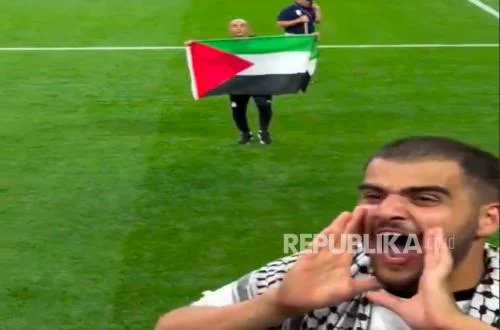
NEW YORK – The display of the Palestinian flag has emerged as a focal point of contention and increased scrutiny during the ongoing World Cup tournament hosted across various cities in the United States. Despite official regulations from FIFA, the global governing body of football, that ostensibly permit the display of national flags, numerous reports indicate that supporters carrying the Palestinian banner have faced intervention from security personnel at stadium entrances, being instructed to either conceal the flag or face its confiscation. These incidents highlight a complex interplay between sporting regulations, security protocols, and burgeoning geopolitical sensitivities on a global stage.
The core of the issue stems from a series of encounters reported by fans to Middle East Eye (MEE), detailing instances where individuals attempting to enter World Cup venues with Palestinian flags were stopped. Security staff reportedly informed them that the flags were not permitted, despite FIFA’s widely understood guidelines that allow national flags to be flown within stadiums. This discrepancy has fueled frustration among supporters and raised questions about the consistent application of rules by host nation security forces, potentially acting beyond the scope of FIFA’s official directives.
Incidents and Fan Experiences
Throughout the tournament, which serves as a massive international gathering, the presence of Palestinian flags has been notably widespread, particularly among supporters of Arab teams. This phenomenon occurs even though the Palestinian national team itself is not a participant in the competition. For many, the flag represents a powerful symbol of identity, solidarity, and a broader political cause that resonates deeply within various communities worldwide.
Eyewitness accounts describe a pattern of intervention. Fans carrying Palestinian flags have been subjected to detailed checks, often more rigorous than those for other national flags. These checks have reportedly led to confrontational situations, where fans are put in the difficult position of choosing between adhering to what they believe are their rights under FIFA rules and complying with the demands of on-site security personnel to avoid missing the match or having their property seized. These experiences have been consistent across multiple venues, suggesting a broader, if unofficial, policy rather than isolated incidents.
FIFA’s Ambiguous Stance and Regulatory Framework
The ambiguity surrounding the permissibility of the Palestinian flag is further complicated by what activists describe as confusing messages emanating from FIFA itself. Maisa Morrar, a Palestinian-American community organizer from Oakland, California, critically noted that FIFA bears responsibility for these confrontations. Morrar highlighted initial reports suggesting FIFA had explicitly permitted Palestinian flags, which she found perplexing given the standard practice of fans displaying their national flags at World Cup events. "People always bring their national flags to World Cup games all the time. So, it felt strange to me that the question of whether Palestinians are allowed to fly their flag or not even came up," Morrar stated, underscoring the perceived double standard.
FIFA’s general regulations regarding stadium conduct typically allow for the display of national flags that are officially recognized by the United Nations or its member states, provided they do not contain offensive, discriminatory, or overtly political messages unrelated to the sport. The Palestinian flag, representing a recognized observer state at the UN, should, under normal interpretation, fall within these permissible categories. However, the interpretation and enforcement of these rules at specific events can be influenced by host nation security concerns, local political sensitivities, and the discretion of on-ground staff. This often creates a grey area, where what is technically allowed can be overruled by perceived security risks or directives from higher authorities.
Broader Context of Palestinian Solidarity
The widespread display of the Palestinian flag at the World Cup is not merely a spontaneous act of national pride but reflects a growing global wave of solidarity with the Palestinian people. In recent years, particularly against the backdrop of ongoing conflict and humanitarian crises in the Palestinian territories, international awareness and support for the Palestinian cause have surged. Major global events, such as the World Cup, provide an unparalleled platform for expressing these sentiments, reaching billions of viewers worldwide.
For many fans, flying the Palestinian flag transcends mere political statement; it is an act of humanitarian solidarity, a call for justice, and an assertion of identity in a highly visible public space. The sight of the flag waving alongside those of participating nations, even when Palestine is not competing, underscores the global reach of the issue and the emotional connection many feel towards it. This heightened visibility, however, also places the symbol under increased scrutiny, particularly in contexts where host nations might have complex diplomatic relations or security concerns related to such displays.
Historical Precedents and Challenges of Political Symbolism in Sport
The intersection of sport and politics is a long-standing and often contentious issue. Major sporting events like the Olympics and the World Cup have historically served as arenas for political expression, protest, and solidarity. From the Black Power salute at the 1968 Mexico City Olympics to various displays against apartheid and other injustices, athletes and fans have consistently used these platforms to convey powerful messages.
FIFA and other sporting bodies have often struggled to maintain a strict "no politics in sport" stance, as the very act of hosting an international event inherently involves political and diplomatic dimensions. While rules exist to prevent overtly offensive or violent political messaging, distinguishing between legitimate national expression and "political" content can be subjective and fraught with challenges. The current situation with the Palestinian flag highlights this enduring dilemma, especially when security apparatuses, rather than sporting officials, become the primary enforcers of what is permissible.
Implications for Freedom of Expression and Future Events
The incidents involving the Palestinian flag raise significant questions about freedom of expression within public spaces, even those privately managed during major events. For many pro-Palestinian activists, these confrontations are indicative of an intensified surveillance and suppression of Palestinian identity in public spheres, occurring precisely at a time when global support for the Palestinian struggle is becoming more evident. This perceived crackdown on a national symbol is seen as an attempt to de-legitimize or silence a specific narrative.
Looking ahead, as the tournament progresses towards its climax, including the final match at MetLife Stadium in New Jersey, the question of whether authorities will permit the unimpeded display of the Palestinian flag remains pertinent. The precedents set during this tournament could have lasting implications for future major sporting events, especially those held in countries with diverse populations and complex geopolitical alignments.
Official Responses and Calls for Clarity
As of the latest reports, a comprehensive, unambiguous statement from FIFA directly addressing the specific issue of Palestinian flags and the reported confiscations has been lacking. The onus, according to critics like Maisa Morrar, is on FIFA to clarify its position unequivocally and ensure that its rules are consistently and fairly applied by all security personnel, irrespective of the specific national symbol.
The organizing committee of the World Cup in the US, in conjunction with local law enforcement and private security firms, is responsible for implementing stadium security protocols. Their interpretation of what constitutes a permissible item versus a potential security risk or an inappropriate political display becomes crucial. A lack of clear guidance from FIFA can lead to varied interpretations, potentially resulting in arbitrary enforcement that alienates fan groups and damages the inclusive spirit of the tournament.
Human rights organizations and civil liberties advocates are likely to monitor these developments closely. Any perceived suppression of non-violent expression, particularly when it pertains to a national identity, could draw criticism and calls for greater transparency and adherence to international standards of freedom of speech. The argument often put forth is that if other national flags are permitted, singling out the Palestinian flag constitutes discriminatory practice.
Economic and Political Dimensions
Hosting a global event like the World Cup involves immense financial investment and political prestige. Host nations aim to present an image of unity, hospitality, and efficient organization. However, managing the diverse political expressions of millions of international fans presents a formidable challenge. Balancing commercial interests, security imperatives, and the protection of fundamental freedoms is a tightrope walk.
The US, as the host nation, has its own intricate foreign policy considerations, particularly concerning the Middle East. While official neutrality is often desired in such sporting contexts, the actions of on-ground security personnel can inadvertently reflect or be perceived as reflecting broader governmental stances. This can, in turn, affect the perception of the host nation on the global stage, potentially drawing criticism from international observers and civil society groups.
Conclusion: A Call for Consistent Application
The incidents surrounding the Palestinian flag at the World Cup in the United States underscore a persistent tension between global sporting regulations, local security enforcement, and the universal right to expression. While the World Cup is intended to be a celebration of sport and unity, it often becomes a microcosm of broader geopolitical realities.
For the tournament to truly embody its spirit of inclusivity and fair play, there is an urgent need for FIFA to issue clear, unambiguous guidelines regarding the display of all national flags, ensuring these are communicated effectively to all security personnel. Such clarity would help prevent arbitrary enforcement, uphold the rights of fans, and allow the focus to remain squarely on the beautiful game, rather than on controversies stemming from the symbolism of national identity. The consistent application of rules, free from political bias, is paramount to maintaining the integrity and global appeal of such monumental sporting spectacles.