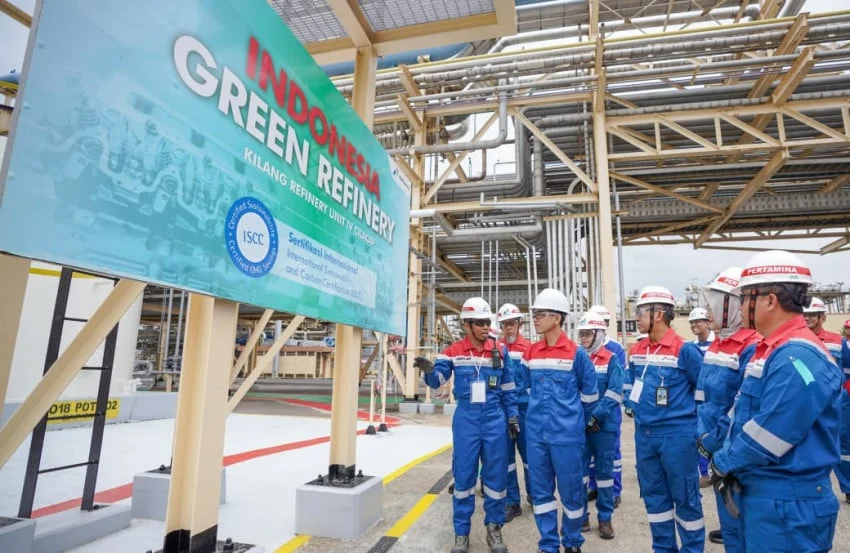
PT Pertamina Patra Niaga has officially marked a monumental milestone in Indonesia’s sustainable energy landscape by successfully producing approximately 11 million liters of Sustainable Aviation Fuel (SAF) derived from used cooking oil, locally known as minyak jelantah or mijel, at its state-of-the-art Green Refinery in Cilacap, Central Java. This commercial-scale production highlights Indonesia’s proactive stance in addressing climate change, reducing carbon emissions within the aviation sector, and fostering a circular economy that directly integrates grassroots communities into the national industrial supply chain.
The landmark achievement gained high-level national attention when Vice President Gibran Rakabuming Raka conducted a direct, on-site inspection of the processing facilities at the Green Refinery Cilacap. His visit underscored the government’s unwavering commitment to transitioning toward renewable energy sources while simultaneously uplifting local economic structures through grassroots empowerment.
Grassroots Empowerment Meets National Industrial Strategy
During his inspection of the facility, Vice President Gibran emphasized that the transition to green energy must not occur in a vacuum; rather, it must directly benefit ordinary citizens. The integration of household waste—specifically used cooking oil collected by homemakers through local waste banks (bank sampah)—into a high-tech industrial refining process serves as a prime example of inclusive green growth.
"The development of SAF must go hand in hand with community empowerment. This ensures that the used cooking oil managed by mothers through local waste banks possesses tangible economic value and remains securely connected to the national industry," Vice President Gibran stated in an official press release.
This model creates a symbiotic relationship between micro-economies and macro-industrial frameworks. Households and local waste management cooperatives are provided with financial incentives to collect and properly dispose of used cooking oil, which otherwise might be improperly discarded into the environment or illegally recycled for human consumption. Meanwhile, state-owned energy giant Pertamina secures a steady, domestic stream of renewable feedstock for its advanced refining processes.
Technical Innovation at the Green Refinery Cilacap
The large-scale commercialization of SAF at the Cilacap facility is powered by cutting-edge technology and strategic engineering. Taufik Aditiyawarman, Vice President Director I of PT Pertamina Patra Niaga, elaborated on the technical specifications and operational milestones achieved during the production phase.
According to Taufik, the transformation of waste oil into aviation-grade biofuel is executed through the Thermal Distillate Hydro Treating (TDHT) facility. The plant utilizes a sophisticated co-processing scheme, wherein used cooking oil is refined alongside conventional petroleum components under high temperatures and pressures in the presence of hydrogen catalysts.
"In the implementation of SAF production at the Green Refinery Cilacap, we have successfully reached the commercial production stage. In October alone, we produced approximately 11 million liters of co-processed SAF," Taufik explained.
He further detailed that used cooking oil is utilized at a precise ratio of up to 5 percent of the total production capacity of the TDHT unit. This strategic ratio allows Pertamina to maximize the efficiency of its existing refinery infrastructure without requiring entirely new standalone facilities, thereby optimizing capital expenditure while accelerating the decarbonization of the energy portfolio.

Contextualizing Indonesia’s Aviation Biofuel Roadmap
The commercial rollout of SAF in Cilacap does not happen in isolation; it represents the culmination of years of research, trial runs, and regulatory alignment aimed at fulfilling international aviation decarbonization mandates. The global aviation industry, regulated heavily by the International Civil Aviation Organization (ICAO), has committed to achieving net-zero carbon emissions by 2050. To meet these stringent targets, international airlines are increasingly pressured to blend conventional Jet A-1 fuel with certified sustainable alternatives.
For Indonesia—an archipelago reliant heavily on domestic air connectivity and positioned as a growing hub in Southeast Asian aviation—developing domestic SAF capabilities is both an environmental imperative and an economic safeguard. By producing SAF locally, Indonesia reduces its reliance on imported energy components, stabilizes domestic fuel security, and positions national carriers to comply with cross-border environmental regulations, such as the Carbon Offsetting and Reduction Scheme for International Aviation (CORSIA).
Pertamina’s journey toward green refining began years prior, with initial test flights utilizing palm oil-based bioavtur (J2.4) conducted by national flag carrier Garuda Indonesia. The evolution from palm-derived feedstock to waste-based feedstock like used cooking oil reflects a broader global shift toward advanced biofuels that do not compete directly with food crops, thereby avoiding food-versus-fuel debates and satisfying stringent European Union and international sustainability criteria.
Broader Economic and Environmental Implications
The socio-economic and ecological ramifications of Pertamina Patra Niaga’s latest milestone extend far across multiple sectors. From an environmental perspective, processing used cooking oil prevents significant water and soil pollution. Disposing of cooking oil down residential drains routinely leads to clogged sewage systems and severe aquatic contamination. Channeling this waste into biofuel production creates a closed-loop system that cleans the environment while fueling aircraft.
From an economic standpoint, the commercial production of 11 million liters of SAF signals to global investors that Indonesia is serious about building a robust green industrial ecosystem. It opens up avenues for green financing, carbon credit generation, and technological partnerships with global aviation and energy leaders.
Furthermore, the integration of community-level waste banks into Pertamina’s supply chain acts as a catalyst for behavioral change regarding waste management. As local communities realize the monetary worth of household waste, civic participation in recycling initiatives is projected to rise significantly.
Future Outlook and Challenges Ahead
While the production of 11 million liters of SAF at the Green Refinery Cilacap is a monumental leap forward, industry analysts point out that scaling up production to meet national and international demand will require sustained commitment and infrastructural expansion.
Key challenges moving forward include establishing standardized, nationwide collection networks for used cooking oil to ensure a consistent, high-quality supply of feedstock. Because used cooking oil varies in chemical composition depending on its prior culinary use, rigorous pre-treatment and purification protocols are mandatory before the oil enters the TDHT units.
Additionally, pricing parity remains a critical factor. Currently, SAF is more expensive to produce than conventional fossil-based jet fuel. Broad adoption will hinge upon supportive government policies, tax incentives, carbon pricing mechanisms, and long-term off-take agreements with commercial airlines operating within and outside Indonesia.
Despite these hurdles, the leadership demonstrated by state officials, including Vice President Gibran Rakabuming Raka, alongside the technical execution by Pertamina Patra Niaga, establishes a solid foundation. As the global aviation market aggressively seeks low-carbon solutions, Indonesia’s strategic utilization of waste oil in Cilacap firmly positions the nation as an emerging pioneer in sustainable aviation fuels within the Asia-Pacific region.