The landscape of Islamic philanthropy and community development in Indonesia has long been shaped by the institutional prowess of Muhammadiyah, one of the nation’s premier socio-religious organizations. Operating thousands of educational institutions, healthcare facilities, and social welfare centers, the organization stands as a titan of civil society. However, beneath the veneer of vast institutional assets and infrastructural growth, internal reflections reveal a persistent structural vulnerability: the economic empowerment of the grassroots remains critically constrained. This tension between top-tier institutional success and grassroots economic limitation took center stage during a high-profile discourse in the capital, prompting leaders to re-evaluate how economic pillars function within the broader framework of Islamic propagation, or dakwah.
The Jakarta General Assembly: Setting the Stage for Economic Self-Sufficiency
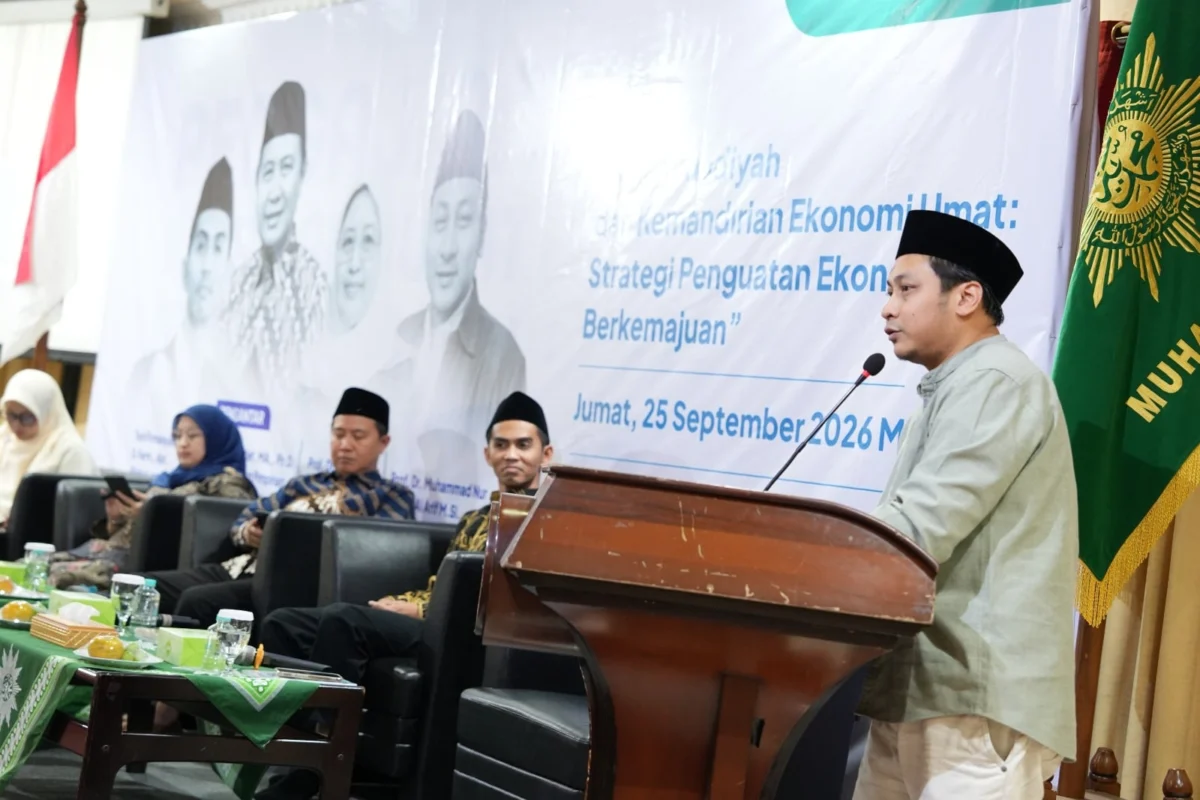
On Friday, September 25, the Muhammadiyah Central Leadership (PP Muhammadiyah) convened its routine General Assembly at the Gedung Dakwah Muhammadiyah in Jakarta. The gathering, designed to deliberate on strategic organizational policies and spiritual guidance, drew regional leaders, scholars, and activists from across the capital and its surrounding districts. Among the prominent speakers was Muhammad Nur Rianto Al Arif, Chairman of the East Jakarta Regional Leadership (PD Muhammadiyah) of Muhammadiyah.
Taking the podium, Nur delivered a candid assessment of the organization’s economic trajectory. While acknowledging that economic instruments are formally integrated into Muhammadiyah’s dakwah mission to serve as practical tools for community upliftment, he argued that the actual implementation falls short of its potential. The core objective of embedding economic pillars within the movement—namely, to advance the financial standing of the organization, its members, and the general public—is currently hampered by systemic disconnects between structural leadership and community-level execution.
According to Nur, the root of this limitation traces back to the composition of organizational leadership. He pointed out a noticeable absence of seasoned entrepreneurs within the structural hierarchy of leadership boards. This lack of commercial representation at the decision-making level fosters an institutional culture of risk aversion. Consequently, when leadership is presented with high-value economic opportunities that could significantly scale the organization’s financial footprint, hesitation prevails over calculated ambition.
"We often find that when major opportunities present themselves and we are fully capable of pursuing them, a sense of unpreparedness takes over," Nur remarked during the assembly. This psychological and structural barrier prevents local chapters from tapping into lucrative markets, leaving substantial economic potential unexploited.
The Grassroots Dilemma: Object vs. Subject in Economic Development
A central theme of the critique presented in Jakarta was the marginalization of grassroots entities—specifically the sub-district (branch) and village (ranting) levels—in the broader economic architecture of Muhammadiyah. Despite boasting a massive network of Amal Usaha Muhammadiyah (AUM), which serve as the operational arms of the organization in fields ranging from schooling to hospital management, the everyday members at the local level are frequently treated as economic targets rather than active participants.
Nur highlighted the disconnect between top-down strategic planning and bottom-up execution. Elaborating on this structural challenge, he noted that while central committees formulate comprehensive economic blueprints, the translation of these concepts into tangible benefits for the grassroots remains an elusive goal.
To illustrate this systemic friction, Nur drew attention to a growing trend within the organization’s business ecosystem: the proliferation of bottled drinking water enterprises operating under various Muhammadiyah affiliations. Across different regions, multiple AUMs have ventured into the production of packaged water, all utilizing the organization’s esteemed name and brand equity. Far from generating a unified, synergistic economic powerhouse, this uncoordinated expansion has created internal market cannibalization.
Members and local branches are left bewildered by the sheer multitude of internal brands, struggling to discern which products actively contribute to the financial sustenance of the parent organization. Compounding the issue is the distribution strategy of these ventures. Rather than penetrating mainstream commercial markets to capture external capital, these localized entities frequently rely on captive internal markets—selling their goods back to local branches, schools, and congregations.
"Everyone is playing their own game, and where do they sell their products? Back to the regional chapters, the branches, and the sub-districts," Nur explained, underscoring the inward-looking nature of these commercial efforts.
Historical Context and the Cost of Financial Dependency
To understand the current economic predicament of Muhammadiyah’s grassroots, one must examine the historical evolution of its institutional infrastructure. Since its founding in 1912 by Ahmad Dahlan, Muhammadiyah adopted a pioneering approach to social modernization through the establishment of schools, clinics, and orphanages. These institutions, collectively formalized as AUMs, became the hallmark of the movement.
However, the traditional blueprint for establishing an AUM has heavily favored social welfare and education over commercial enterprise. For generations, when local branches sought to establish a physical presence, the standard template dictated the founding of a school, a mosque, or a clinic. While these institutions fulfill vital spiritual and educational needs, their financial architecture is predominantly designed around operational costs rather than surplus generation. In economic terms, these entities function primarily as cost centers rather than profit centers.
Consequently, local branches and sub-districts have grown accustomed to a state of perpetual financial dependency. Many grassroots units rely almost entirely on logistical and financial subsidies trickling down from large-scale educational AUMs or central endowments. When these traditional funding streams face constraints, local operations immediately feel the pressure.
Nur shared a practical example from his own jurisdiction in East Jakarta, where executing routine programs—such as comprehensive training modules for local preachers (mubaligh)—frequently encounters severe budgetary hurdles. Without a diversified, self-sustaining financial base at the grassroots level, vital religious and social outreach programs remain vulnerable to economic fluctuations and funding shortages.
Rethinking Endowment Assets: From Social Welfare to Productive Sectors
Addressing the structural imbalance requires a fundamental shift in how organizational assets are conceptualized and managed. During his address, Nur placed particular emphasis on the utilization of endowment assets, or wakaf. Traditionally, wakaf properties within the Muslim community in Indonesia have been strictly channeled toward consumption-oriented social infrastructure, such as building mosques, cemeteries, or Quranic study centers. While these uses hold profound spiritual value, they do not inherently generate the recurring financial capital required to sustain modern organizational activities.
Nur advocated for a strategic pivot, urging administrators to allocate wakaf assets toward productive economic sectors. By transforming dormant or purely consumption-based endowments into income-generating commercial ventures—such as agricultural enterprises, commercial real estate, or strategic business partnerships—local chapters can secure an independent financial lifeblood.
This diversification aligns with the broader contemporary discourse within Muhammadiyah regarding "progressive Islam" (Islam Berkemajuan), a paradigm that emphasizes civilizational advancement, economic independence, and scientific literacy.
"When we speak of a progressive economic movement, we must discuss it comprehensively, ensuring that the grassroots level is actively mobilized and participating," Nur concluded.
Implications for the Future of Islamic Civil Society in Indonesia
The frank assessments aired at the Jakarta General Assembly carry significant implications not only for Muhammadiyah, but for the broader ecosystem of Islamic civil society in Southeast Asia. As faith-based organizations grow in scale, the challenge of institutional professionalization becomes increasingly acute.
Experts in Islamic economics note that organizations like Muhammadiyah and its counterpart, Nahdlatul Ulama, possess immense latent economic power through the collective wealth and consumer loyalty of their tens of millions of members. However, capturing this economic dividend requires transitioning from traditional philanthropic models to modern corporate governance frameworks.
Key implications of this ongoing internal debate include:
- Structural Reform in Leadership Selection: There is a growing consensus that future leadership slates within Islamic organizations must intentionally incorporate professionals, entrepreneurs, and financial experts to bridge the gap between ideological mission and commercial execution.
- Consolidation of Commercial Brands: The proliferation of uncoordinated internal businesses points to an urgent need for institutional consolidation. Establishing centralized holding companies or umbrella corporations for AUM-driven products can prevent internal competition and enhance market competitiveness.
- Decentralized Economic Empowerment: Moving away from top-down charity models toward cooperative-based grassroots enterprises will likely become a focal point of future strategic plans, ensuring that local branches possess the economic autonomy required to fund their own community programs.
- Optimization of Philanthropic Assets: The modernization of zakat (alms), infaq (charity), and wakaf (endowments) into venture-backed or productive assets represents the next frontier for sustainable organizational financing in the digital age.
As Muhammadiyah continues to navigate its second century of existence, the dialogues initiated by regional leaders in Jakarta signal a mature willingness to confront internal structural hurdles. By addressing the economic limitations at the akar rumput, the organization seeks to fortify its foundational pillars, ensuring that its mission of religious enlightenment and social welfare remains economically resilient for generations to come.