The infrastructural development of regional roadways often encounters unique challenges that extend far beyond engineering and budgetary constraints. A striking example of this recurring phenomenon unfolded in Pekalongan, Central Java, capturing widespread public attention and sparking intense online discourse across various social media platforms. On Monday, September 28, 2026, a video surfaced showing numerous motorists, spanning both two-wheeled and four-wheeled vehicles, persistently navigating through a freshly poured road segment that was actively undergoing heavy construction and structural remediation.
The viral footage, originally disseminated and amplified by the prominent regional social media aggregator account @info_jabodetabek, quickly gained traction among digital communities. The incident highlights a persistent cultural and behavioral hurdle in municipal project management: the tendency of certain motorists to bypass physical safety barriers, compromise ongoing construction integrity, and disregard fundamental traffic advisories in pursuit of immediate convenience or time savings.
Chronology of the Pekalongan Roadway Incident
According to detailed visual evidence and corresponding location metadata provided in the viral digital reports, the incident occurred during the daylight hours of Monday, September 28, 2026, in a designated active construction zone within Pekalongan. Municipal authorities and private contracting crews had previously established standardized traffic diversion protocols, deploying physical barricades, warning signs, and hazard markers to cordon off the specific lane undergoing structural resurfacing.
Despite these established safety interventions, the footage demonstrates a systematic breach of the construction perimeter. Initially, municipal contractors had installed structural barriers, including wooden or metal-reinforced poles and hazard tape, directly across the center of the road access points. These measures were explicitly intended to signal to incoming traffic that the thoroughfare was strictly closed to all civilian vehicles due to ongoing foundational engineering work.
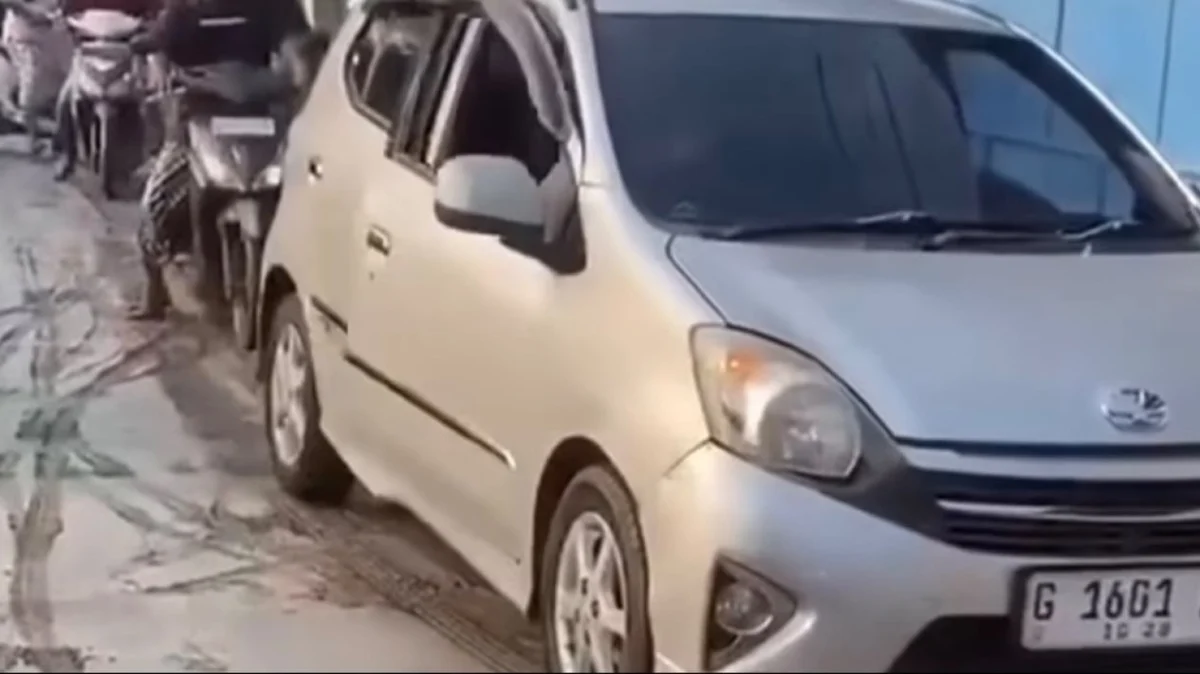
However, observational data from the scene reveals a breakdown in compliance. Motorists approaching the cordoned zone began actively shifting, removing, or squeezing past the positioning of the physical barriers. Once a rudimentary pathway was forced open, a psychological herd mentality took hold. A growing queue of motorcyclists, followed conspicuously by a passenger automobile, began driving directly over the uncured, wet asphalt surface. The video illustrates individual motorcycle riders carefully maneuvering their machines at remarkably low speeds through the sticky, malleable material, leaving deep, permanent tire ruts in their wake. Similarly, the automobile navigated along the outer edge of the partially completed lane, compounding the physical disruption to the wet substrate.
Structural and Material Implications of Uncured Asphalt Interference
From an engineering and civil infrastructure perspective, the unauthorized traversal of vehicles across uncured construction zones carries severe technical repercussions. Roadway construction, particularly asphalt resurfacing and concrete pouring, follows precise thermodynamic and chemical curing timelines. When aggregate materials, bitumen, or concrete mixtures are freshly laid, they require an uninterrupted cooling and setting period to achieve their targeted structural density, tensile strength, and load-bearing capacity.
When automobiles and motorcycles drive over wet or semi-fluid road surfaces prematurely, the physical weight of the vehicles exerts concentrated downward pressure that exceeds the unhardened material’s shear strength. This results in several immediate structural defects:
- Surface Deformation and Rutting: The immediate indentation caused by tire treads creates uneven topography, localized depressions, and structural ruts. If left uncorrected, these deformities lead to premature water pooling, hydroplaning risks, and rapid pothole formation once the road is officially opened to traffic.
- Compromised Aggregate Bonding: The mechanical traction of tires passing over unbonded aggregates disrupts the uniform distribution of binding agents, creating micro-fissures within the sub-base and surface layers.
- Prolonged Project Timelines: Remediating damaged, freshly poured road sections requires contractors to scrape away the compromised material, level the sub-grade, and reapply the surfacing mixture. This not only incurs additional financial costs for municipal public works departments but also extends traffic congestion and community inconvenience by delaying the final handover date.
Beyond the threat to municipal assets, traversing active construction zones presents immediate physical dangers to the motorists themselves. Uncured asphalt and loose aggregate significantly diminish vehicle tire traction. For motorcyclists, the disparity in friction coefficients between normal asphalt and sticky construction compounds creates a high risk of sudden loss of control, potential skidding, and injurious falls.
Broader Sociological and Infrastructure Management Challenges
The Pekalongan incident is far isolated; rather, it reflects a broader behavioral pattern observed across developing urban and semi-urban transit corridors throughout Southeast Asia. Infrastructure sociologists and traffic management experts point to several underlying factors driving such non-compliant behavior:
- Perception of Public Spaces: Many drivers view public roadways as a continuous, uninterrupted utility to which they maintain an absolute right of access, often viewing temporary closures as bureaucratic inconveniences rather than vital safety measures.
- Deficiencies in Alternative Route Planning: In many regional infrastructure projects, detour routes are either poorly marked, overly circuitous, or suffer from severe pre-existing congestion. Frustrated by the prospect of prolonged commuting delays, motorists frequently calculate that the physical risk and potential illegality of breaching a construction zone are outweighed by the time saved.
- Inadequate Enforcement Presence: Construction zones are rarely monitored by continuous traffic police or municipal enforcement officers. Contractors typically rely on passive signage and physical barriers, which can easily be manipulated or ignored in the absence of active penal deterrence.
Responses and Analytical Perspectives from Regional Observers
In the wake of the viral video dissemination, urban planning analysts and regional governance advocates have weighed in on the systemic vulnerabilities exposed by the Pekalongan event. Transportation safety advocacy groups emphasize that physical barricades alone are frequently insufficient in environments where public compliance is low.
According to public policy specialists, effective infrastructure management during capital works projects requires a multi-layered communication and enforcement strategy. This includes the deployment of high-visibility electronic variable message signs well in advance of construction zones, proactive deployment of local traffic wardens (Dishub) during peak hours, and the installation of robust, heavy-duty physical barriers that cannot be casually displaced by determined motorists.
Furthermore, legal analysts note that unauthorized entry into active construction zones frequently violates regional traffic regulations and public property protection statutes. While direct enforcement against anonymous drivers captured on social media remains challenging, municipalities increasingly rely on crowdsourced digital evidence to identify repeat offenders or to pressure local authorities into deploying permanent security infrastructure around vulnerable public works projects.
Conclusion and Future Mitigation Strategies
The incident captured on video in Pekalongan on September 28, 2026, serves as a cautionary case study in the intersection of human behavior and civil engineering maintenance. While the immediate damage inflicted upon the uncured roadway surface represents a localized financial and logistical setback for municipal contractors, the broader implications touch upon core issues of civic responsibility, public safety enforcement, and infrastructural resilience.
To mitigate similar occurrences in future municipal projects, regional authorities are being urged to adopt more comprehensive safety frameworks. These measures include integrating advanced community notification channels, enhancing the physical robustness of site perimeters, establishing clear legal repercussions for construction site trespassing, and fostering a greater cultural appreciation for the integrity of public infrastructure development. Only through a combined approach of robust physical engineering, active legal deterrence, and sustained public education can municipal projects be completed efficiently and safely for the benefit of the entire community.