JAKARTA — In the contemporary landscape of Indonesian Islamic philanthropy and social development, the economic empowerment of grassroots communities remains one of the most critical yet challenging agendas for major religious organizations. Muhammadiyah, as one of Indonesia’s largest Islamic mass organizations, has long positioned economic pillars as a practical instrument for its multifaceted da’wah (missionary and community development) framework. However, a critical evaluation reveals that despite the organization’s massive institutional infrastructure, economic mobility and self-sufficiency at the grassroots level—specifically within local branches and sub-branches—continue to experience notable limitations.
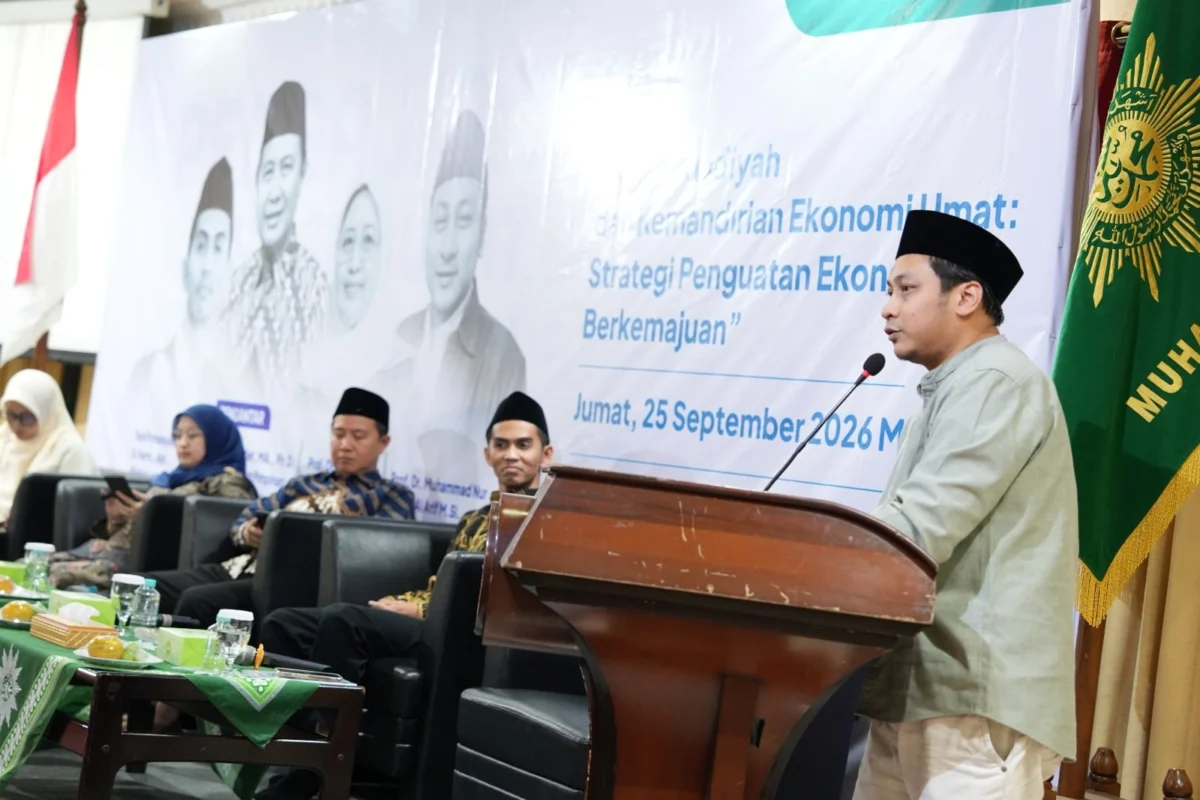
These systemic challenges were brought to the forefront during a recent public lecture session. Muhammad Nur Rianto Al Arif, Chairman of the East Jakarta Regional Leadership (PD) of Muhammadiyah, addressed these pressing concerns during the routine Public Lecture hosted by the Central Leadership (PP) Muhammadiyah. Held at the Gedung Dakwah Muhammadiyah in Jakarta, the event served as a reflective forum on the strategic direction of the organization’s economic jihad, drawing attention to structural disconnects between high-level institutional assets and the economic realities of everyday members.
The core of the discussion centered on the realization that while Muhammadiyah possesses vast institutional wealth through its thousands of Amal Usaha Muhammadiyah (AUM)—ranging from elite universities and hospitals to secondary schools and social welfare institutions—the actual distribution of economic benefits rarely penetrates deep enough to empower the grassroots. Analysts and organizational insiders argue that bridging this gap is essential not only for financial sustainability but also for fulfilling the organization’s broader vision of progressive Islam (Islam Berkemajuan).
Structural Bottlenecks and Leadership Composition
According to Muhammad Nur Rianto Al Arif, the limitations observed in grassroots economic movements stem largely from a structural imbalance within the organization’s leadership ranks. Specifically, he pointed out a relative scarcity of experienced entrepreneurs and business practitioners occupying key structural leadership positions. This lack of commercial representation at the decision-making level has fostered a culture of risk aversion, where leaders hesitate to leverage high-value economic opportunities or capitalize on market potentials that could otherwise generate substantial organizational revenue.
"When we look at the actual situation, there are numerous major opportunities that we could easily execute, but internally, there is a pervasive feeling of not being ready," Nur explained during his address.
This psychological and structural barrier prevents local chapters from engaging in high-impact commercial ventures. In many instances, leadership panels composed predominantly of academics, clerics, and educators lack the specialized risk-assessment capabilities required to navigate competitive modern markets. Consequently, potential revenue-generating initiatives are frequently sidelined in favor of traditional, low-risk administrative routines. Furthermore, this dynamic trickles down to the branch (cabang) and sub-branch (ranting) levels, where members are often treated merely as passive consumers or objects of institutional programs rather than active stakeholders in economic enterprises.
The Proliferation of Competing Internal Brands and Market Confusion
Compounding the leadership deficit is a lack of strategic coordination among the various Amal Usaha Muhammadiyah operating in identical commercial sectors. Nur highlighted a prominent example within the fast-growing bottled drinking water industry (AMDK). Across different regions, various Muhammadiyah entities have independently established commercial water brands, all operating under the umbrella or moral backing of the organization’s name, yet competing in the same localized markets.
This uncoordinated expansion has generated widespread confusion among Muhammadiyah members and the broader public. Consumers are often left uncertain about which specific product directly contributes to the financial sustenance of the organizational core versus independent commercial ventures.
"Everyone is playing their own game. And where are they selling these products? Right back to the regional chapters, the sub-branches, and local communities," Nur remarked, criticizing the inward-looking market strategy.
Rather than pooling resources to create a unified, nationally competitive brand capable of capturing a significant market share, decentralized AUMs engage in fragmented commercialization. This internal competition dilutes brand loyalty, reduces profit margins due to localized scaling limits, and fails to establish a robust supply chain that benefits the broader membership.
Dependency on Educational Assets and Cost-Center Traps
Historically, the financial sustainability of Muhammadiyah’s grassroots chapters—namely the branch and sub-branch levels—has relied heavily on logistical support generated by large-scale educational institutions. However, this dependency model presents inherent structural flaws. The prevailing organizational mindset has long prioritized the establishment of conventional social assets, such as formal schools, mosques, and orphanages.
While these institutions are vital for community service and religious propagation, they predominantly function as cost centers rather than surplus-generating economic units. Operating and maintaining schools, clinics, and houses of worship demand continuous capital injections, placing a heavy financial burden on local administrators.
Consequently, when grassroots leaders attempt to execute community-centric programs—such as specialized training camps for preachers (mubaligh) or localized capacity-building workshops—they frequently encounter severe budgetary constraints. Without independent, productive economic units generating recurring revenue at the grassroots level, local leaders must constantly solicit donations or rely on top-down subsidies from central or regional boards. This lack of financial autonomy hampers the agility and responsiveness of grassroots da’wah initiatives, leaving local chapters perpetually vulnerable to economic fluctuations.
Repurposing Waqf Assets for Productive Economic Sectors
To dismantle the cycle of financial dependency and operational stagnation, organizational strategists are increasingly advocating for a paradigm shift in asset management—specifically regarding the utilization of waqf (Islamic endowment) properties. Traditionally, waqf lands and funds within Indonesian Muslim communities have been channeled almost exclusively into non-profit social infrastructure, such as building mosques, cemeteries, and madrasas.
While these allocations fulfill immediate spiritual and communal needs, they do little to generate the continuous cash flow required to fund broader organizational activities. In response, reform-minded leaders like Nur are calling for a strategic pivot toward productive waqf (wakaf produktif). By channeling endowment assets into commercial agriculture, light manufacturing, retail networks, and modern service sectors, Muhammadiyah can create self-sustaining economic engines at the grassroots level.
"When we talk about a progressive economic movement, we must speak comprehensively. We must ensure that the grassroots are also moving and generating real economic value," Nur emphasized.
Productive waqf models have gained traction among economic observers as a viable solution to institutional funding gaps. By transforming idle land and stagnant capital into revenue-generating enterprises, local chapters can secure independent operational budgets, reduce reliance on external donations, and directly fund community welfare programs, scholarships, and small business incubators.
Chronology of Muhammadiyah’s Economic Development Initiatives
The ongoing debate surrounding grassroots economic empowerment is part of a broader, decades-long institutional evolution within Muhammadiyah. Understanding the current challenges requires examining the historical milestones of the organization’s economic engagement:
- Early 20th Century (Founding Era): Muhammadiyah was established by K.H. Ahmad Dahlan in 1912 with a dual focus on religious purification and social modernization. Economic activities initially centered on cooperative societies (Koperasi) and mutual aid systems designed to uplift indigenous traders against colonial monopolies.
- Mid-to-Late 20th Century (Institutional Expansion): The organization experienced massive growth in its Amal Usaha portfolio, focusing heavily on education, health, and social welfare. During this period, economic efforts were largely institutionalized through formal banking precursors, credit unions, and cooperative ventures affiliated with regional boards.
- 2010–2020 (The Economic Resurgence): Recognizing the disparity between its elite higher education institutions and grassroots economic vitality, the Central Leadership of Muhammadiyah officially declared the strengthening of the economic pillar as a primary strategic focus during successive national congresses (Muktamar). Initiatives such as the "Muhammadiyah Microfinance" and retail networks were launched to formalize community-level trade.
- 2020–Present (Post-Pandemic Realignment): The COVID-19 pandemic exposed the vulnerabilities of traditional funding models, accelerating internal critiques regarding grassroots self-sufficiency. Current discussions emphasize digital transformation, halal supply chain integration, and the commercial optimization of waqf assets to insulate local chapters from external financial shocks.
Fact-Based Analysis of Economic Implications
The structural bottlenecks identified by regional leaders carry significant implications for the future trajectory of Islamic civil society organizations in Indonesia. Failure to address grassroots economic disparity could lead to several long-term outcomes:
- Widening Inequality Between Central and Local Structures: While central boards and major urban AUMs accumulate substantial wealth through universities and hospitals, rural and remote sub-branches may struggle to maintain basic administrative functions. This decentralization imbalance risks creating a two-tiered organization.
- Stagnation of Grassroots Innovation: Without access to independent capital, local leaders cannot invest in modern communication tools, professional talent acquisition, or innovative community programs, ultimately reducing the organization’s appeal to younger, digitally native generations.
- Loss of Economic Sovereignty: In an increasingly hyper-capitalist national market, failure to establish robust internal supply chains and cooperative networks leaves Muhammadiyah communities vulnerable to external corporate exploitation, reducing their capacity to shape local economic policies.
Conversely, successful reform—driven by the integration of entrepreneurial leadership, productive waqf utilization, and streamlined internal commercialization—could position Muhammadiyah as a pioneer in Islamic social capitalism. By converting its vast moral authority and physical assets into an integrated economic ecosystem, the organization could empower millions of grassroots members, ensuring that its century-old mission of social upliftment remains vibrant, financially resilient, and structurally sound for generations to come.