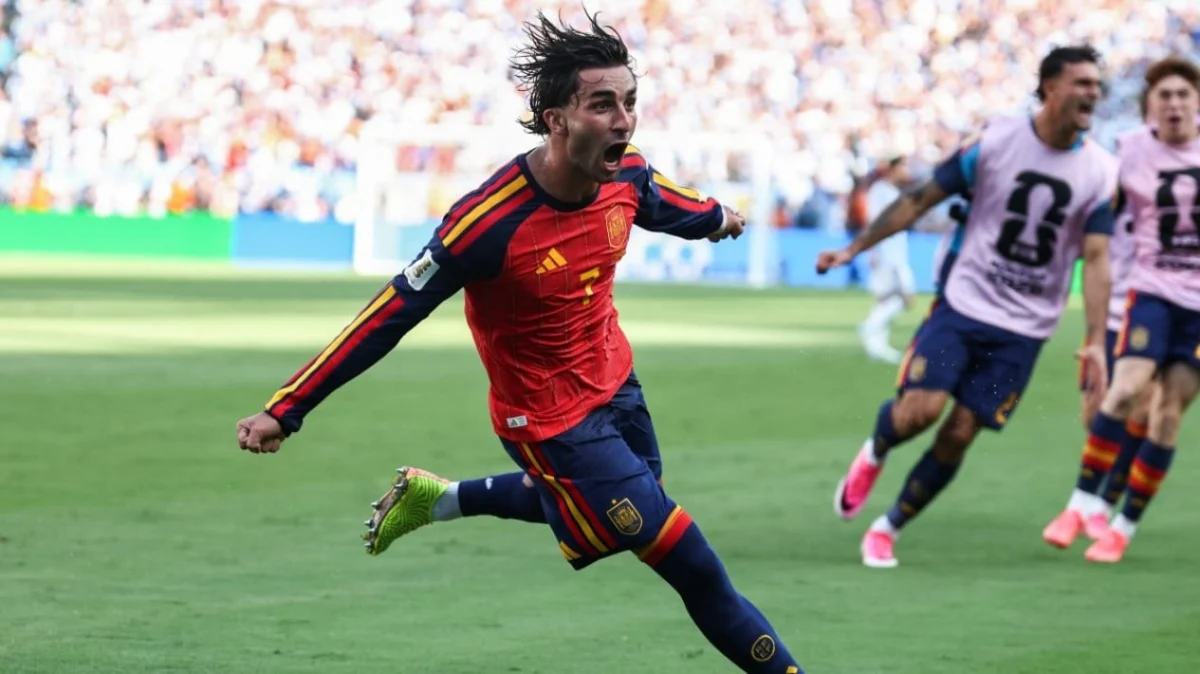
EAST RUTHERFORD, NEW JERSEY – Spain has etched its name into football history once more, securing their second FIFA World Cup title after a hard-fought 1-0 victory over defending champions Argentina. The dramatic final, held at a sold-out MetLife Stadium in New York/New Jersey on Sunday, July 20, 2026, culminated in a moment of brilliance from Ferran Torres in extra time, breaking a century of deadlock and sending La Roja into rapturous celebrations. The win marks a triumphant return to the pinnacle of international football for Spain, 16 years after their maiden triumph in South Africa in 2010.
The decisive goal arrived in the 106th minute, a testament to Spain’s relentless pressure and unwavering belief. Following a relentless onslaught throughout regulation time and the initial period of extra time, Ferran Torres finally found a way past the impenetrable Emiliano Martinez, sparking an explosion of joy among the Spanish contingent and their global fanbase. The victory was a culmination of a meticulously executed game plan by coach Luis de la Fuente, who guided a revitalized squad brimming with youthful talent and seasoned experience to glory.
A Grueling Battle of Wills: The Match Chronology
From the moment referee Stephanie Frappart blew the whistle to commence the 2026 World Cup final, it was clear that spectators were in for a tense, tactical encounter. The atmosphere at MetLife Stadium, packed with 82,500 fervent fans, was electric, a cacophony of vuvuzelas, drums, and chants from supporters of both nations. Spain, known for its possession-based "tiki-taka" style, immediately sought to assert control, dominating the midfield and meticulously building attacks. Argentina, under the stewardship of Lionel Scaloni, adopted a more pragmatic approach, prioritizing defensive solidity and seeking opportunities to launch swift counter-attacks, a strategy that had served them well in their 2022 triumph.
The first half was a masterclass in Spanish dominance, both in possession and intent. As early as the fifth minute, the electrifying Lamine Yamal, a breakout star of the tournament, carved open Argentina’s defense. Skipping past Nicolas Tagliafico with dazzling footwork, Yamal unleashed a powerful left-footed shot that seemed destined for the net, only to be heroically denied by a sprawling Emiliano Martinez. The Argentine goalkeeper, a veteran of many high-stakes encounters, immediately signaled his intent to be a formidable barrier.
Spain continued to dictate terms for the remainder of the opening 20 minutes. Their midfield trio of Pedri, Rodri, and the energetic Alex Baena expertly recycled possession, stifling any attempts by Argentina to establish a foothold in the game. Argentina’s usually potent attacking line, spearheaded by emerging talents and seasoned veterans, found themselves isolated and starved of service. The discipline of Spain’s defensive line, marshaled by Aymeric Laporte and Pau Cubarsi, was exemplary, cutting off passing lanes and preventing any meaningful penetration.
As the half progressed, Spain’s pressure intensified. In the 39th minute, Mikel Oyarzabal, drifting in from the left, unleashed a speculative long-range effort that forced another smart save from Martinez. Four minutes later, Marc Cucurella, surging forward from left-back, tried his luck from outside the box, his shot narrowly whistling past the post. Despite Spain’s relentless efforts, the score remained locked at 0-0 heading into halftime, largely due to Martinez’s exceptional goalkeeping and Argentina’s resolute defending.
The second half began much like the first, with Spain immediately on the offensive. Barely a minute after the restart, Alex Baena tested Martinez once more with a powerful strike from distance, but the outcome was familiar – another save by the formidable Argentine stopper. The pattern continued, with Spain relentlessly probing Argentina’s deep-set defense. In the 64th minute, Dani Olmo, introduced as a substitute to inject fresh impetus, unleashed a thunderous strike from outside the penalty area, forcing Martinez into yet another acrobatic save, tipping the ball over the bar.
The tension ratcheted up further in the 67th minute when Lamine Yamal, dazzling on the left wing, delivered a pinpoint cross into the box. Ferran Torres met it with a powerful header, but Martinez, demonstrating incredible reflexes, once again thwarted Spain, palming the ball away from danger. This sequence highlighted the growing frustration for Spain and the sheer brilliance of Martinez, who seemed unbeatable.
Spain’s late surge in regulation time was a desperate plea for a breakthrough. Pedri came agonizingly close in the 77th minute, his low shot fizzing just wide. A minute later, Pau Cubarsi ventured forward, his shot from a tight angle again parried away by Martinez. The aerial threat of Aymeric Laporte saw him connect with a header in the 81st minute, only for Martinez to make a crucial block. Ferran Torres had another golden opportunity in the 87th minute, his shot from inside the box bravely blocked by a diving defender. Even in injury time, Nico Williams, a late substitute, unleashed a fierce shot that Martinez somehow managed to deflect. The final whistle for regular time blew, confirming what everyone had anticipated: extra time was needed to separate these two footballing titans.
Extra Time: The Breakthrough
The commencement of extra time saw no let-up in Spain’s attacking fervor. In the 93rd minute, Nico Williams, whose pace had troubled Argentina’s tired defense, found himself with a clear sight of goal, but his powerful shot was once again instinctively saved by Emiliano Martinez, who seemed to be playing the game of his life. The collective gasp from the crowd was palpable as Argentina held on by a thread.
However, Spain’s persistence finally paid off in the 106th minute. A sweeping move down the right flank saw Dani Olmo combine with Rodri, who threaded a precise pass to Ferran Torres at the edge of the box. Torres, with ice in his veins, took one touch to control, then unleashed a low, powerful shot that threaded its way through a maze of defenders and finally beat Martinez, who, despite getting a hand to it, couldn’t prevent it from nestling in the bottom corner. The roar from the Spanish supporters was deafening, a release of pent-up emotion after over 100 minutes of relentless effort. The goal was a moment of pure relief and ecstasy for La Roja.
Argentina, stung by the goal, tried to mount a comeback in the remaining minutes, pushing more players forward, but Spain’s defense, emboldened by their lead, held firm. The final whistle was met with an outpouring of emotion from the Spanish bench, players collapsing in relief and joy, while Argentinian players looked dejected, their dream of back-to-back titles shattered.
The Road to the Final: A Tale of Two Journeys
Spain’s journey to the 2026 World Cup final was marked by a blend of tactical brilliance and a resurgent squad. Under Luis de la Fuente, who took over from Luis Enrique after the 2022 World Cup, Spain navigated a challenging group stage, showcasing their evolving style that combined traditional possession with more direct attacking play. They defeated formidable opponents in the knockout stages, including a thrilling quarter-final clash against Germany and a dominant semi-final performance against France. Their campaign saw breakout performances from youngsters like Lamine Yamal, who at just 19, became one of the tournament’s most exciting players, alongside established stars like Rodri and Pedri. Spain’s defensive solidity, conceding only three goals throughout the tournament, was a testament to their collective discipline.
Argentina, on the other hand, arrived at the final as the reigning champions, carrying the immense pressure of defending their crown. Their path was equally arduous, demonstrating their characteristic grit and resilience. They had overcome strong challenges in the group stage and navigated tense knockout matches, including a penalty shootout victory in the semi-final against Brazil. Their squad, while still featuring some veterans from 2022, had also seen the emergence of new talents stepping up to fill the void left by potential retirements, maintaining their reputation as a team capable of grinding out results. Emiliano Martinez’s heroics were a consistent feature of their campaign, often single-handedly keeping them in contention.
Key Players and Tactical Analysis
The final was ultimately decided by individual brilliance and collective resilience. For Spain, the performance of Ferran Torres, culminating in the decisive goal, was pivotal. His movement, tenacity, and clinical finish were exactly what Spain needed. Lamine Yamal’s electric pace and dribbling skills consistently troubled the Argentine defense, creating numerous chances. The midfield trio, anchored by Rodri’s defensive intelligence and Pedri’s creative vision, ensured Spain maintained control for the vast majority of the match, boasting over 65% possession and registering 25 shots, with 12 on target.
However, the true hero for much of the match was Argentina’s Emiliano Martinez. His astonishing performance, with at least 10 crucial saves, kept Argentina in the contest far longer than many expected. He was the bulwark against a Spanish tidal wave, and his efforts earned him the Golden Glove award for the tournament’s best goalkeeper, a small consolation in defeat. Nicolas Tagliafico also delivered a commendable performance, battling tirelessly against Spain’s dynamic wingers. Argentina’s strategy of absorbing pressure and seeking quick transitions was executed effectively for over 100 minutes, but ultimately, they lacked the final cutting edge to capitalize on their limited chances.
Post-Match Reactions and Celebrations
The final whistle brought an immediate outpouring of emotion from the Spanish camp. Coach Luis de la Fuente, visibly moved, embraced his coaching staff and players. "This is an incredible moment for Spanish football," de la Fuente stated in the post-match press conference. "We believed in our style, we believed in these players, and they delivered. To beat a team of Argentina’s caliber, the reigning champions, in such a demanding final, speaks volumes about their character. Ferran’s goal was the reward for our relentless effort."
Ferran Torres, beaming, shared his elation. "It’s a dream come true. Every kid dreams of scoring in a World Cup final. We fought so hard, and to finally see that ball hit the back of the net… it’s an indescribable feeling. This trophy is for all of Spain, for everyone who believed in us." Captain Rodri lifted the iconic golden trophy amidst a shower of confetti and fireworks, a moment that will be forever etched in Spanish sporting memory. Celebrations immediately erupted across Spain, from Madrid to Barcelona, as millions poured into the streets, waving flags and chanting "¡Campeones!".
On the other side, the disappointment was palpable. The Argentine players looked heartbroken, many shedding tears as they received their runner-up medals. Coach Lionel Scaloni, while gracious in defeat, acknowledged the pain. "It’s tough to lose a final, especially after such a fight. My players gave everything, absolutely everything. Emiliano was outstanding, truly exceptional. We came up against a very strong Spanish side today. We are proud of our journey, but the sting of this defeat will last for a while." Emiliano Martinez, despite his stellar performance, couldn’t hide his sadness. "We fought until the very end. Sometimes, football is cruel. We wanted to make history, but it wasn’t our day. We will learn from this and come back stronger."
Historical Context and Legacy
This victory marks Spain’s second World Cup triumph, adding another star to their national team crest. It solidifies their position among the elite footballing nations and heralds a potential new golden era, following the successes of the late 2000s and early 2010s. The blend of seasoned veterans and a new generation of supremely talented youngsters suggests a bright future for La Roja. The win also serves as a testament to the resilience and adaptability of Spanish football, demonstrating their ability to evolve and succeed on the biggest stage.
For Argentina, it was a missed opportunity to achieve the rare feat of back-to-back World Cup titles, a feat last accomplished by Brazil in 1958 and 1962. While the defeat is bitter, their journey to the final as defending champions showcased their enduring quality and fighting spirit. The performance of Emiliano Martinez will be remembered as one of the greatest individual displays by a goalkeeper in a World Cup final, despite being on the losing side.
The 2026 Tournament and Host Nation Impact
The 2026 FIFA World Cup, co-hosted by the United States, Canada, and Mexico, proved to be a resounding success. The expanded format, featuring 48 teams, brought new nations into the global spotlight and provided thrilling football across multiple venues. MetLife Stadium, one of the premier sporting arenas in North America, delivered a spectacular setting for the final, highlighting the region’s capability to host mega-events. The tournament generated unprecedented revenue, broke attendance records, and further cemented football’s growing popularity in North America. The final match alone attracted a global television audience estimated to be in the billions, demonstrating the sport’s unparalleled reach.
The successful organization and electrifying atmosphere throughout the tournament underscored the power of sport to unite nations and celebrate diverse cultures. The infrastructure, logistics, and fan engagement were lauded by FIFA and participants alike, setting a high benchmark for future global sporting events.
Looking Ahead
Spain’s victory is a significant statement, asserting their return to the top tier of international football. With a young core of players who are only set to improve, the future looks exceptionally bright for La Roja. They will undoubtedly be considered favorites for upcoming European Championships and the next World Cup cycle.
For Argentina, the focus will now shift to rebuilding and re-strategizing. While the pain of defeat is fresh, the talent within their squad remains undeniable. The experience gained by their newer players in this high-pressure final will be invaluable. The football world will eagerly anticipate their response in the coming years as they aim to reclaim their lost glory. The 2026 World Cup final will be remembered as a classic encounter, a testament to the beautiful game’s enduring drama and the relentless pursuit of glory.