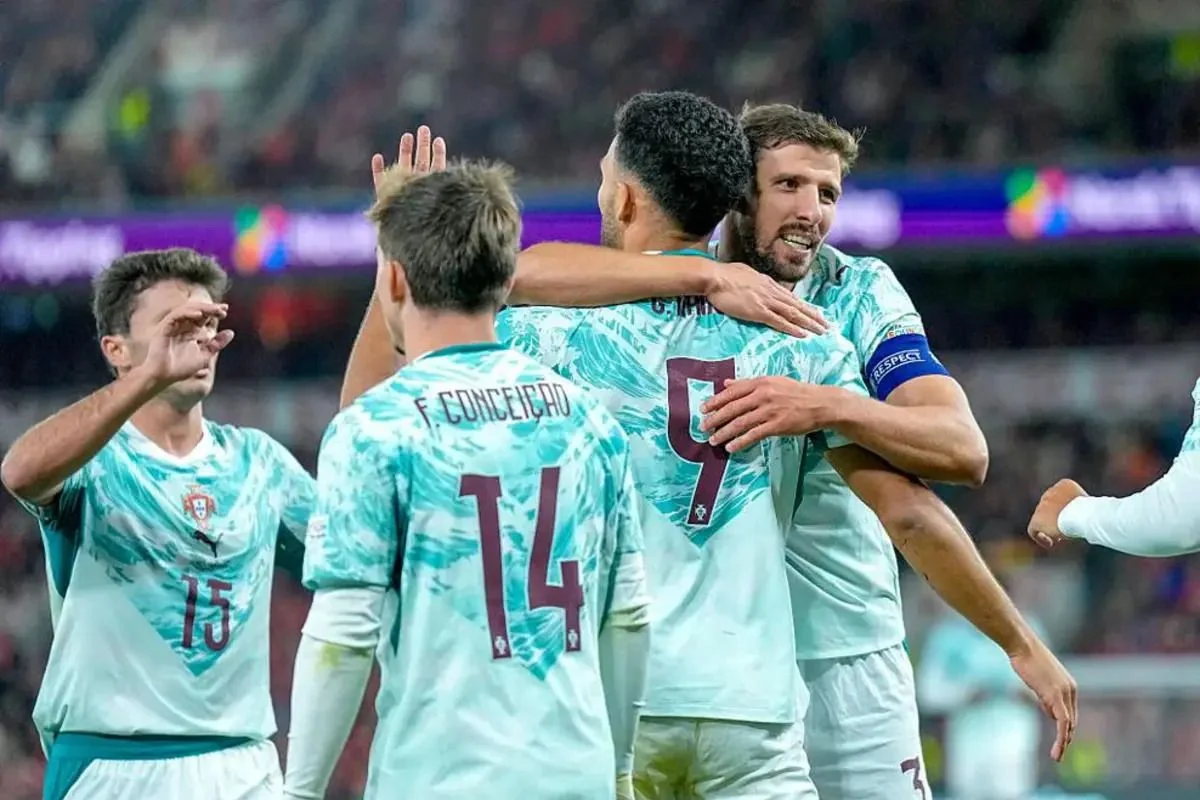
Portugal maintained their perfect start to the UEFA Nations League campaign, securing a vital 2-1 victory against Norway at the Ullevaal Stadion in Oslo on Sunday evening. The result, which saw Goncalo Ramos capitalize on a critical goalkeeping blunder, propelled the Seleção das Quinas to the summit of Group A4 with a maximum of six points from two matches. While the absence of Cristiano Ronaldo from the starting lineup dominated the pre-match headlines, the collective tactical discipline of Jorge Jesus’ side ultimately proved the difference in a high-intensity encounter.
The match served as a stark reminder of the evolving landscape in European international football, where tactical adaptability often outweighs individual reputation. For Norway, the defeat represents a significant setback in their quest for top-tier survival, leaving them trailing Portugal by three points as the competition moves into its middle phase.
A Tactical Masterclass at the Ullevaal
Under the tactical direction of Jorge Jesus, Portugal adopted a fluid, high-pressing system designed to disrupt Norway’s rhythm. The decision to bench Cristiano Ronaldo in favor of Goncalo Ramos was a clear signal of intent: Portugal prioritized movement and defensive transitions over the stationary target-man approach.
The match began with high intensity, as both sides sought to establish dominance in the midfield. Portugal’s early control was facilitated by the defensive pairing of Ruben Dias and Renato Veiga, who effectively neutralized the space between the lines. Joao Neves provided the engine room with necessary dynamism, linking play between the defensive third and the attacking trio of Pedro Neto, Joao Felix, and Francisco Conceicao.
Norway, urged on by a vocal home crowd, sought to leverage the physicality of Erling Haaland. However, the service to the Manchester City forward was sporadic in the opening twenty minutes, as Portugal’s midfield duo of Joao Palhinha and Neves stifled the passing lanes intended for Martin Odegaard.
Chronology of the Match
The breakthrough arrived in the 17th minute. Following a sustained period of possession, Pedro Neto executed a precise cut-back from the flank. Joao Felix, operating in the half-space, met the delivery with a clinical, low-driven strike that bypassed the outstretched hands of Orjan Nyland, nestling into the bottom left corner. It was a goal that reflected Portugal’s patience and technical superiority during the early exchanges.
Norway responded with increased vigor after the halftime interval. The equalizer, arriving in the 51st minute, was a testament to the persistence of the Norwegian squad. Martin Odegaard’s curling free-kick forced a spectacular parry from Diogo Costa, but the resulting scramble saw Patrick Berg recycle the ball with a clever header. Erling Haaland, positioning himself with typical instinct, pounced on the loose ball to level the score at 1-1, sending the Ullevaal crowd into a frenzy.
The parity was short-lived, however. Just three minutes after conceding, Norway’s aspirations were undone by a momentary lapse in concentration. Orjan Nyland, under minimal pressure, attempted an ill-advised clearance that was intercepted by the opportunistic Goncalo Ramos. With the composure of a seasoned veteran, Ramos chipped the ball over the stranded goalkeeper, restoring Portugal’s lead in the 54th minute.
Despite Norway’s late surge and the introduction of fresh legs, Portugal’s defense held firm. A late scare saw Rafael Leao nearly extend the lead, only for his deflected effort to rattle the woodwork, while a second goal by Ramos was ruled out by the VAR officials for a marginal offside decision.
Statistical Breakdown and Performance Analysis
The statistical narrative of the match underscores the efficiency of the Portuguese approach. Portugal registered 54% possession throughout the 90 minutes, a figure that masks the intent of their play. While Norway attempted 12 shots, only four were on target, highlighting the effectiveness of the Portuguese defensive block.
Joao Felix’s performance was particularly notable, as the playmaker operated with a freedom that frequently bypassed the Norwegian defensive structure. His goal-scoring contribution, combined with the tireless running of Pedro Neto, created a constant threat for the Norwegian fullbacks, Julian Ryerson and Fredrik Aursnes.
Conversely, Norway’s reliance on Erling Haaland proved to be a double-edged sword. While the striker remains the focal point of their attacking strategy, the lack of secondary scoring options became apparent as the match progressed. Martin Odegaard’s creative output was stifled by the disciplined marking of Joao Palhinha, who recorded the highest number of successful tackles in the match.
Group A4 Standings and Wider Implications
The implications of this result extend beyond the three points gained. With two wins from two, Portugal now occupies the top spot in Group A4, distancing themselves from their rivals. Denmark’s 2-0 victory over Wales in the parallel fixture has moved the Danes into third place, while Wales remains winless at the bottom of the table.
This standing is crucial for the UEFA Nations League structure, as the top two finishers in the group will progress to the knockout stages, while the bottom-ranked team faces the prospect of relegation to League B. For Portugal, this start provides a cushion that allows for further experimentation in upcoming fixtures. For Norway, the focus must now shift to their next encounter, where they will need to address the defensive errors that proved costly against the Portuguese.
Insights into Managerial Decisions
The decision to utilize Goncalo Ramos over Cristiano Ronaldo was a subject of much debate in the post-match press conference. Jorge Jesus remained stoic, emphasizing that the selection was purely tactical.
"We are playing a schedule that demands high intensity and constant pressing," Jesus noted in his post-match summary. "Goncalo offers a profile that allows us to maintain that pressure for ninety minutes. It is not about the names; it is about the system that best counters the opposition’s strengths."
The success of this strategy—evidenced by the winning goal originating from a high press—suggests that the Portuguese coaching staff is prioritizing a system-first philosophy. This evolution indicates a transition phase for the national team, as they look to integrate younger talent while balancing the immense legacy of their senior stars.
The Path Forward
As the UEFA Nations League continues, the focus for both teams will be on consistency. Portugal travels to face Denmark in their next encounter, a match that will likely determine the eventual group winner. The victory over Norway has provided the Seleção with the momentum needed for such a high-stakes clash.
For Norway, the road back to contention is narrower. They face Wales in a must-win game, where the absence of defensive errors will be paramount. The quality shown by Odegaard and Haaland suggests that Norway possesses the talent to compete at the elite level, but the transition from creating chances to converting them—and maintaining defensive stability—remains their primary hurdle.
Fact-Based Context: The UEFA Nations League Format
It is important to contextualize this match within the broader framework of the UEFA Nations League. Designed to replace friendly internationals with competitive fixtures, the tournament has increased the stakes for teams across Europe. The significance of this victory for Portugal lies in the coefficient rankings, which influence seeding for future FIFA World Cup and UEFA European Championship qualification cycles.
Furthermore, the data from this match highlights a recurring theme in modern international football: the importance of the "transitional phase." Both of Portugal’s goals originated from rapid transitions, either through structured play or forced errors. This reflects a broader trend in the European game where teams that can capitalize on high-intensity turnovers are increasingly finding success.
Conclusion
The encounter at the Ullevaal Stadion was a masterclass in opportunistic football. Portugal demonstrated the maturity to absorb pressure, the tactical discipline to exploit weaknesses, and the clinical edge to secure the result. While the goalkeeping error by Nyland was the decisive moment, it was the product of a persistent, high-pressure system implemented by Portugal.
As the dust settles on this second round of Group A4 fixtures, the table paints a clear picture of the current hierarchy. Portugal sits at the summit, not merely through individual brilliance, but through a cohesive, tactical effort that suggests they are well-equipped for the challenges of the tournament’s latter stages. The international break may be concluding, but the narratives established in Oslo will undoubtedly shape the tactical discourse in European football for months to come.