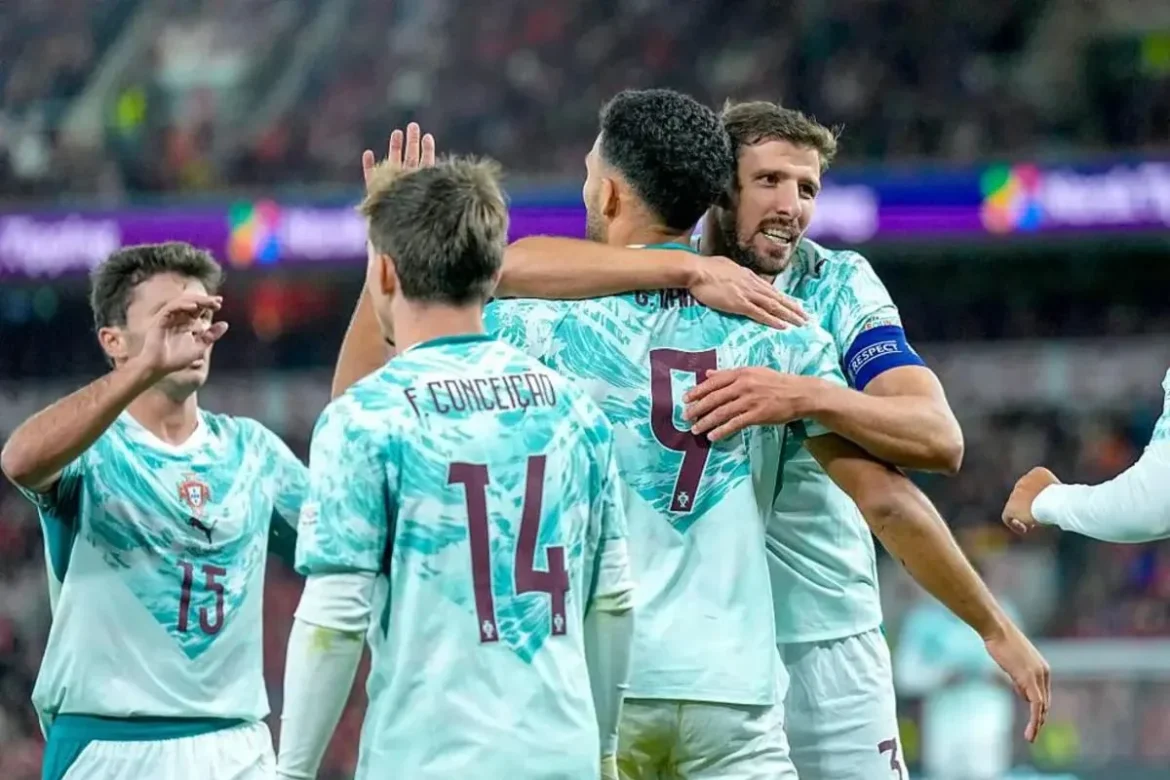
Portugal secured a vital three points in their UEFA Nations League Group A4 campaign on Monday, September 28, 2026, defeating Norway 2-1 at the Ullevaal Stadium in Oslo. In a match characterized by tactical discipline and high-stakes transitions, the visitors managed to overcome a resilient Norwegian side, ultimately capitalizing on a late defensive lapse by goalkeeper Orjan Nyland to seal the win. The result reaffirms Portugal’s standing as a powerhouse in the competition, while Norway remains in a difficult position as they seek to navigate the upper tier of the Nations League structure.
Tactical Setup and First-Half Dynamics
The atmosphere in Oslo was electric, with a capacity crowd eager to see how their national team, led by Erling Haaland, would fare against the tactical fluidity of the Portuguese squad. Notably, Portugal’s manager opted for a strategic rotation, leaving captain Cristiano Ronaldo on the bench for the kickoff. This decision signaled a shift toward a more high-tempo, mobile attacking structure, designed to neutralize the physical presence of Norway’s defensive block.
From the first whistle, the tempo was relentless. Norway, deploying a direct style of play aimed at exploiting Haaland’s aerial prowess and pace in behind, sought to unsettle the Portuguese center-backs. However, Portugal’s midfield transition proved more efficient. In the 17th minute, Joao Felix broke the deadlock. After a sustained period of possession, the Barcelona attacker found space just outside the penalty area, curling a clinical strike past the outstretched arms of Nyland.
This goal was significant for several reasons. Felix has been in an exceptional run of form, and this strike extended his record of scoring in nine consecutive international appearances—a feat that highlights his growing importance in the national setup. His ability to open or close the scoring has become a trademark of his current international tenure, providing Portugal with a psychological edge early in matches.
Norway’s Response and the Defensive Battle
Stung by the early deficit, Norway intensified their pressure. Erling Haaland, constantly shadowed by Ruben Dias, found limited pockets of space. One of the match’s most critical moments occurred mid-way through the first half. A loose ball, spilled by Portuguese goalkeeper Diogo Costa, fell invitingly into the path of Haaland. With the goal seemingly at his mercy, the Manchester City striker prepared to equalize, but a desperate and perfectly timed block from Ruben Dias prevented the ball from crossing the line.
This defensive sequence underscored the quality of Portugal’s backline. Dias, often tasked with containing the world’s most dangerous strikers, demonstrated the composure necessary to maintain a narrow lead in a hostile away environment. Norway’s inability to capitalize on these fleeting opportunities would prove to be the defining narrative of the evening.
The Second Half and the Decisive Error
As the second half progressed, the tactical chess match continued. Norway’s manager made several adjustments to bolster the midfield, aiming to provide better service to Haaland and his strike partner. The pressure eventually yielded results, as Norway managed to breach the Portuguese defense, forcing an equalizer that rejuvenated the home crowd and shifted the momentum of the game.
However, the deadlock was broken in the closing stages due to a momentary lapse in concentration from the Norwegian rearguard. In a play that will likely be studied in future tactical reviews, Orjan Nyland attempted to distribute the ball from the back under pressure. The miscalculation allowed Goncalo Ramos—who had been brought on to provide fresh energy—to intercept the ball. With the goal largely unguarded, Ramos kept his composure to slot the ball home, restoring Portugal’s lead and effectively silencing the Ullevaal Stadium.
Context of the UEFA Nations League Group A4
The victory places Portugal in a commanding position within Group A4. The Nations League has evolved into a crucial tournament, serving not only as a pathway to potential silverware but also as a definitive ranking tool for international teams. For Portugal, maintaining consistency against tier-one European opposition is vital as they prepare for the upcoming qualification cycles.

Norway, despite the loss, showcased significant improvements in their tactical cohesion. The integration of young talents alongside experienced figures like Haaland suggests that the team is on an upward trajectory. However, the fine margins of the Nations League mean that individual errors, such as the one witnessed in the 80th minute, are punished with immediate effect.
Managerial Perspectives and Team Dynamics
While official post-match press conferences were brief, the implications of the team selections were clear. For Portugal, the benching of Cristiano Ronaldo suggests a long-term strategy of squad management. By utilizing the veteran star as an impact substitute, the coaching staff aims to manage his minutes effectively while allowing younger, high-energy players to stretch opposition defenses early in the match.
Conversely, Norway’s reliance on Haaland remains the centerpiece of their identity. The frustration of the loss was evident among the Norwegian players, who felt that their defensive organization for the majority of the match warranted a share of the points. Nevertheless, the statistical breakdown—which favored Portugal in terms of possession and passing accuracy—suggests that the result was a fair reflection of the tactical battle on the pitch.
Broader Impact and Statistical Analysis
Beyond the scoreline, the match provided valuable data regarding the state of European football. Portugal’s ability to win without their primary talisman for the majority of the game is a testament to their depth. The squad depth, particularly in the attacking midfield and forward positions, allows for a variety of tactical configurations that make them a difficult team to scout and contain.
For Norway, the focus will now shift to defensive consistency. While their attacking output remains world-class, the transition between defense and midfield remains an area for improvement. In a group containing other European heavyweights, clean sheets or the ability to manage the closing stages of a draw are essential for advancement.

Looking Ahead
As the UEFA Nations League continues, both teams face a rigorous schedule. Portugal will look to carry the momentum from this win into their upcoming fixtures, aiming to secure a top-two finish in the group. For Norway, the path forward involves correcting the individual errors that cost them today’s result. The margin for error in the top division of the Nations League is razor-thin, and as evidenced in Oslo, one singular moment of hesitation can negate ninety minutes of hard-fought labor.
The fans in Oslo, while disappointed, witnessed a high-level contest that highlighted the evolving tactical landscape of international football. With the competition reaching its midway point, the intensity is expected to ramp up, with every pass, tackle, and goal carrying significant weight for the final tournament standings. Portugal’s victory in Oslo is not merely three points; it is a statement of intent that they remain a formidable force in the European game, capable of winning even when the odds and the atmosphere are stacked against them.
The match serves as a reminder of the relentless nature of elite international football, where the difference between success and failure is often found in the smallest of margins—a well-timed block by a defender or a momentary lapse of concentration by a goalkeeper. As Portugal returns to Lisbon with the victory, they do so with the knowledge that their campaign is firmly on track, while Norway must regroup and prepare for the challenges that lie ahead in a highly competitive group.