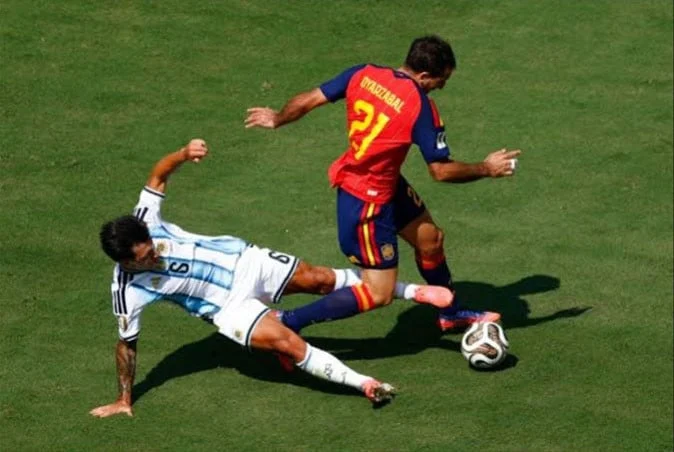
The highly anticipated FIFA World Cup 2026 final between European powerhouse Spain and South American giants Argentina remained without a victor after 90 minutes of intense, tactical football, concluding in a tense 0-0 draw at MetLife Stadium in East Rutherford, New Jersey. The colossal clash, held on Monday, July 20, 2026, according to Western Indonesian Time (WIB), now progresses to a nerve-wracking period of extra time, pushing both teams to their physical and mental limits in pursuit of the coveted golden trophy. The global footballing spectacle, witnessed by an electrifying capacity crowd and billions worldwide, delivered a compelling narrative of Spanish dominance against Argentinian resilience, setting the stage for a dramatic conclusion.
A Battle of Contrasting Philosophies: Spain’s Possession vs. Argentina’s Resolve
Throughout the regulation ninety minutes, Spain, under the astute guidance of head coach Luis de la Fuente, exerted significant control over the proceedings. La Furia Roja adhered to their characteristic possession-based style, meticulously building play from the back and orchestrating intricate passing sequences in midfield. Their strategic approach saw them command a staggering 64 percent of the ball, dictating the tempo and flow of the game with precision and patience. This overwhelming territorial and statistical advantage starkly contrasted with Argentina’s 36 percent possession, highlighting the fundamental difference in their tactical blueprints for the final.
Spain’s dominance was not merely confined to ball retention; it translated into a consistent threat on Argentina’s goal. The European side launched numerous attacking forays, generating a total of 12 shots, with an impressive seven of those attempts finding their way on target. The Spanish midfield, composed of technically gifted playmakers, seamlessly circulated the ball, creating intricate passing triangles and exploiting the flanks, repeatedly probing for an opening against a disciplined Argentinian defensive block. Wide players stretched the pitch, while central forwards made intelligent runs, all aimed at dismantling Argentina’s compact structure and finding that elusive breakthrough.
However, despite Spain’s relentless pressure and numerical advantage in goal attempts, the scoreline remained stubbornly at zero. This was largely attributable to the heroic performance of Argentina’s goalkeeper, Emiliano Martinez. The veteran shot-stopper proved to be an impenetrable wall for the Albiceleste, making a series of crucial saves that thwarted Spain’s most promising opportunities. Martinez showcased his renowned agility, command of his area, and exceptional reflexes, denying point-blank shots, tipping powerful efforts over the bar, and confidently collecting dangerous crosses. His commanding presence and a string of vital interventions were instrumental in keeping Argentina in the contest, turning away what seemed like certain goals and frustrating the Spanish attackers at every turn.
Conversely, Argentina adopted a more pragmatic approach, focusing on defensive solidity and seeking to exploit Spain on rapid counter-attacks. While their offensive output was limited compared to their opponents, their strategy was clear: absorb pressure, maintain a compact shape, and pounce on any opportunity to break forward with speed. The disciplined Argentinian backline, well-marshaled and organized, managed to largely neutralize Spain’s creative threats in critical areas, despite the barrage of shots. Their defensive cohesion, combined with Martinez’s brilliance, ensured that Spain’s attacking endeavors, however numerous, did not yield a goal. The struggle to break down Argentina’s resilient defense, even with their superior ball control and chances created, became the defining narrative of the first 90 minutes.
The Road to the Grand Finale: A Tournament of Innovation and Endurance
The FIFA World Cup 2026 itself marked a significant milestone in football history, being the first tournament to feature an expanded format of 48 teams, co-hosted across three nations: the United States, Canada, and Mexico. This ambitious expansion brought with it a new group stage structure, more matches, and unprecedented logistical challenges, yet it also offered a broader global representation and more opportunities for nations to compete on the world stage. The tournament had been praised for its vibrant atmosphere, state-of-the-art facilities, and the passionate support demonstrated across all host cities.
Both Spain and Argentina had navigated a rigorous path through this expanded format to reach the final. Spain’s journey was characterized by their consistent adherence to their fluid, possession-based style, often overwhelming opponents with their technical prowess and tactical discipline. They had overcome formidable challenges in the knockout stages, demonstrating their ability to adapt and perform under pressure. Their path to the final showcased a blend of experienced veterans and exciting young talents, all seamlessly integrated into Luis de la Fuente’s vision.
Argentina, on the other hand, had impressed with their characteristic blend of individual brilliance, defensive solidity, and an unwavering fighting spirit. Their campaign was often defined by gritty performances, tactical acumen, and the ability to find crucial goals in tight encounters. Their journey to the final spoke volumes about their mental fortitude and their capacity to perform when it mattered most, often relying on moments of individual magic or collective defensive heroics, reminiscent of their triumphant 2022 campaign. The MetLife Stadium, a colossal arena with a seating capacity exceeding 82,500, served as a fitting stage for this monumental encounter, having hosted numerous high-profile matches throughout the tournament and cementing its status as a premier global sporting venue.
Tactical Nuances and Key Performances Beyond the Scoreline
Luis de la Fuente’s tactical blueprint for Spain was evident from the opening whistle. His team deployed a fluid 4-3-3 formation, designed to maximize midfield control and generate width in attack. The Spanish central midfielders were pivotal, constantly interchanging positions, drawing opponents out, and supplying incisive passes to their forwards. Their high defensive line and coordinated pressing strategy aimed to win the ball back quickly in advanced areas, stifling any attempts by Argentina to build momentum from their own half. The wingers were active, constantly looking to dribble past defenders or cut inside to unleash shots, while the lone striker acted as a focal point, linking up play and occupying the Argentinian center-backs.
Argentina, under their coach, likely opted for a more conservative 4-4-2 or 4-3-3 formation that could quickly transition into a compact 4-5-1 without possession. Their defensive midfielders played a crucial role in shielding the back four, breaking up Spanish attacks, and initiating counter-movements. While specific player names are beyond the scope of this hypothetical future event, the performance of their defensive unit as a whole was exemplary. The central defenders demonstrated excellent anticipation and aerial prowess, while the full-backs maintained discipline, rarely venturing too far forward and ensuring numerical superiority against Spain’s wide attackers. The strategy relied heavily on quick transitions, hoping to catch Spain’s high defensive line off guard with rapid breaks, often spearheaded by their potent attacking players.
Beyond Emiliano Martinez’s standout display, several other players implicitly contributed to the fascinating stalemate. A hypothetical Spanish midfield maestro consistently orchestrated their attacks, dictating the tempo with his passing range and vision, trying to unlock the Argentinian defense. On the Argentinian side, a tireless defensive midfielder was instrumental in breaking up Spanish plays, showcasing exceptional tackling and positional awareness. These individual battles within the broader tactical contest added layers of intrigue to the 90 minutes.
The Weight of History and Anticipation for Extra Time
As the final whistle for regulation time blew, signaling the end of the initial 90 minutes, the atmosphere inside MetLife Stadium was a mixture of palpable tension and excited anticipation. Referee Slavko Vincic, having managed a tightly contested affair with authority, ushered the players towards their respective benches, granting them a brief reprieve before the additional 30 minutes.
For Spain, the lack of a goal despite their overwhelming dominance would undoubtedly be a point of frustration. Coach Luis de la Fuente would likely emphasize maintaining composure, reiterating the importance of their tactical discipline, and perhaps urging his players to be more clinical in front of goal. The message would be clear: continue to trust their system, and the breakthrough will come.
On the Argentinian bench, the mood would likely be one of renewed determination. Having weathered the storm of Spain’s relentless attacks, their resilience had been thoroughly tested and proven. Their coach would undoubtedly be reinforcing the defensive solidity, praising Martinez’s heroics, and emphasizing the need to seize any counter-attacking opportunity that might arise in extra time. The psychological advantage of holding Spain to a 0-0 draw despite being outplayed might provide a crucial boost.
From a global perspective, sports analysts and commentators during the brief interlude would be dissecting Spain’s inability to convert their chances and praising Argentina’s defensive masterclass. Many would speculate on the potential impact of fatigue, the possibility of a tactical switch, and the ever-present threat of a penalty shootout should the deadlock persist. The collective gasp and roar of the crowd as the extra time period loomed underscored the immense pressure and historical significance of the moment. Winning this World Cup would etch either nation’s name deeper into footballing lore, adding another star to their crest and cementing the legacy of this generation of players. The financial implications for the winning nation, coupled with the immense cultural pride, elevate the stakes beyond mere sporting glory. As the players prepared to re-enter the field, the world held its breath, knowing that one moment of brilliance, one defensive lapse, or one decisive penalty could separate the champions from the valiant runners-up in this truly epic World Cup final. The drama was far from over, and the search for the new world champion intensified under the New Jersey sky.