The Indonesian National Police (Polri) has officially concluded the high-profile Ethics Commission (KKEP) proceedings against Inspector General of Police (Irjen Pol) Ahrie Sonta, resulting in his dishonorable discharge from the force. The decision, announced on Tuesday, November 10, 2026, marks a significant turning point in an internal investigation that has gripped the nation, centering on allegations of unauthorized surveillance directed at President Prabowo Subianto. The termination, categorized as Pemberhentian Tidak Dengan Hormat (PTDH), serves as a stern administrative reprimand for what the commission identified as a severe breach of professional conduct and institutional integrity.
The Conduct of the KKEP Proceedings
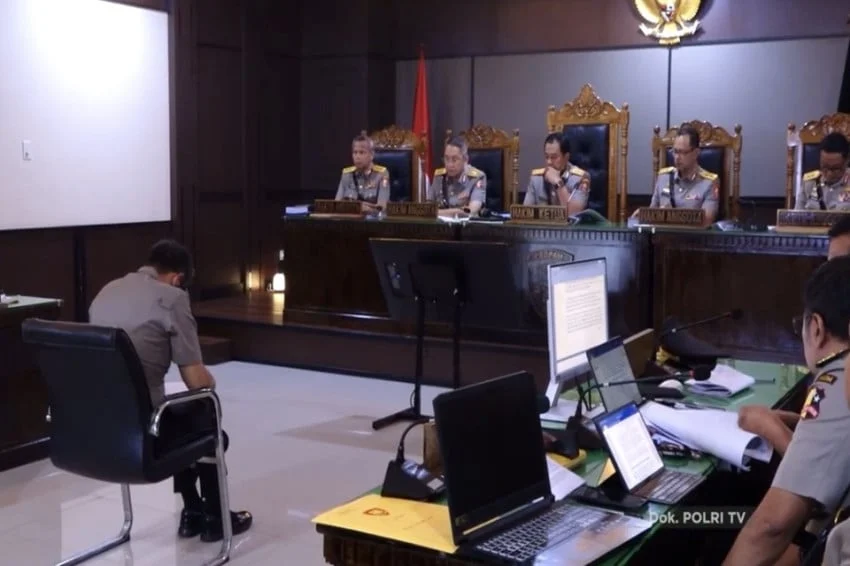
The disciplinary hearing, which spanned an exhaustive 11-hour session from 09:00 to 20:10 WIB, was conducted under rigorous scrutiny. According to official reports, Ahrie Sonta, once considered a rising star within the Polri hierarchy, appeared visibly solemn throughout the proceedings, frequently keeping his head bowed as evidence was presented.
The panel presiding over the case was comprised of high-ranking officers, underscoring the gravity of the allegations. The commission was led by Commissioner General (Komjen Pol) Rudy Darmoko, serving as the Chairman. He was supported by Vice Chairman Irjen Pol Roma Hutajulu and a panel of three senior members: Irjen Pol M. Zulkarnain, Irjen Pol Jayadi, and Irjen Pol Rahmat Setyadi. The inclusion of such high-ranking officials indicates the National Police’s commitment to addressing internal corruption and security lapses at the highest levels.
Chronology and Nature of the Allegations
The case against Ahrie Sonta stems from his tenure as the Acting Head of the Monitoring Center at the Robinopsnal Bareskrim (Criminal Investigation Agency) of the National Police. Investigators concluded that Sonta utilized his operational authority to conduct illegal wiretapping activities targeting President Prabowo Subianto.
The timeline of the investigation suggests a rapid escalation once the unauthorized activities were detected by intelligence oversight units. While the specific methodology of the surveillance has not been disclosed for security reasons, it is understood that the activity circumvented the legal protocols required for authorized state surveillance. The breach was classified as a violation of the Police Code of Ethics, specifically regarding the abuse of technical resources and the compromise of national security protocols.
Institutional Implications and Official Statements
Kadiv Humas Polri (Head of Public Relations Division), Irjen Pol Johnny Eddizon Isir, addressed the media in a press conference following the verdict. Isir emphasized that the institution maintains a zero-tolerance policy regarding the misuse of technological infrastructure, particularly when such actions implicate the Head of State.
"The KKEP commission has determined that the suspected violator, AS, is guilty of committing grave breaches of the code of conduct," Isir stated. "The evidence presented confirms that the unauthorized wiretapping operations were executed outside the scope of professional duty and legal mandate. Consequently, the council has reached a unanimous decision to issue a dishonorable discharge."
Legal experts have noted that the dismissal is not merely an internal administrative matter but a precursor to potential criminal proceedings. Under Indonesian law, unauthorized surveillance, especially when targeting high-ranking government officials, may fall under the purview of the Electronic Information and Transactions (ITE) Law and the State Intelligence Law.
The Weight of the Scandal: Context and Background
The fallout from this incident has sent shockwaves through the Indonesian political and law enforcement landscape. Ahrie Sonta was previously recognized as one of the youngest two-star generals in the force, a status that made his involvement in such a scandal particularly jarring to the public and his peers.
The incident highlights the inherent risks associated with the concentration of technical intelligence capabilities within the Bareskrim division. The Monitoring Center, designed to support criminal investigations through data analysis and surveillance, has now been thrust into the spotlight, with calls for a complete overhaul of its oversight mechanisms.
Furthermore, the involvement of high-ranking figures, including previous reports suggesting even higher levels of leadership involvement, indicates that this investigation may be part of a broader "cleansing" process within the police force. The National Police is currently under immense pressure to restore public trust, which has been tested by a series of scandals over the past several years.
Analysis of the Security Breach
The implications of an illegal wiretap targeting a President are profound. From a national security perspective, the ability of a mid-to-high-level official to bypass established firewalls and legal authorization procedures to monitor the President suggests significant vulnerabilities in the current communication security framework.
Analysts suggest that the following areas require immediate reform:
- Technological Governance: The implementation of stricter multi-factor authorization and "dual-key" protocols for any surveillance operations.
- Audit Trails: Enhancing the transparency of the Monitoring Center’s activity logs to ensure that all actions are traceable to a legitimate, warrant-backed investigation.
- Internal Oversight: Strengthening the role of the Professional and Security Division (Propam) in performing continuous audits of technical units.
Public and Political Response
The announcement has generated widespread discussion across social media and among political observers. While many have praised the swift and decisive action taken by the KKEP, others remain concerned about the potential for broader systemic issues within the police force that allow such breaches to occur in the first place.
The incident also complicates the relationship between the executive branch and the National Police. Given that President Prabowo Subianto’s administration has prioritized internal security and the rule of law, the fact that he was the target of illegal surveillance is likely to result in significant policy shifts regarding how the police interact with the presidential security detail and state intelligence services.
Conclusion and Future Outlook
The dishonorable discharge of Ahrie Sonta marks the end of his career within the Polri, but it is unlikely to be the end of the legal saga. As the police move forward, they must address the lingering questions regarding how such high-level misconduct was permitted to occur and whether other personnel were involved in the unauthorized operation.
The National Police’s decision to air this case publicly is a clear signal of an intent to demonstrate accountability. However, the path to restoring institutional credibility will require more than just the termination of a single officer. It will require a rigorous, transparent, and long-term commitment to reform, ensuring that the tools of the state are never again turned against its own leadership. The nation now watches closely to see if the ongoing investigation will lead to further prosecutions and whether structural changes will successfully prevent a recurrence of such a severe security failure. As the dust settles on this historic hearing, the Indonesian National Police faces the difficult task of rebuilding a reputation that has been damaged at its very core.