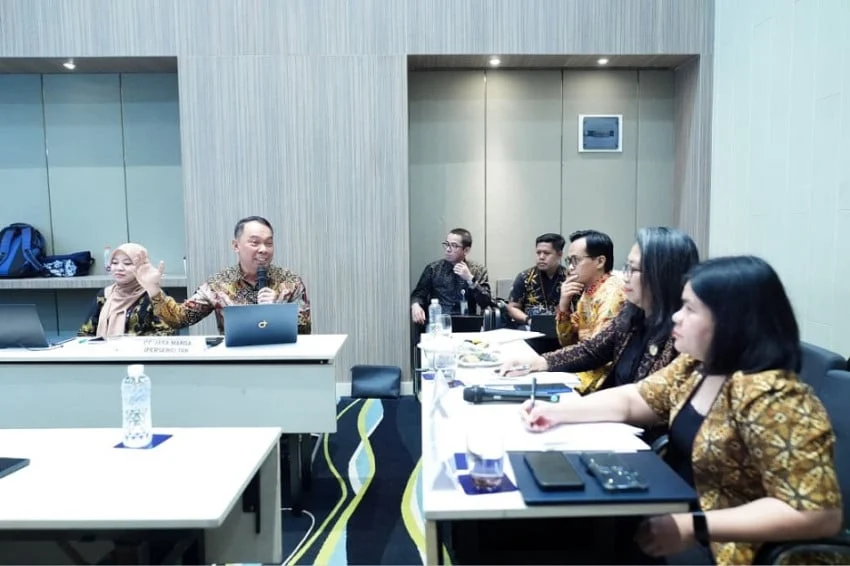
PT Jasa Marga (Persero) Tbk has reaffirmed its dedication to upholding the principles of transparency and accountability by participating in the 2026 Public Information Disclosure Monitoring and Evaluation (Monev KIP) assessment conducted by the Central Information Commission (Komisi Informasi Pusat) in Jakarta on Wednesday, November 11, 2026. This participation marks a critical milestone in the company’s ongoing transformation toward becoming a more accessible, responsive, and technologically integrated public body.
As the largest toll road operator in Indonesia, Jasa Marga manages an extensive network that serves as the backbone of the national logistics and transportation infrastructure. By subjecting its internal processes to rigorous external evaluation by the Central Information Commission, the company aims to demonstrate that its operations—from executive decision-making to real-time traffic management—align with the highest standards of corporate governance and the mandates set forth by Law Number 14 of 2008 concerning Public Information Disclosure.
The Strategic Importance of the 2026 Monev KIP
The Monitoring and Evaluation of Public Information Disclosure (Monev KIP) is an annual assessment tool designed by the Central Information Commission to gauge the level of compliance among public bodies in Indonesia. The process involves a comprehensive review of how public institutions manage, provide, and disseminate information to citizens. For a state-owned enterprise (SOE) like Jasa Marga, this is not merely a regulatory exercise but a strategic imperative.
During the public test presentation, the company outlined its roadmap for information management, emphasizing that transparency is a fundamental pillar of its service quality. The evaluation covers various dimensions, including the availability of information, the efficiency of the Pejabat Pengelola Informasi dan Dokumentasi (PPID) office, and the responsiveness of the company’s digital infrastructure. By participating in this assessment, Jasa Marga seeks to identify operational gaps and implement improvements that ensure stakeholders—ranging from individual motorists to institutional investors—have access to accurate and timely data.
Leadership Perspective on Corporate Governance
Jasa Marga President Director Rivan A. Purwantono emphasized that the company’s commitment to information disclosure is an integral component of its broader corporate transformation. "We are committed to establishing Jasa Marga as a trusted public entity through information management that is transparent, accountable, participatory, and grounded in digital technology," Purwantono stated during the session.
He further elaborated that the company’s strategy transcends mere legal compliance. Instead, Jasa Marga is actively fostering a "culture of openness" across all levels of the organization. This cultural shift is intended to make the company more sensitive to the evolving needs of the public. By prioritizing the flow of information, the leadership believes the company can better navigate the complexities of public scrutiny and maintain the trust of the 3.6 million vehicles that traverse its toll roads daily.
Operational Scale and the Need for Data Transparency
To understand the gravity of Jasa Marga’s information management requirements, one must consider the sheer scale of its operations. As of late 2026, Jasa Marga operates 36 toll road segments, totaling 1,318 kilometers of active highways within a broader concession footprint of 1,736 kilometers. Managing such a vast network requires a sophisticated approach to data handling.
With millions of daily users, the demand for information is constant and highly dynamic. Commuters require real-time updates on traffic congestion, accident reports, road maintenance schedules, and toll tariff adjustments. The inability to provide this information efficiently could lead to gridlock, economic inefficiencies, and public dissatisfaction. Consequently, the company has transitioned from traditional communication methods to a data-driven model that prioritizes instantaneous information dissemination.
The Role of JMTC in Intelligent Transportation Systems
Central to Jasa Marga’s transparency strategy is the Jasa Marga Tollroad Command Center (JMTC). Established as the nerve center for the company’s operations, the JMTC acts as the primary hub for data synthesis. It integrates data from over 3,500 closed-circuit television (CCTV) cameras, smart sensors, and various Intelligent Transportation System (ITS) components deployed across the network.
The JMTC does more than just monitor traffic; it functions as a processing engine that converts raw data into actionable information. This data is fed into a variety of public-facing channels, including:
- The Travoy App: An all-in-one mobile application providing real-time traffic updates, CCTV snapshots, and rest area information.
- Call Center 133: A dedicated 24/7 hotline for emergencies and information inquiries.
- Official Digital Channels: The company’s corporate website, the PPID portal, and active social media accounts.
By utilizing these platforms, Jasa Marga ensures that the information is not only accurate but also easily accessible to any user with a smartphone or internet connection. This proactive disclosure strategy is designed to minimize the information asymmetry that often exists between infrastructure operators and the public.
Proactive Disclosure and the PPID Framework
Beyond real-time traffic updates, Jasa Marga has strengthened its PPID (Public Information and Documentation Management Officer) unit to ensure compliance with the three categories of public information mandated by law:
- Periodic Information: Regular disclosures regarding financial performance, operational achievements, and governance reports.
- Immediate Information: Urgent notifications concerning accidents, major maintenance projects, or natural disasters that could impact toll road functionality.
- Information Available at All Times: Static data such as company bylaws, standard operating procedures, and contact details for information requests.
The reinforcement of the PPID unit involves systematic training for employees, the implementation of standardized SOPs for information requests, and the deployment of digital documentation systems. This ensures that when a citizen or a member of the media submits a request for information, the company is equipped to respond within the legally mandated timeframe with high-quality, verifiable data.
Broader Economic and Social Implications
The implications of Jasa Marga’s transparency efforts extend well beyond the toll roads themselves. In the context of Indonesia’s national development, the efficiency of toll road management is a key indicator of economic health. When the public has access to reliable information, it facilitates better travel planning, reduces fuel consumption, and optimizes logistics operations for businesses that rely on the toll road network for supply chain management.
Moreover, the transparency of an SOE is a critical benchmark for investor confidence. As Jasa Marga seeks to fund future expansions, maintaining a reputation for transparency ensures a stable relationship with both domestic and international stakeholders. By consistently participating in evaluations like the Monev KIP, the company signals that it is open to external oversight, which in turn mitigates operational risks and promotes long-term sustainability.
Fact-Based Analysis: The Path Forward
The 2026 evaluation represents a maturation of Jasa Marga’s information strategy. Looking ahead, the challenge for the company will be to maintain this momentum in the face of increasing digital traffic and rising public expectations. As artificial intelligence and big data analytics continue to reshape the transportation sector, Jasa Marga will likely need to integrate more predictive features into its public information services—for instance, providing users with AI-driven travel time predictions or automated notifications about traffic incidents before they encounter them.
Furthermore, as the company continues to manage its 1,736-kilometer concession footprint, the integration of ESG (Environmental, Social, and Governance) reporting into its public disclosure framework will become increasingly important. The public and regulators are not only interested in traffic speed and safety; they are increasingly concerned with how these massive infrastructure projects impact the environment and local communities.
Conclusion
The participation of PT Jasa Marga (Persero) Tbk in the 2026 Monev KIP is a clear indication that the organization views public information as a vital asset rather than a regulatory burden. By bridging the gap between its technical operations and the public’s information needs, Jasa Marga is setting a benchmark for other Indonesian SOEs. As the company continues to refine its digital ecosystem—anchored by the JMTC and an empowered PPID—the ultimate beneficiaries will be the millions of motorists who rely on Jasa Marga to keep the country moving.
The ongoing commitment to transparency, as evidenced by the events of November 11, 2026, underscores a shift toward a more mature, digitally-integrated corporate governance model, ensuring that as Jasa Marga grows, its accountability to the public grows in parallel.