
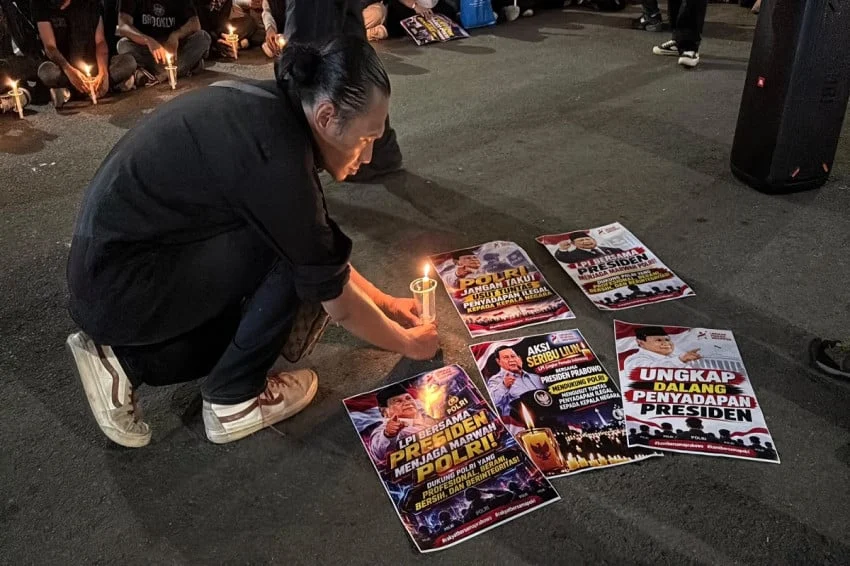
In a significant display of public concern regarding national security and institutional integrity, approximately 300 members of the Lingkar Pemuda Indonesia (LPI) gathered on Thursday, November 5, 2026, in front of the National Police Headquarters (Mabes Polri) on Jalan Trunojoyo, South Jakarta. The demonstrators conducted a peaceful "Thousand Candles" vigil, accompanied by the distribution of red and white roses, to signal their unwavering support for President Prabowo Subianto following revelations of an alleged wiretapping scandal involving high-ranking police officials.
The demonstration, which saw participants engage in a long march toward the police headquarters before commencing their vigil, served as a symbolic call for transparency. The group’s presence highlights the intensifying public scrutiny directed at the Indonesian National Police (Polri) as the institution grapples with internal investigations that have reached the highest echelons of the force.
The Genesis of the Allegations
The unrest stems from reports that three high-ranking police generals are currently under formal investigation for their alleged involvement in a wiretapping operation targeting the President of the Republic of Indonesia. While details remain fluid due to the sensitivity of the intelligence-related nature of the case, the implications of such an act—if proven—strike at the core of the state’s executive sovereignty.
The scandal first gained traction in national discourse following reports linking senior officials to the unauthorized interception of presidential communications. In response, President Prabowo Subianto has publicly advocated for a rigorous, objective, and transparent investigation. The President’s stance is widely viewed as an attempt to decouple the institution of the National Police from the alleged rogue actions of specific individuals within its ranks.
LPI Demands Institutional Accountability
Akhrom Saleh, the National Executive Director of LPI, articulated the organization’s position during the event. "This Thousand Candle vigil and the distribution of flowers represent the support of the Indonesian Youth Circle for President Prabowo in light of the wiretapping allegations attributed to senior police officers," Saleh stated. He emphasized that the group is not merely expressing solidarity but is also issuing a stern request for the police leadership to handle the proceedings with absolute independence and objectivity.
The LPI’s demand reflects a broader public anxiety regarding the accountability of law enforcement agencies. The demonstrators emphasized that the integrity of the police force is paramount to public trust, particularly when investigations involve the highest office in the land. By holding a peaceful vigil, the LPI aimed to remind authorities that the public is monitoring the progress of these investigations closely and expects a clear, evidence-based resolution.
A Chronology of Internal Tension
The current crisis did not emerge in a vacuum. It follows months of speculation regarding internal friction within the police force and the broader security apparatus.
- Early October 2026: Intelligence reports suggest irregular activity within specific communication channels utilized by the presidential inner circle. Initial internal audits indicate potential breaches.
- Late October 2026: The investigation widens, implicating three high-ranking generals. Formal interrogation procedures are initiated by the internal affairs division and the national security intelligence wing.
- November 3, 2026: Speculation regarding the identity of the suspects reaches a fever pitch, with rumors circulating about the involvement of high-level figures, including former key officials such as Listyo Sigit.
- November 5, 2026: The LPI demonstration takes place, marking the first major public mobilization in response to the reports.
Throughout this period, the police leadership has consistently maintained that no internal "rivalry" or systemic power struggle is driving the scandal. However, the optics of three generals being under investigation for a direct threat to presidential security have inevitably led to heightened public discourse about the politicization of law enforcement.
Fact-Based Analysis: Implications for National Security
The allegations of wiretapping against a sitting head of state represent a severe breach of national security protocols. From a constitutional perspective, the incident raises critical questions regarding the oversight mechanisms currently in place for the National Police. As an institution that reports directly to the President, the police force’s alleged involvement in such a breach suggests a failure in the chain of command or, more alarmingly, the emergence of a "state within a state" phenomenon.
Political analysts suggest that the President’s insistence on an objective investigation is a strategic move to restore stability. If the investigation concludes that the wiretapping was an act of personal or factional gain, the government must move to purge the institution of those elements. Conversely, if the investigation reveals systemic vulnerabilities in the state’s digital security, the government will likely be forced to undertake a massive, structural overhaul of its cyber-intelligence and internal counter-intelligence protocols.
The economic and social implications are equally significant. Foreign investors and international partners often view the stability of the relationship between the President and the state’s security apparatus as a primary indicator of national risk. Any perception of an intelligence war within the government could lead to short-term market volatility and a re-evaluation of Indonesia’s security index.
Official Responses and the Road Ahead
In the wake of the public outcry, the National Police leadership has been under immense pressure to maintain the narrative of institutional neutrality. Official statements have stressed that the investigations are proceeding according to standard operating procedures (SOP). The leadership has repeatedly denied that the investigation is a result of organizational friction, framing it instead as a routine process of internal discipline and rule of law.
"We are committed to the principle of transparency," a spokesperson for the National Police hinted in a previous briefing. "No individual, regardless of rank, is above the law. The investigation into the alleged wiretapping is being conducted with the highest level of caution and integrity to ensure that the findings are indisputable."
However, the skepticism remains high. The act of gathering at the headquarters—a place usually associated with the enforcement of order—to demand that the police enforce the law against its own members is a poignant sign of the public’s desire for clarity. The "Thousand Candles" were not just a vigil for the President, but a light shed upon the dark corners of bureaucratic power.
The Role of Civil Society
The involvement of groups like the LPI serves as a crucial barometer for the current administration. In a democratic society, the participation of youth organizations in national security debates underscores the fact that institutional trust is a two-way street. By engaging in peaceful, symbolic protests, these organizations provide the government with a mandate to act decisively against those who would compromise national stability.
As the investigation enters its next phase, the focus will likely shift to the evidentiary stage. The presentation of facts, the testimony of the implicated officers, and the subsequent legal ramifications will define the legacy of this scandal. Will it lead to a revitalized police force, purged of bad actors, or will it leave a permanent scar on the relationship between the executive and the security services?
For now, the candles have been extinguished, and the roses have wilted, but the question remains at the forefront of the national consciousness. The Indonesian public, represented by voices like those of the LPI, continues to demand a security apparatus that serves the constitution and the people, rather than the interests of any specific faction.
The coming weeks will be decisive. As the judiciary and the police prepare for the potential indictment of senior officials, the eyes of the nation remain fixed on Jalan Trunojoyo. The administration’s ability to navigate this scandal with transparency will ultimately determine the resilience of the country’s democratic institutions in the face of internal institutional challenges. The government’s next steps will be scrutinized not just for their legal merits, but for their ability to restore the broken trust between the people and the protectors of their state.
