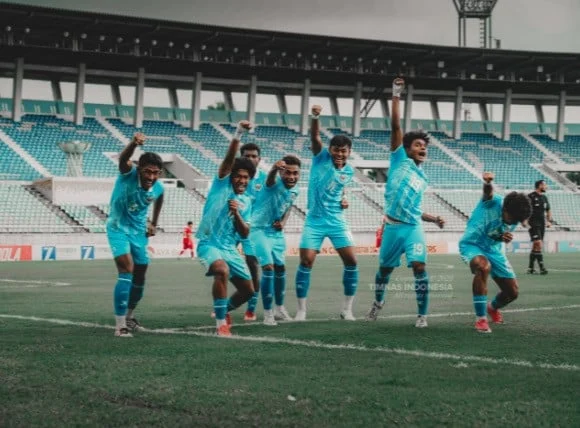
The journey of Indonesian football reached another milestone on Tuesday afternoon, November 17, 2026, as the national under-17 team secured a resounding victory over Afghanistan in Group A of the AFC U-17 Asian Cup Qualifiers. Hosted at the historic Thuwunna Stadium in Yangon, Myanmar, the match not only added three crucial points to Garuda Muda’s tally but also officially guaranteed their qualification for the prestigious continental tournament scheduled for 2027. Under the tactical guidance of head coach David Nascimento, the youth squad demonstrated both moments of brilliance and areas requiring refinement, ultimately sealing a dominant scoreline that cemented their status at the summit of the group standings.
With this qualification already secured, Indonesia will approach their final group-stage fixture against hosts Myanmar on Friday, November 20, 2026, with a degree of tactical freedom, though maintaining momentum remains a priority for the coaching staff. The achievement marks a continuation of the positive developmental trends seen across various age brackets of Indonesian national teams in recent years, reflecting increased structural investments by the football federation in youth scouting, training camps, and international exposure.
Match Chronology and Tactical Breakdown
The encounter at Thuwunna Stadium kicked off under humid conditions, with both sides looking to assert dominance in the opening minutes. Indonesia, lining up in their traditional red and white kits, adopted an aggressive high press that immediately caught the Afghan defense off guard. This tactical approach bore fruit as early as the eighth minute when I Dewa Gede Majesta capitalized on a defensive lapse inside the penalty box, slotting home a precise finish to break the deadlock and give Indonesia a 1-0 lead.
For the first twenty minutes, Garuda Muda dictated the tempo of the game, circulating possession effectively and exploiting the flanks through rapid transitions. However, as the first half progressed, the intensity of the Indonesian press noticeably dropped. Afghanistan began to find pockets of space in the midfield, testing the defensive resolve of the Indonesian backline through quick counter-attacks. Despite a dip in overall consistency and several missed defensive assignments, Indonesia managed to preserve their slender one-goal advantage heading into the halftime interval.
The second half witnessed a tactical adjustment by Coach David Nascimento, who urged his players to regain their positional discipline and increase the tempo of their ball circulation. The tactical shift paid immediate dividends shortly after the restart. In the 53rd minute, Dzaky Azfar doubled Indonesia’s lead with a well-timed run and clinical finish, neutralizing any momentum Afghanistan had attempted to build toward the end of the first half.
The floodgates opened further as the match entered its final quarter. Dhamar Tri Kusuma added his name to the scoresheet in the 73rd minute, capitalizing on a rebound from a long-range effort to make it 3-0. Just three minutes later, in the 76th minute, Dzaky Azfar struck again, securing his second of the match and rounding off the scoring to seal a comprehensive victory. The final whistle confirmed a dominant performance that underscored Indonesia’s offensive potency, even as questions lingered regarding their defensive concentration during the middle phases of the match.
Post-Match Analysis and Coach Reactions
Despite the emphatic nature of the victory and the subsequent qualification, the mood in the post-match press conference led by head coach David Nascimento was one of cautious evaluation rather than unbridled celebration. Nascimento acknowledged the team’s promising start but was quick to point out the vulnerabilities that emerged as the match progressed.
"We started the pertandingan with very good energy. In the first 20 minutes, the team played exceptionally well and successfully executed our tactical plan to score early," Nascimento stated through an interpreter in Yangon. "However, after that initial phase, our performance dropped drastically. The players failed to consistently follow the tactical instructions we had given them before the match, particularly regarding our defensive organization and transition phases."
Nascimento’s candid assessment highlights the rigorous standards expected within the youth setup, where qualification alone is viewed as a baseline rather than the ultimate destination. The Portuguese tactician emphasized that against higher-tier opponents in the continental finals, lapses in defensive discipline and concentration during mid-game periods could prove costly. The technical staff is expected to use the upcoming fixture against Myanmar to address these structural inconsistencies, focusing heavily on defensive compactness and sustained ninety-minute focus.
Group A Standings and Tournament Context
The qualification campaign in Group A has proven to be a rigorous test of endurance and tactical adaptability for all participating nations. By securing victories in their opening fixtures, Indonesia has accumulated an unassailable lead at the top of the group, rendering the outcome of the final matchday mathematically irrelevant to their qualification status, though crucial for seeding and regional pride.
The AFC U-17 Asian Cup 2027 serves not only as the premier continental championship for youth national teams but also acts as the qualification pathway for the FIFA U-17 World Cup. Consequently, every match played during these qualifiers carries significant long-term implications for the development cycle of the players involved. For Indonesia, securing a spot in the 2027 edition guarantees that this cohort of players will continue to receive high-level international exposure against Asia’s finest footballing nations.
The logistical challenges of playing away from home in Myanmar, combined with the demanding schedule of regional qualifiers, have tested the depth and physical conditioning of the Indonesian squad. The sports science and medical teams have played a pivotal role in managing player workloads, ensuring that recovery protocols are strictly observed between matches.
Broader Implications for Indonesian Football Development
The qualification of the under-17 national team for the 2027 continental showcase aligns with PSSI’s broader strategic roadmap aimed at elevating the global competitiveness of Indonesian football. Over the past several cycles, structural reforms focusing on elite youth academies, regional scouting networks, and increased international friendly matches have begun to yield tangible results.
Exposing players to high-pressure continental qualifiers at a formative age helps bridge the developmental gap between domestic competitions and international standards. Analysts note that consistent participation in major tournaments fosters psychological resilience, tactical maturity, and technical proficiency among young athletes—traits that are essential when they eventually transition to senior professional football and the senior national team.
Furthermore, success at the youth level generates widespread public enthusiasm and corporate interest, reinforcing the financial and infrastructural ecosystem required to sustain long-term development. As Garuda Muda prepares for their final group encounter against Myanmar on November 20, 2026, the focus shifts immediately toward refining their tactical identity, rectifying defensive vulnerabilities, and building a cohesive squad capable of making a significant impact on the continental stage when the AFC U-17 Asian Cup commences in 2027.