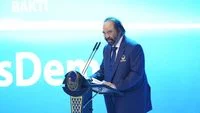
Jakarta, CNN Indonesia — In a significant political address that underscored the ongoing dynamics of Indonesia’s ruling coalition, NasDem Party General Chairman Surya Paloh publicly called upon President Prabowo Subianto to fortify national consolidation and leadership resolve. Speaking before a packed auditorium of party cadres, elites, and invited dignitaries during the celebration of the NasDem Party’s 15th anniversary on Wednesday evening, Paloh emphasized the critical importance of unity and structural cohesion as the current administration navigates the complex socioeconomic and political challenges facing the nation.
The high-profile event served not only as a milestone anniversary for the nationalist party—which was founded in 2011 and has since established itself as a major pillar in Indonesian parliamentary politics—but also as a platform to reaffirm NasDem’s strategic alignment with the executive branch. Paloh’s remarks were closely watched by political analysts and observers, particularly given the shifting alliances within Indonesia’s post-election landscape and the high stakes riding on the success of the current presidential term.
A Call for Robust Leadership and Unwavering Unity
Addressing the audience, Surya Paloh offered both a personal blessing and a political mandate to President Prabowo Subianto. Paloh conveyed heartfelt wishes for the president’s health, stamina, and resilience, expressing a desire to see the head of state maintain optimism and a steady demeanor amid the heavy burdens of governance. Crucially, Paloh used the moment to definitively cement NasDem’s position as a dependable partner within the governing coalition, assuring the administration of the party’s steadfast support.
"Our collective prayer is that you remain in good health, stay spirited, smile more often, and successfully consolidate the ranks. Among those ranks, NasDem is proudly present," Paloh stated during his keynote address, drawing applause from the party faithful.
The emphasis on "consolidating the ranks" is widely interpreted by political experts as a reference to the intrinsic challenge of managing a broad-based coalition government in Indonesia’s multi-party presidential system. With numerous political factions represented in the legislature and the cabinet, maintaining disciplined coordination between the executive and legislative branches is essential for passing key national legislation and implementing long-term policy reforms. By highlighting this need, Paloh positioned NasDem as a constructive stabilizing force dedicated to minimizing political friction and maximizing administrative efficiency under Prabowo’s leadership.
The Imperative of Administrative Success
Moving beyond expressions of loyalty, Paloh articulated a stern and unequivocal stance on the necessity of governmental success. Looking ahead at the remainder of the current presidential term, the NasDem leader asserted that failure is simply not an option for the administration, framing the success of the presidency as a collective national imperative that transcends partisan interests.
"I say it once again: President Prabowo cannot fail! Even the presidents who come after Prabowo must not fail in managing this country," Paloh declared with firm emphasis.
This uncompromising declaration reflects the gravity of the socioeconomic hurdles currently confronting Indonesia. As Southeast Asia’s largest economy strives to maintain robust post-pandemic growth, manage inflationary pressures, create sustainable employment opportunities for its youthful demographic, and execute massive national infrastructure and social programs—such as the ambitious free nutritious meal initiative—the margin for policy error is narrow. Paloh’s remarks serve as both an encouragement and a high-stakes benchmark, reminding political elites that the ultimate metric of the administration’s worth will be tangible improvements in the daily lives of ordinary Indonesian citizens.
Furthermore, Paloh expanded his historical and political horizon by noting that the mandate for effective governance extends beyond a single administration, establishing a continuum of responsibility for future national leaders. This perspective aligns with NasDem’s broader ideological commitment to institutional continuity and national development goals, such as the grand vision of Golden Indonesia 2045.
NasDem’s Strategic Vision and Contribution to Governance
During the anniversary commemoration, Surya Paloh also elaborated on the party’s overarching philosophy regarding national development and governance. He expressed a strong desire for the NasDem Party to elevate its substantive contributions to the state, moving beyond mere political representation to become an active engine of policy formulation and execution.
Paloh argued that the ultimate realization of Indonesia’s national potential relies heavily on the consistent, collective mobilization of all available resources. He stressed the necessity of fostering genuine synergy across different sectors of society and government, urging political stakeholders to multiply cooperative efforts rather than allow division to undermine national progress.
"God willing, it is entirely proper for Indonesia to continue placing great hope and optimism in the future," Paloh concluded, striking an upbeat tone that contrasted with the sobering warnings regarding the consequences of administrative failure.
This forward-looking optimism is a hallmark of NasDem’s public messaging, which frequently emphasizes progressive reform, the restoration of institutional integrity, and the cultivation of a modern political culture. By tying national optimism directly to systemic cooperation, Paloh reinforced the party’s identity as an inclusive, reform-minded organization willing to collaborate across ideological divides for the greater good of the republic.
Background Context and Political Implications
The 15th anniversary of the NasDem Party arrives at a pivotal juncture in modern Indonesian political history. Founded originally as a mass organization (Nasional Demokrat) before transforming into a formal political party in July 2011, NasDem quickly carved out a distinctive niche under Paloh’s media-mogul leadership, championing the slogan of "Restoration" (Restorasi Indonesia) aimed at combating corruption, bureaucratic inefficiency, and political stagnation.
Over the past decade and a half, NasDem has evolved from an ambitious political newcomer into a formidable kingmaker and a reliable coalition partner. The party’s decision to formally align with President Prabowo Subianto’s administration following the 2024 general elections marked a continuation of its pragmatic approach to national governance—prioritizing stable working relationships with the executive branch to ensure legislative productivity.
Analysts note that Paloh’s public statements during high-profile party events often carry multi-layered strategic significance. By publicly demanding strict administrative competence and offering unconditional institutional backing, Paloh achieves several objectives simultaneously:
- He solidifies NasDem’s standing as an indispensable, mature, and patriotic political entity that prioritizes state stability over petty partisan maneuvering.
- He sets a high standard for governance accountability, positioning NasDem as a supportive yet discerning ally that expects high performance from the executive branch.
- He reinforces internal party cohesion by rallying cadres around a shared mission of national development and collective responsibility.
Broader Impact on the National Landscape
The implications of Surya Paloh’s address extend far beyond the walls of the NasDem anniversary celebration. As Indonesia continues to navigate global economic uncertainties, geopolitical shifts, and domestic policy transitions under the Prabowo administration, the cohesion of the ruling coalition remains a vital determinant of political stability.
A unified legislative coalition reduces the likelihood of disruptive political deadlocks, enabling the government to swiftly pass budgetary measures and enact structural reforms necessary for attracting foreign investment and stimulating domestic productivity. By publicly endorsing the president’s consolidation efforts and framing national success as a collective duty, Paloh has provided a timely political boost to the administration.
At the same time, the warning that "failure is not an option" serves as a reminder to all political actors within the government that public scrutiny remains intense. Citizens and civil society organizations are closely monitoring the administration’s delivery on key campaign promises, making effective coalition management and rigorous policy execution more critical than ever.
As the NasDem Party looks ahead toward its future trajectory in Indonesian politics, the events of its 15th anniversary demonstrate its enduring commitment to playing a central, constructive role in shaping the nation’s destiny. Through a blend of loyal partnership, strategic counsel, and an unyielding demand for administrative excellence, Surya Paloh and the NasDem Party have once again signaled their readiness to help steer Indonesia through the complex challenges of the years ahead.