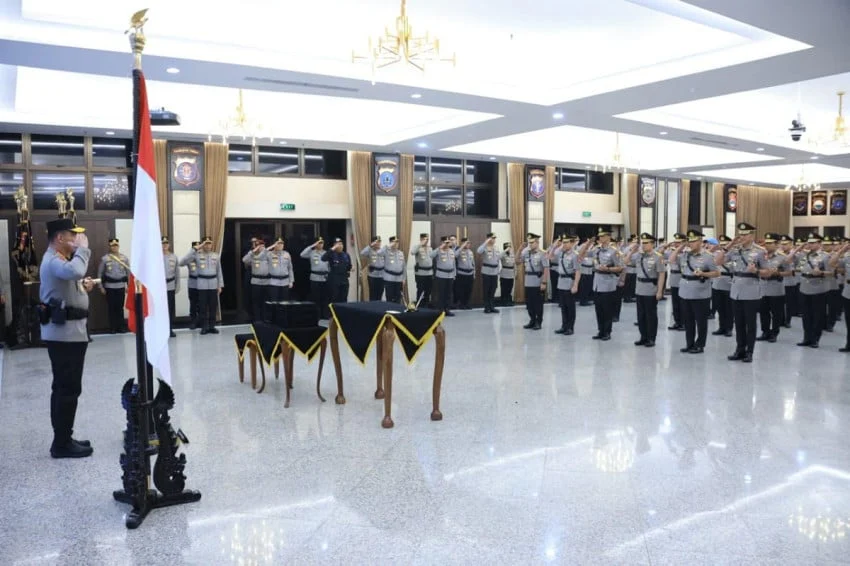
In a sweeping organizational realignment aimed at optimizing regional security operations and bolstering command structures across remote and strategic archipelagic territories, Indonesian National Police (Polri) Chief General Suyudi Ario Seto has reassigned 16 middle-ranking officers holding the ranks of Senior Superintendent (AKBP) and Superintendent (Kompol) to various regional police commands (Polda). This strategic reshuffle forms a crucial part of a broader national structural adjustment executed under official institutional directives issued in early November 2026.
The recent command transitions reflect the ongoing administrative evolution within the national law enforcement agency, prioritizing targeted capability deployment to sensitive regions. The affected officers, all seasoned mid-career professionals possessing diverse operational backgrounds ranging from counter-terrorism to criminal investigation, have been reassigned to foundational regional assignments spanning from East Nusa Tenggara (Polda NTT) to West Papua (Polda Papua Barat) and Maluku (Polda Maluku). This calculated distribution of personnel underscores the leadership’s commitment to reinforcing regional command posts with experienced investigators and tactical supervisors.
Comprehensive Scope of the November 2026 National Police Mutational Directive
The structural movements implemented by General Suyudi Ario Seto are officially codified within National Police Telegram Letter Number ST/2515/XI/KEP./2026, which was formally promulgated on November 9, 2026. This comprehensive administrative document outlines a massive wave of personnel transitions affecting a total of 25 High-Ranking Officers (Pati) and Middle-Ranking Officers (Pamen) nationwide, running parallel to other major concurrent structural shifts, including the reassignment of dozens of Brigadier Generals across various operational and ministerial directorates.
The timing of the November 2026 institutional adjustments aligns with the National Police’s regular cyclical evaluation of personnel placement, career progression pathways, and strategic deployment metrics. By executing these targeted reassignments, the central leadership seeks to address localized security demands, fill critical leadership vacuums resulting from retirements or promotions, and inject renewed operational dynamism into provincial police headquarters that face unique geographic and demographic challenges.
Institutional Rationale and Meritocratic Deployment Strategy
Addressing the media regarding the philosophical and operational underpinnings of the November 2026 mutations, Head of the Public Relations Division of the Indonesian National Police, Inspector General Johnny Eddizon Isir, emphasized that these systemic rotations represent a vital mechanism for institutional refreshment and continuous career development. Speaking from the national police headquarters in Jakarta, Inspector General Isir elaborated on the rigorous evaluation criteria utilized by the police high command during the selection process.
"The placement and rotation of personnel are executed through a rigorous evaluation framework that places paramount importance on meritocracy, proven competence, individual capability, and uncompromised integrity," Inspector General Isir stated. He further stressed that these foundational benchmarks are strictly applied to ensure that every appointed official possesses the requisite expertise to execute their assigned duties and responsibilities with the highest level of professionalism, ultimately reinforcing the overall performance and public accountability of the organization.
Furthermore, the national police leadership extended formal acknowledgments to all officers transitioning out of their previous operational posts. Expressing gratitude for their dedicated service, the Public Relations Division issued a clear directive to the newly appointed regional personnel. Officials stepping into their fresh assignments are expected to adapt swiftly to their new socio-cultural and operational environments, actively forge operational solidities with local stakeholders, and elevate the standard of public safety service delivery to unprecedented levels.
Detailed Profile of Selected Reassigned Middle-Ranking Officers
The November 9, 2026 directive details specific movements of highly competent investigators from central operational bureaus to regional jurisdictions. Among the notable mid-level commanders reassigned in this batch are several key figures previously stationed within specialized directorates at the Bareskrim Polri (Criminal Investigation Agency) and the elite Densus 88 Anti-Terror Special Detachment.
-
AKBP Benito Harleandra
- Previous Assignment: Unit Commander 4 (Kanit 4), Sub-Directorate IV, Directorate of General Crimes (Dittipidum), Bareskrim Polri.
- New Assignment: Middle-Ranking Officer (Pamen) assigned to the East Nusa Tenggara Regional Police (Polda NTT).
- Operational Profile: AKBP Benito Harleandra brings extensive investigative experience derived from handling complex general criminal cases at the national headquarters level. His transfer to Polda NTT is anticipated to strengthen investigative oversight within the regional jurisdiction, particularly concerning multi-jurisdictional crimes and complex syndicates operating across eastern Indonesia’s maritime borders.
-
AKBP Manuel Tadu Rebo
- Previous Assignment: Unit Commander 1 (Kanit 1), Sub-Directorate of Counter-Intelligence, Directorate of Intelligence of the Counter-Terrorism Special Detachment (Ditintel Densus 88 AT Polri).
- New Assignment: Middle-Ranking Officer (Pamen) assigned to the East Nusa Tenggara Regional Police (Polda NTT).
- Operational Profile: Having served within the specialized counter-terrorism intelligence apparatus, AKBP Manuel Tadu Rebo possesses specialized analytical skills in threat detection, intelligence gathering, and security risk assessment. His integration into the regional command structure in East Nusa Tenggara is designed to enhance provincial intelligence capabilities and preemptive threat mitigation frameworks.
-
AKBP Ambuka Yudha Hardi Putra
- Previous Assignment: Unit Commander 4 (Kanit 4), Sub-Directorate III, Directorate of General Crimes (Dittipidum), Bareskrim Polri.
- New Assignment: Middle-Ranking Officer (Pamen) assigned to the East Nusa Tenggara Regional Police (Polda NTT).
- Operational Profile: AKBP Ambuka Yudha Hardi Putra has a proven track record in managing high-profile criminal investigations at the national level. His reallocation to Polda NTT provides the regional police apparatus with advanced investigative leadership capable of tackling sophisticated local criminal enterprises and addressing emerging public safety concerns within the province.
Chronology and Implementation Timeline of the November 2026 Reshuffle
The systematic execution of the November 2026 police mutational cycle followed a structured administrative timeline designed to ensure seamless handovers and uninterrupted public service delivery across all affected units:
- Early November 2026: Finalization of performance evaluations, career assessments, and merit-based placement proposals by the National Police’s Human Resources Assistant (As SDM Polri) under the direct supervision of General Suyudi Ario Seto.
- November 9, 2026: Official issuance and promulgation of Telegram Letter Number ST/2515/XI/KEP./2026, officially greenlighting the rotation of 25 high-ranking and middle-ranking officers, including the 16 AKBP and Kompol personnel designated for regional Polda commands.
- November 12, 2026: Public dissemination of the mutational policies through official institutional channels, accompanied by formal explanatory briefings delivered by Kadiv Humas Polri Irjen Pol Johnny Eddizon Isir in Jakarta, outlining the strategic objectives and professional standards underpinning the decisions.
- Mid-to-Late November 2026: Execution of administrative handovers, command transition ceremonies, and the physical relocation of officers to their respective regional assignments in Nusa Tenggara, Papua, Maluku, and other designated provincial commands.
Broader Implications and Strategic Analysis of Regional Police Realignments
The consistent deployment of seasoned national-level investigators and intelligence officers to regional commands such as Polda NTT, Polda Papua Barat, and Polda Maluku carries profound strategic implications for Indonesia’s internal security architecture. Observers of police administration note that regional commands in outer islands and eastern provinces often face distinct operational hurdles, including geographic dispersion, logistical constraints, and complex local socio-political dynamics.
By infusing these regional headquarters with officers who have honed their skills within elite central units like Bareskrim and Densus 88, the national police leadership aims to bridge the operational gap between central oversight and local execution. This localized empowerment ensures that regional police chiefs possess the tactical and analytical assets necessary to resolve protracted local conflicts, dismantle entrenched transnational smuggling networks, and manage public order during sensitive electoral or economic transitions.
Furthermore, this systematic rotation strategy serves a dual purpose in human resource management. It prevents institutional stagnation by encouraging continuous professional mobility, while simultaneously exposing career officers to diverse operational theaters, thereby preparing them for higher leadership responsibilities within the national hierarchy. As these 16 officers assume their new posts across the archipelago, the success of their deployments will be measured by their ability to foster community trust, enhance localized crime clearance rates, and maintain steadfast stability in some of the nation’s most geographically vital regions.