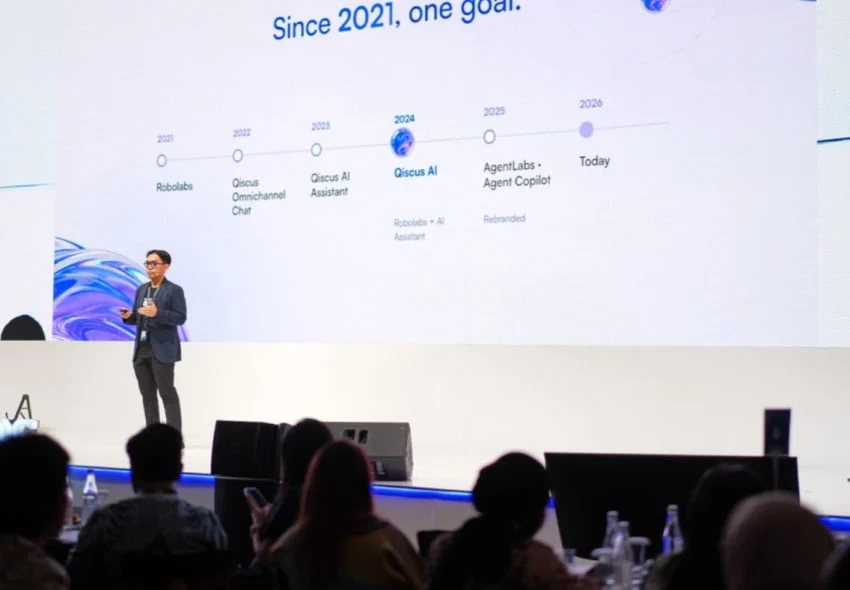
JAKARTA — Qiscus, a prominent Southeast Asian provider of agentic customer engagement platforms, officially unveiled two cutting-edge artificial intelligence technology layers—Operator and Qiscus MCP—during its flagship annual forum, Conversa 6.0, held in Jakarta. The high-profile launch, witnessed by more than 200 business practitioners, industry leaders, and technology experts, marks a pivotal strategic expansion of the Qiscus AI ecosystem. The core objective of this technological rollout is to actualize what the company defines as Perfect CX: a seamless, highly responsive, personalized, and proactive customer experience that transcends traditional support mechanisms.
The introduction of these tools arrives at a time when digital transformation across Southeast Asia has accelerated exponentially. Modern enterprises are no longer satisfied with superficial automation; instead, they demand deep operational integration that can process vast quantities of consumer data in real time. By introducing Operator and Qiscus MCP, Qiscus aims to bridge the persistent gap between customer interaction and backend decision-making, positioning itself at the forefront of the region’s enterprise software market.
Moving AI Beyond the Interaction Layer
During his keynote address at Conversa 6.0, Delta Purna Widyangga, Chief Executive Officer and Co-Founder of Qiscus, elaborated on the strategic philosophy guiding the new products. He emphasized that artificial intelligence in customer service has historically been confined to the surface level—primarily assisting human agents by generating faster replies or summarizing chat logs. However, the paradigm must now shift toward structural operational integration.
"For a long time, AI in customer service has largely operated at the interaction layer, helping to answer questions more quickly. The next step is to bring it to the operational layer, where decisions are made, because what businesses need today is not merely providing faster answers, but providing faster and more accurate decisions," Delta stated in his official statement following the event.
Delta further underscored that this advanced approach allows organizations to deliver a flawless experience to every consumer across the board, moving away from tiered support models where only high-value VIP clients receive premium attention. By embedding AI directly into operational decision-making workflows, enterprises can optimize resource allocation, predict customer friction points before they escalate, and execute resolution strategies autonomously or with minimal human intervention.
Addressing the Root Cause of Decision Latency
The conceptual framework behind the deployment of Operator and Qiscus MCP stems from an exhaustive analysis of contemporary customer service bottlenecks. As digital ecosystems mature, customer interactions have grown increasingly complex. Organizations now manage communications across a fragmented array of digital channels, ranging from traditional email and voice calls to modern messaging apps, social media DMs, and live web chats.
This multichannel proliferation has inadvertently created severe internal inefficiencies. Individual departmental silos often operate on disconnected dashboards, while vital enterprise data remains scattered across disparate cloud systems, legacy databases, and customer relationship management (CRM) platforms. According to Qiscus, this structural disconnect produces a critical vulnerability: decision latency—the dangerous time gap between receiving a customer signal in the market and executing a coordinated corporate response.
To combat this systemic friction, Conversa 6.0 adopted the overarching theme, The Agentic Shift: Orchestrates AI Complexity. Qiscus maintains that orchestration is the single most critical factor for modern enterprises. Without proper orchestration, deploying multiple disjointed AI tools only adds to the operational noise. The new technology layers are explicitly designed to ensure that human teams, software systems, and autonomous AI agents function seamlessly as a unified, cohesive operational unit.
Decoding the Technology: Operator and Qiscus MCP
While specific deep technical specifications of the rollout were detailed across various breakout sessions at the forum, the overarching architecture of Operator and Qiscus MCP focuses on autonomous execution and context-aware data retrieval.
Operator functions as an advanced autonomous agentic layer capable of executing complex multi-step workflows. Unlike traditional chatbots that rely heavily on rigid decision trees or basic generative text models, Operator is engineered to understand business intent, execute backend tasks—such as processing refunds, updating shipping details, or verifying user credentials—and collaborate alongside human agents as a digital teammate.
On the other hand, Qiscus MCP serves as the underlying orchestration and integration protocol, connecting disparate data silos and communication channels into a centralized stream of actionable intelligence. By standardizing how AI models interact with enterprise databases, Qiscus MCP minimizes the latency issues that plague traditional customer engagement structures, ensuring that every automated or human-led decision is backed by up-to-the-minute contextual data.
The Broader Context of Conversa 6.0
Conversa 6.0 has firmly established itself as one of Southeast Asia’s premier annual gatherings for customer experience (CX) and enterprise technology professionals. Over the years, the forum has evolved from a localized networking event into a vital institutional platform where industry standards are debated, and groundbreaking products are debuted.
The 2026 edition in Jakarta drew participation from diverse sectors, including banking, financial technology, telecommunications, e-commerce, logistics, and retail. The high turnout of over 200 practitioners highlights the mounting urgency among Indonesian and regional enterprises to overhaul their customer engagement infrastructures in response to shifting consumer expectations. Industry observers noted that post-pandemic digital adoption in Southeast Asia has permanently raised the bar for consumer service standards, making technological innovation a matter of corporate survival rather than mere luxury.
Industry Implications and Market Impact
The launch of Qiscus’s new AI layers carries profound implications for the enterprise software landscape in Indonesia and the broader ASEAN region. As businesses face tightening economic margins and heightened consumer demands for instant gratification, operational efficiency has become the primary metric of corporate competitiveness.
Financial analysts and tech sector observers point out several key implications of the Agentic Shift:
- Democratization of Premium CX: By leveraging autonomous agents to handle routine yet complex operational decisions, businesses can scale personalized service delivery without a linear increase in human support operational costs. This operational leverage bridges the gap between enterprise-level service quality and small-to-medium enterprise (SME) capabilities.
- Mitigation of Internal Silos: The integration focus of Qiscus MCP directly addresses the chronic enterprise pain point of fragmented data architecture. Companies that successfully unify their communication channels and operational dashboards can significantly reduce response times and eliminate internal miscommunication.
- Evolution of the Workforce: The introduction of agentic AI does not necessarily signal the eradication of human customer service roles. Instead, it catalyzes a structural evolution. Human agents are elevated from repetitive task execution to supervisory, strategic, and empathetic problem-solving roles, working alongside AI operators.
Expert Reactions and Future Outlook
Reactions from early attendees and technology partners at Conversa 6.0 have been largely optimistic. Many industry practitioners noted that Qiscus has correctly identified the next evolutionary phase of enterprise AI. While the market has been flooded with conversational generative AI tools over the past few years, the transition toward agentic, decision-making systems represents a much-needed maturation of the technology sector.
Looking forward, Qiscus plans to roll out comprehensive integration roadmaps for its current enterprise clients throughout the remainder of 2026. The company intends to conduct rigorous pilot programs for Operator and Qiscus MCP across key sectors such as financial services and large-scale retail before wider commercial scaling.
As Southeast Asia continues to solidify its position as one of the world’s fastest-growing digital economies, innovations driven by localized tech leaders like Qiscus will play a critical role in shaping how businesses interact with millions of digital-first consumers. The success of the Agentic Shift introduced at Conversa 6.0 will likely serve as a benchmark for future enterprise software development across the archipelago and the wider ASEAN digital marketplace.