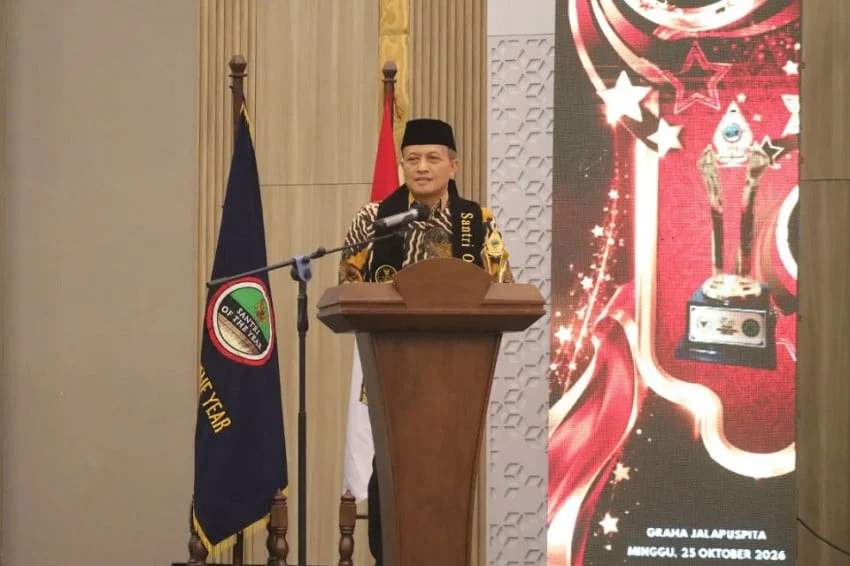
The landscape of national leadership and public service in Indonesia continues to witness the convergence of traditional Islamic values and modern institutional governance. This synergy was prominently highlighted as the Junior Attorney General for Oversight (Jamwas) at the Attorney General’s Office of the Republic of Indonesia, Rudi Margono, was officially conferred the prestigious Santri Dhyaksa Inspiratif award. The accolade was presented during the grand celebration of the Santri of The Year 2026 awards ceremony, held at the historic Graha Jalapuspita located in Central Jakarta.
The high-profile event, which draws nationwide attention annually, serves as a platform to honor individuals who demonstrate exceptional dedication, integrity, and progressive leadership rooted in the moral and ethical foundations of the santri tradition—students of traditional Islamic boarding schools, or pesantren. This year’s ceremony was collaboratively organized by the Islam Nusantara Center (INC) in partnership with Majelis Pesona, receiving robust institutional backing and support from the House of Representatives of the Republic of Indonesia (DPR RI).
Main Facts and the Award Ceremony
The conferral of the Santri Dhyaksa Inspiratif award to Rudi Margono marks a significant milestone in recognizing high-ranking state officials who maintain deep connections to the country’s Islamic educational roots while executing rigorous legal and supervisory responsibilities. The term "Dhyaksa" historically refers to prosecutors or guardians of the law, making the title a unique recognition of a legal statesman whose professional ethos is deeply influenced by santri values such as honesty, social justice, and tireless community service.
During the gala event at Graha Jalapuspita, the atmosphere was charged with a sense of communal pride and spiritual reflection. The ceremony brought together prominent figures from various sectors, including legislative members, religious scholars (kiai), academics, legal practitioners, and civil society leaders.
Upon receiving the award, Rudi Margono delivered an inspiring address that underscored the critical function of educational and cultural institutions in shaping national character. He specifically commended the ongoing initiatives spearheaded by the Islam Nusantara Center, noting that INC has consistently played an indispensable role in fostering human resource development across the archipelago.
Rudi emphasized that gatherings of this magnitude should transcend mere ceremonial symbolism. Instead, he urged attendees and organizers to view such platforms as vital incubators for strengthening institutional and interpersonal networks, ultimately driving forward a shared mission of genuine public service. "This is an extraordinary event. May this gathering bring us together again in paradise," Rudi remarked in his closing statement, reflecting the spiritual humility characteristic of traditional pesantren upbringing.
Background Context of the Santri of The Year Event
The Santri of The Year awards have evolved into one of Indonesia’s most anticipated annual observances, celebrating the multifaceted contributions of santris and alumni of Islamic boarding schools to the nation’s social, political, cultural, and legal spheres. Since its inception, the initiative has sought to dismantle outdated stereotypes regarding pesantren graduates, showcasing instead how traditional Islamic education produces dynamic leaders capable of navigating and reforming complex modern state institutions.
Organized primarily by the Islam Nusantara Center—an institution dedicated to researching, developing, and disseminating moderate Islamic traditions native to Indonesia—the event highlights individuals who embody the spirit of rahmatan lil ‘alamin (a mercy to the universe). By partnering with Majelis Pesona and securing the endorsement of the DPR RI, the organizers have elevated the stature of the awards, bridging grassroots religious communities with the highest echelons of national governance.
The inclusion of categories such as "Santri Dhyaksa Inspiratif" reflects a deliberate effort to recognize legal and law enforcement professionals. In a democratic nation striving for structural and systemic legal reform, the presence of leaders with a santri background in institutions like the Attorney General’s Office is viewed by many sociologists and legal analysts as a vital anchor for moral integrity and public trust.
Career Profile and Academic Journey of Rudi Margono
To fully comprehend the significance of Rudi Margono receiving this national accolade, one must examine his extensive career trajectory, academic achievements, and foundational upbringing within the Indonesian legal apparatus. Born in Magetan, a regency in East Java, on December 6, 1969, Rudi grew up immersed in the cultural and religious traditions of Java, which heavily influenced his worldview and professional discipline.
His educational journey reflects an unwavering commitment to legal scholarship and institutional excellence. Rudi completed his undergraduate studies, earning a Bachelor of Laws (S.H.) degree from the Faculty of Law at Universitas Brawijaya in Malang, East Java. Recognizing the necessity of continuous learning in an evolving legal landscape, he pursued further postgraduate education at Universitas Gadjah Mada (UGM) in Yogyakarta, where he successfully obtained his Master of Humanities (M.Hum.) degree. Demonstrating a profound dedication to academic rigor, Rudi later returned to his alma mater, Universitas Brawijaya, to complete his doctoral studies, earning his doctorate in legal science (Dr.).
Professionally, Rudi Margono is recognized as a senior career prosecutor who has dedicated decades of service to the Indonesian Attorney General’s Office. Over the years, he has navigated numerous strategic assignments, steadily rising through the ranks due to his meticulous approach to prosecution, institutional oversight, and policy formulation. His deep expertise in criminal law and state administration has positioned him as a key thinker within the nation’s justice system.
Track Record in Asset Recovery and Institutional Reform
Beyond his routine prosecutorial duties, Rudi Margono has garnered widespread public and academic attention for his forward-thinking legal philosophies, particularly concerning the complex arena of asset recovery and financial crime deterrence. In an era where transnational organized crime, grand corruption, and money laundering threaten national economic stability, Rudi’s intellectual contributions to asset confiscation have proven instrumental.
His progressive stance on asset recovery emphasizes that punishing perpetrators of financial crimes through incarceration alone is insufficient to repair the systemic damage inflicted on the state and society. Instead, he has consistently advocated for robust legal mechanisms that prioritize the systematic tracing, freezing, and repatriation of illegally acquired assets back to the state treasury for public welfare. This analytical framework has heavily influenced discussions surrounding revisions to criminal procedure codes and specialized asset forfeiture bills in Indonesia.
His leadership capabilities were further underscored when he was entrusted with strategic leadership roles within the institution, including serving as the Acting Deputy Attorney General for Special Crimes (Plt Jampidsus). In this high-stakes capacity, Rudi oversaw complex investigations involving major white-collar crimes and state financial losses, demonstrating an unyielding resolve to uphold the rule of law without fear or favor.
Official Responses and Institutional Implications
The recognition of Rudi Margono as Santri Dhyaksa Inspiratif has generated positive reactions across various segments of Indonesian society, ranging from legal observer circles to Islamic educational networks. Institutional stakeholders note that this accolade serves as a powerful validation of the Attorney General Office’s ongoing internal transformation, which emphasizes not only professional competence but also uncompromising moral integrity.
Legal analysts point out that public institutions in Indonesia face a perpetual challenge in maintaining public trust. When high-ranking officials tasked with rigorous oversight—such as the Jamwas—are publicly recognized for embodying ethical foundations derived from religious and community traditions, it sends a reassuring signal regarding the character of leadership steering the nation’s law enforcement agencies.
Furthermore, the award highlights the evolving paradigm of institutional accountability. The Office of the Junior Attorney General for Oversight plays a critical role in investigating internal disciplinary infractions, ensuring that prosecutors and administrative personnel across the country adhere strictly to the professional code of conduct. By integrating the ethical resilience associated with the santri tradition into supervisory duties, leadership figures like Rudi Margono set a benchmark for internal governance and institutional discipline.
Broader Impact on the Indonesian Legal Landscape
The convergence of traditional Islamic values and modern legal administration, as exemplified by Rudi Margono’s career and recent recognition, holds profound implications for the future of Indonesia’s legal landscape. As the nation continues to navigate complex socio-legal challenges in the 21st century, the demand for technocratic expertise tempered by profound ethical grounding has never been more acute.
For the broader santri community, the recognition serves as an empowering reminder that the educational values instilled within traditional boarding schools—such as independence, sincerity, discipline, and social responsibility—provide an exceptional foundation for high-level state service. It challenges historical perceptions that segregate religious traditionalism from secular state governance, proving instead that these two spheres can harmoniously reinforce one another to build a more just, transparent, and equitable society.
Ultimately, the conferral of the Santri Dhyaksa Inspiratif award at the Santri of The Year 2026 ceremony is more than a momentary celebration of individual achievement. It stands as a testament to a lifelong dedication to the law, an unyielding commitment to institutional reform, and the enduring power of ethical leadership rooted in the heart of Indonesia’s cultural and religious heritage.