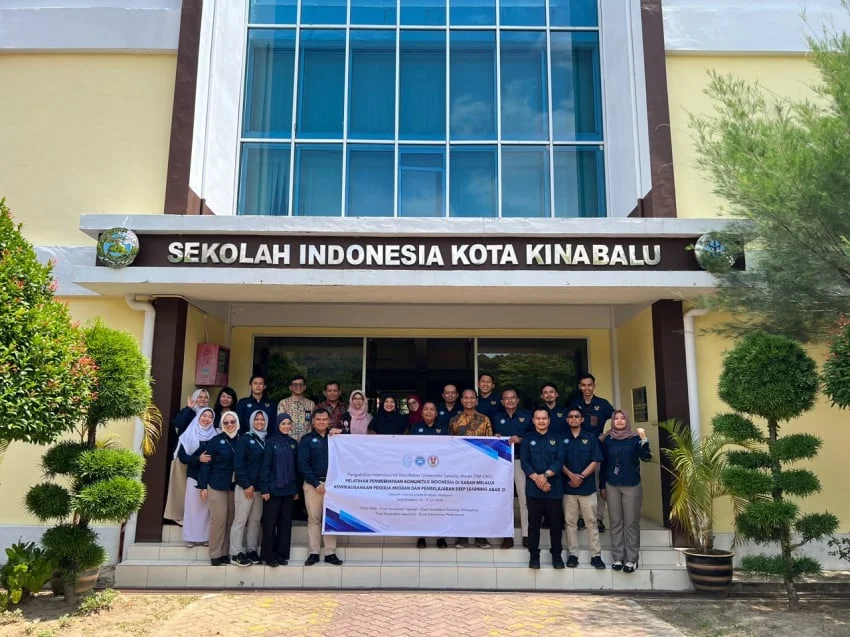
The Faculty of Teacher Training and Education (FKIP) at Universitas Sebelas Maret (UNS) has officially launched an ambitious international community engagement initiative aimed at strengthening the educational and economic landscape for Indonesian citizens residing in Sabah, Malaysia. Known as the Mandatory International Service (PIM) program, this collaborative effort focuses on empowering the Indonesian diaspora—specifically migrant workers and educators—through targeted workshops held at the Sekolah Indonesia Kota Kinabalu (SIKK).
The program, titled "Empowering the Indonesian Community in Sabah through Migrant Worker Entrepreneurship and 21st-Century Deep Learning Education," took place on July 15, 2026. Attended by 41 participants, including teaching staff and school committee members, the initiative represents a significant bridge between Indonesian academic institutions and the migrant communities that form the backbone of the workforce in East Malaysia.
The Strategic Importance of SIKK
Sekolah Indonesia Kota Kinabalu serves as a vital institution for the children of Indonesian migrant workers in Sabah. Given the unique challenges faced by the Indonesian diaspora—often working in the plantation, construction, and domestic service sectors—the school acts as both an educational facility and a community hub. The collaboration with UNS is designed to leverage university expertise to improve the quality of life for these families. By focusing on both pedagogical advancements for teachers and economic literacy for parents, the program adopts a holistic approach to community development.
A Multidisciplinary Approach to Empowerment
The UNS delegation, led by Professor Triyanto, comprised an interdisciplinary team of experts spanning various academic faculties. This diversity was intentional, ensuring that the intervention addressed multiple facets of the community’s needs. The team included representatives from the Accounting, Office Administration, History Education, Sociology-Anthropology, and Civics Education departments.
By integrating these disciplines, the program provided a comprehensive curriculum. For instance, while the Sociology and Anthropology experts focused on the cultural integration and social welfare of the migrant workers, the Accounting and Administration faculty provided practical tools for financial management and entrepreneurship. This structural design reflects an understanding that successful community empowerment requires more than just academic knowledge; it requires actionable economic strategies that can be applied in the day-to-day lives of the workers.
Chronology of the Program
The event, held in the SIKK high school auditorium, followed a structured format designed to maximize impact within a single-day intensive schedule. The proceedings began with formal opening remarks from Professor Triyanto, which underscored the commitment of UNS to international community service. This was followed by a keynote address from the Principal of SIKK, who emphasized the necessity of external support in maintaining high academic and social standards within the school’s unique environment.
Following the opening ceremony, the program split into two parallel sessions:
- The Educators’ Track: This session focused on pedagogical innovation. Facilitated by Nur Fatah Abidin and Yosafat Hermawan Trinugraha, the workshop introduced teachers to the "Deep Learning" framework. This modern approach to education moves beyond rote memorization, encouraging students to develop critical thinking, problem-solving, and collaborative skills necessary for the 21st century.
- The Entrepreneurship Track: This session was tailored for the school committee members, many of whom are migrant workers. The focus here was on micro-entrepreneurship, financial literacy, and administrative management, providing participants with the skills to potentially diversify their income streams or better manage their household finances.
The 21st-Century Deep Learning Paradigm
The inclusion of "Deep Learning" in the curriculum for SIKK teachers is particularly significant. In the context of international schools serving migrant communities, students often face hurdles related to language acquisition, cultural adaptation, and limited resources. The Deep Learning model focuses on connecting academic concepts to real-world applications, which is essential for students who may eventually return to Indonesia or transition into the Malaysian workforce.
Facilitators Nur Fatah Abidin and Yosafat Hermawan Trinugraha emphasized that the shift toward student-centered learning is essential for the sustainability of the Indonesian educational mission abroad. By empowering the teachers at SIKK, UNS is ensuring that the long-term educational outcomes for the students are improved even after the visiting delegation departs.
Economic Context: The Indonesian Diaspora in Sabah
To understand the necessity of this program, one must look at the broader economic context of Sabah. Thousands of Indonesian workers are employed in Sabah’s vast palm oil plantations. While these workers are vital to the local economy, they often live in remote areas with limited access to financial education or professional development.
The entrepreneurship component of the UNS program is a strategic intervention. By teaching members of the school committee—who are effectively community leaders among the migrant population—how to manage small businesses and organize financial assets, the program aims to create a ripple effect. These leaders are expected to share their knowledge with the wider community, potentially reducing the vulnerability of migrant families to economic instability.
Institutional Implications and Future Prospects
This program is part of a growing trend of "Mandatory International Service" (PIM) implemented by top-tier Indonesian universities. UNS, as a leading institution, is setting a precedent for how public universities can fulfill their "Tri Dharma" (the three pillars of higher education: education, research, and community service) on an international scale.
For the Indonesian government, such initiatives serve a dual purpose. First, they provide essential services to citizens living abroad, fulfilling the state’s obligation to protect and empower its diaspora. Second, they strengthen the diplomatic ties between Indonesia and Malaysia through "soft power" and educational diplomacy.
Analysis: Bridging the Gap
The initiative by FKIP UNS addresses a critical gap in the support infrastructure for Indonesian migrants. Often, diaspora policies are focused on labor rights and legal protections. While these are essential, the "soft" support—such as education and entrepreneurship training—is what truly allows families to thrive rather than merely survive.
The collaboration also highlights the importance of the university’s role as an agent of social change. By moving beyond the classroom and taking their expertise into the field, the faculty members involved in the PIM program are gaining valuable insights into the realities of migration. These insights will likely inform future research and policy recommendations back in Indonesia, creating a feedback loop that benefits both the institution and the community.
Conclusion and Expected Outcomes
As the program concluded, the feedback from participants was overwhelmingly positive. The school committee members expressed interest in follow-up sessions, indicating a demand for ongoing professional development. For the teachers, the implementation of Deep Learning strategies is expected to be a long-term transition, with the UNS team providing remote monitoring and guidance as needed.
Looking ahead, the success of this collaboration suggests that similar models could be replicated in other countries with significant Indonesian populations. The integration of pedagogical training and economic empowerment provides a robust framework for community development. By fostering a culture of continuous learning and entrepreneurship, the FKIP UNS team has planted the seeds for a more resilient and capable Indonesian community in Sabah. As these teachers and committee members apply their new skills, the ripple effects will be felt throughout the SIKK school community, ensuring that the next generation of Indonesian children in Malaysia is better prepared for the challenges of an increasingly complex global economy.