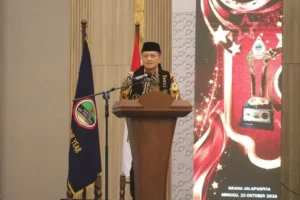
JAKARTA, Indonesia — In a powerful address directed at the nation’s upcoming generation, the 5th President of the Republic of Indonesia and Chairperson of the Indonesian Democratic Party of Struggle (PDI-Perjuangan), Megawati Soekarnoputri, has issued a resounding call for young Indonesians to look beyond academic achievement and technological prowess. Speaking virtually at the grand finale of the Merah Muda Fest 2026, held at the historic Lapangan Banteng in Central Jakarta on Sunday, October 25, 2026, Megawati emphasized that the true measure of human resource quality lies not merely in cognitive capability, but in steadfast character, ethical responsibility, and the courage to advocate for the marginalized.
The festival, organized by PDI-Perjuangan to commemorate the momentous 98th Youth Pledge Day (Hari Sumpah Pemuda), served as a vibrant platform for political leaders, cultural figures, and thousands of young citizens to reflect on the evolving role of youth in shaping the future of the archipelago. As Indonesia navigates an increasingly complex global landscape defined by rapid digital transformation and socioeconomic shifts, the leadership’s message aimed to anchor the nation’s demographic dividend in core foundational values rooted in Pancasila, the state ideology.
The Imperative of Character in a Technologically Advanced Era
Addressing an audience that bridged political leadership and grassroots youth organizations, Megawati articulated a pressing concern regarding modern education and professional training. While acknowledging the necessity of mastering science, mathematics, and cutting-edge technologies, she cautioned that intellectual brilliance devoid of moral fortitude is ultimately insufficient for national leadership.
"The future of Indonesia will not be determined solely by the level of scientific mastery you possess, but equally by the strength of your character," Megawati stated via video broadcast, capturing the attention of the festival attendees gathered under the open skies of Lapangan Banteng.
Elaborating on this theme, she pointed out a recurring paradox in modern governance and society: highly educated individuals who possess extraordinary technical skills yet falter when faced with ethical dilemmas. "Many individuals are undeniably smart, yet their hearts waver, their resolve lacks firmness, and they lack the essential courage to stand for what is right," she observed.
This critique underscores a broader philosophical debate within Indonesian political and educational circles regarding the orientation of national development. As the government continues to heavily invest in digital infrastructure, artificial intelligence literacy, and STEM (Science, Technology, Engineering, and Mathematics) education, senior statesmen and civic leaders frequently remind the public that technological advancement must be counterbalanced by humanities, ethics, and social empathy.
Megawati’s remarks specifically challenged the youth to cultivate moral bravery—the courage to speak truth to power, combat systemic injustice, and consistently defend vulnerable segments of society who lack the platform to advocate for themselves. She urged the younger generation to synthesize modern capabilities with timeless ethical frameworks.
"Be a generation capable of integrating intelligence with wisdom, technological progress with profound humanitarian values, and the courage to act alongside moral and ethical responsibility," she concluded.
Chronology and Context of the Merah Muda Fest 2026 Celebrations
The culmination of the Merah Muda Fest 2026 on Sunday marked the high point of a weeks-long series of cultural, intellectual, and political events organized across Jakarta and other major urban centers by PDI-Perjuangan’s youth wing and associated committees. The festival was strategically designed to honor the legacy of the 1928 Youth Pledge—a historic milestone where young nationalists from diverse ethnic, linguistic, and religious backgrounds swore allegiance to a single homeland, a single nation, and a single unifying language: Indonesia.
The day’s itinerary began early, reflecting the multifaceted approach the party took to engage diverse demographics. Prior to Megawati’s evening address, high-profile political figures affiliated with the party visited key historical landmarks to reinforce the historical continuity of youth activism in Indonesia.
On Sunday afternoon, Jakarta Governor Pramono Anung, alongside prominent legislator and House of Representatives (DPR RI) Commission X member Denny Cagur, made an official visit to the Museum Sumpah Pemuda in Central Jakarta. The museum, housed in the historic boarding house where the Second Youth Congress was held in 1928, served as a symbolic backdrop for discussions on contemporary youth nationalism. During their visit, Pramono and Denny interacted with student groups, historians, and cultural activists, discussing how the historical sacrifices of the independence-era youth can serve as a blueprint for addressing modern challenges such as youth unemployment, mental health, and digital ethics.
The convergence of historical reflection at the museum and forward-looking policy discussions at Lapangan Banteng highlighted the organizing committee’s intent to connect historical memory with actionable future strategies. Merah Muda Fest featured musical performances, startup showcases, policy debate competitions, and community service workshops, drawing tens of thousands of participants throughout the weekend.
Broader Sociological and Economic Implications
Megawati’s intervention comes at a critical juncture in Indonesia’s demographic timeline. The country is currently experiencing its demographic dividend, a period wherein the working-age population significantly outnumbers the dependent population. Projections by national and international economic agencies indicate that this window of opportunity will peak toward the middle of the 21st century, making the current generation of youth the primary drivers of Indonesia’s ambition to escape the middle-income trap and achieve its "Golden Indonesia 2045" vision.
However, sociologists and labor market analysts frequently warn that while the demographic dividend offers immense economic potential, it also presents profound risks if human capital development is misaligned. Challenges such as skill mismatches, the displacement of traditional jobs by automation, and a rising incidence of youth disillusionment with civic institutions have prompted intense debate among policymakers.
By emphasizing character, integrity, and social responsibility, leaders like Megawati seek to address the invisible infrastructure of national development. Analysts note that economic growth fueled solely by technical output often leads to social stratification and ethical erosion if not guided by a robust sense of collective justice. Consequently, the call to merge intellectual rigor with humanitarian values addresses not only individual moral development but also systemic resilience against corruption, polarization, and social apathy.
Reactions and Responses from Civil Society and Political Observers
The address delivered by the former president elicited widespread discussion across various political and social platforms in Jakarta. While supporters praised the timeless emphasis on Pancasila ethics and moral courage, academic commentators offered nuanced perspectives on how such ideals can be practically integrated into institutional frameworks.
Dr. Hendra Setiawan, a political sociologist based in Jakarta, noted that Megawati’s remarks resonate deeply with the foundational ethos of the Indonesian nationalist movement. "For decades, the narrative surrounding youth development has oscillated between economic utility—how to make youth employable—and ideological continuity. Megawati’s speech brings the focus back to the foundational philosophy of the republic: that intellectual capital without social conscience is politically and morally sterile," Hendra explained.
Meanwhile, youth representatives attending the festival expressed appreciation for the acknowledgment of their potential, while also calling for clearer pathways to translate moral encouragement into concrete policy action. Siti Rahmawati, a 23-year-old environmental activist and attendee at Lapangan Banteng, remarked that while moral courage is indeed essential, young people also require institutional support and protection when they choose to challenge entrenched injustices.
"We hear the call to be brave and defend the weak, and we want to do that," Siti said. "At the same time, young leaders need reassurance that when we speak out against environmental degradation, corruption, or social inequity, our democratic spaces and civil liberties are robust enough to protect us."
Looking Forward: The Legacy of Youth Pledge Day in Modern Politics
As the celebrations of the 98th Youth Pledge Day draw to a close, the discourse initiated at Merah Muda Fest 2026 is expected to ripple through upcoming legislative sessions and educational policy reviews. PDI-Perjuangan officials have indicated that the themes highlighted by Megawati—particularly the integration of ethical responsibility into digital-age education—will form a cornerstone of their ongoing youth engagement strategies leading up to the centenary of the Youth Pledge in 2028.
Ultimately, the convergence of historical commemoration and forward-looking critique at Lapangan Banteng serves as a reminder of the enduring weight carried by Indonesia’s younger generations. As the nation continues to navigate the complexities of global modernization, the fundamental challenge articulated by its veteran leaders remains clear: equipping the minds of the youth with advanced knowledge while anchoring their hearts in unwavering integrity and social justice.