JAKARTA — In a significant diplomatic and civil society engagement, the Central Leadership (Pimpinan Pusat/PP) of Muhammadiyah, Indonesia’s second-largest Islamic organization, has held high-level discussions with a delegation from the Ministry of Endowments and Islamic Affairs of Qatar. The meeting, which took place at the PP Muhammadiyah office in Menteng, Central Jakarta, served as a platform to deliberate on an array of strategic bilateral initiatives. These prospective collaborations span Arabic language education, the publication of authoritative Islamic literature, the training and professionalization of prayer leaders (imams) and callers to prayer (muazins), and potential ventures in the economic and healthcare sectors.
The dialogue underscores the growing institutional ties between prominent Indonesian Islamic bodies and Gulf state entities, reflecting a shared commitment to fostering moderate Islamic thought, educational excellence, and cross-cultural humanitarian endeavors. As both Indonesia and Qatar navigate an increasingly interconnected global landscape, partnerships of this nature highlight the pivotal role of religious diplomacy in strengthening international relations between the world’s largest archipelago nation and the influential peninsular state of Qatar.
Chronology and Setting of the High-Level Engagement
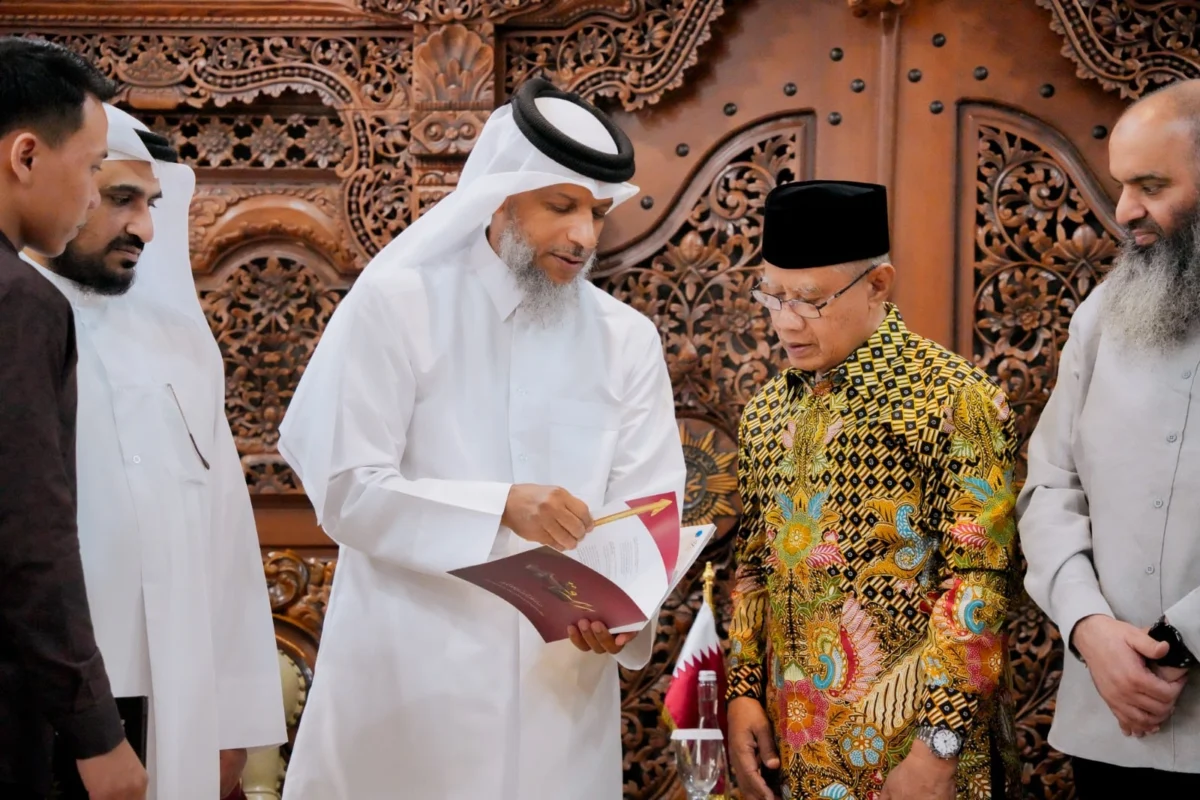
The diplomatic engagement materialized on a Tuesday, bringing together key decision-makers from both organizations. Representing the Qatari side was a delegation led by Sultan Saad Hassan Al-Badr, Assistant Director of the Sheikh Abdullah bin Zaid Al-Mahmoud Islamic Cultural Center, operating under the auspices of the Qatari Ministry of Endowments and Islamic Affairs. The delegation’s presence in Jakarta was part of a broader diplomatic and outreach mission directed by the Qatari ministry to introduce specialized Islamic programs, cultural initiatives, and institutional cooperation frameworks to major Islamic organizations across Indonesia.
On the host side, PP Muhammadiyah deployed its top leadership tier to receive the delegation, signaling the high institutional priority assigned to the visit. The meeting was chaired by PP Muhammadiyah General Chairperson Haedar Nashir, accompanied by prominent central board members, including Chairperson Anwar Abbas, Chairperson Agung Danarto, General Treasurer Hilman Latief, and Secretary Izzul Muslimin.
The discussions unfolded in an atmosphere of mutual respect and shared strategic vision. Following formal introductions, both delegations engaged in intensive sectoral talks, identifying tangible avenues where Qatari institutional expertise and funding mechanisms could synergize with Muhammadiyah’s vast domestic infrastructure, which encompasses thousands of educational institutions, hospitals, and social welfare centers across Indonesia.
Core Areas of Strategic Cooperation
The comprehensive agenda addressed during the Jakarta meeting encompassed several critical pillars designed to bolster institutional capacity, enhance human resource development, and enrich Islamic scholarship.
Arabic Language Proficiency and Educational Exchanges
A central focus of the deliberations was the establishment of robust programs aimed at enhancing Arabic language mastery among Indonesian students, educators, and religious preachers. Haedar Nashir highlighted that the Qatari government demonstrated profound openness toward facilitating intensive training sessions and scholarship pathways.
"Today we received the Qatari delegation from representatives of the Ministry of Endowments, and we discussed plans to foster cooperation in education, specifically regarding Arabic language mastery training programs for students, teachers, mubaligs [preachers], and others. The Qatari government is remarkably open to such initiatives," Haedar stated following the meeting.
Under the prospective framework, Qatari institutions—particularly cultural and educational centers managed by the Ministry of Endowments—will offer structured capacity-building programs. Opportunities will be made available for Muhammadiyah affiliates to nominate prospective participants, with coordination handled through the Embassy of Qatar in Jakarta. This initiative aims to bridge linguistic barriers and deepen engagement with classical and contemporary Arabic Islamic texts among Indonesia’s academic community.
Professionalization and Kaderisasi of Imams and Muazins
In addition to academic language training, the two delegations addressed the specialized training and cadre development (kaderisasi) of imams and muazins. Ensuring spiritual leadership of the highest caliber is a priority for both institutions. The Qatari representatives outlined specialized professionalization programs designed to equip religious leaders with advanced liturgical skills, pastoral care techniques, and contemporary community leadership methodologies. By aligning with Qatari initiatives, Muhammadiyah seeks to further elevate the standards of mosque administration and spiritual guidance within its extensive network of religious facilities nationwide.
Islamic Literature and Joint Publications
The dissemination of authentic, moderate Islamic literature also featured prominently in the talks. During the meeting, PP Muhammadiyah formally expressed its deep appreciation to the Qatari government for previous humanitarian and cultural contributions, notably the provision and distribution of standard copies of the Holy Quran (mushaf Al-Quran) that have already been systematically distributed across Jakarta and Yogyakarta.
Building upon this foundation, both parties explored prospects for joint publishing ventures. These initiatives would involve translating, printing, and distributing scholarly works that promote values of peace, tolerance, and civilizational progress—core tenets shared by both Muhammadiyah’s progressive Islamic philosophy and Qatari cultural diplomacy frameworks.
Expanding Horizons: Healthcare and Economic Partnerships
While the initial framework heavily emphasizes religious and educational cooperation, visionary leaders from Muhammadiyah pushed the boundaries of the partnership to include strategic economic and healthcare collaborations.
Anwar Abbas, a senior Chairperson of PP Muhammadiyah, articulated the organization’s aspiration to broaden the scope of bilateral engagements into health services and trade economics. Abbas emphasized the potential for establishing robust public-private partnerships with Qatari investors and philanthropic entities, pointing specifically to the ongoing modernization and expansion of Muhammadiyah’s extensive network of hospitals and clinics. Given Qatar’s advanced healthcare investments globally, such partnerships could introduce state-of-the-art medical technologies and management systems to Muhammadiyah health facilities, enhancing service delivery for the broader Indonesian public.
Institutional Continuity and Upcoming Missions
To ensure that the discussions do not remain merely conceptual, both organizations mapped out a clear timeline for subsequent operational meetings and reciprocal visits. A concrete milestone in this ongoing diplomatic exchange is the scheduled official visit of PP Muhammadiyah General Treasurer Hilman Latief to Qatar in early November.
Latief’s upcoming mission to Doha is designed to facilitate direct consultations with key Qatari philanthropic organizations, higher education institutions, Islamic endowment (waqf) boards, and international humanitarian agencies. This follow-up visit will serve to operationalize the agreements forged in Jakarta, laying the technical and financial groundwork for joint projects in education, economic development, and humanitarian aid.
Background Context: Muhammadiyah’s Global Diplomacy
Founded in 1912 by K.H. Ahmad Dahlan, Muhammadiyah stands as one of the world’s largest Islamic non-governmental organizations, boasting a membership of tens of millions and operating an unmatched infrastructure comprising over 160 universities, thousands of schools, hundreds of hospitals, and extensive orphanages across the Indonesian archipelago. Known for its progressive theological stance, commitment to modern education, and nationalist contributions, Muhammadiyah has increasingly engaged in international diplomacy to project moderate Indonesian Islamic values onto the global stage.
In recent years, the organization has actively cultivated strategic partnerships with governments and civil society organizations across the Middle East, Europe, and North America. Engagement with Gulf states like Qatar represents a calculated diplomatic effort to secure institutional support, financial partnerships for educational endowments, and collaborative platforms for international humanitarian interventions.
Analysis of Implications: Religious Diplomacy and Soft Power
The burgeoning partnership between Muhammadiyah and the Qatari Ministry of Endowments carries significant implications for regional and international Islamic affairs. From a geopolitical perspective, Qatar’s proactive outreach to mainstream, moderate organizations like Muhammadiyah reflects Doha’s broader soft-power strategy. By partnering with organizations that champion "Islam Berkemajuan" (Progressive Islam)—a theology that integrates Islamic values with modern science, democracy, and human rights—Qatar reinforces its diplomatic posture as a supporter of moderate, constructive institutional Islam in Southeast Asia.
Conversely, for Muhammadiyah, forging direct ties with Middle Eastern state ministries outside traditional diplomatic channels enhances its institutional autonomy and expands its global network. The ability to secure direct institutional funding, scholarship allocations, and technical expertise without relying solely on state-to-state bureaucratic pathways demonstrates the growing efficacy of civil society diplomacy.
Furthermore, the focus on Arabic language proficiency and literature publication addresses a persistent structural challenge within Indonesian Islamic education: the need for direct access to primary Arabic sources coupled with contemporary pedagogical methodologies. By embedding Qatari resources within Muhammadiyah’s extensive educational ecosystem, the initiative promises to produce a new generation of scholars and religious leaders who are both deeply rooted in classical Islamic tradition and fully conversant with contemporary global discourses.
As Hilman Latief prepares his delegation for the upcoming November mission to Doha, the international development community will be watching closely. If successfully executed, the Muhammadiyah-Qatar partnership could serve as a benchmark model for how national civil society organizations and Middle Eastern philanthropic-state bodies can collaborate effectively to foster educational advancement, economic resilience, and cross-cultural understanding.