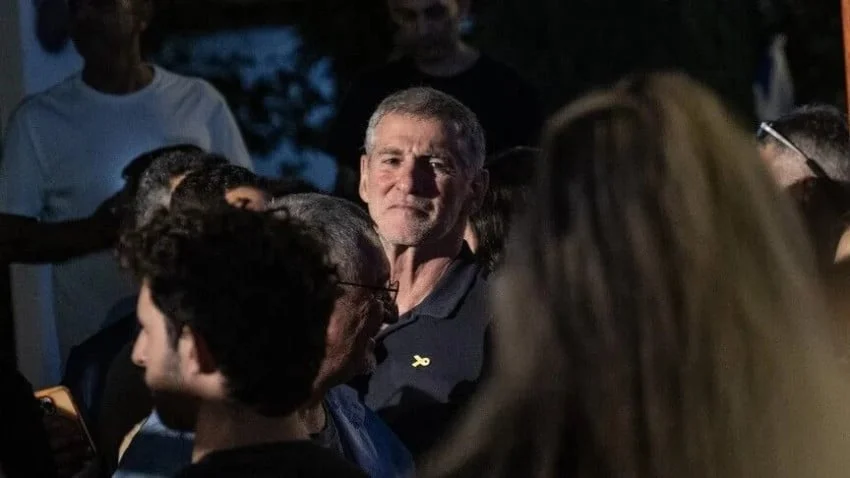
The political landscape in Israel faced a harrowing moment on Tuesday, October 27, 2026, when Yair Golan, the leader of the opposition Democratic Party, was targeted in an apparent assassination attempt while campaigning in Tel Aviv. The incident, which occurred at the bustling Railway Park, has sent shockwaves through the nation’s political establishment, raising urgent questions regarding the security of public officials and the volatile nature of the current political climate. According to reports from the Israeli newspaper Yedioth Ahronoth, local law enforcement apprehended an unidentified male suspect who was found to be carrying a large knife at the precise moment he approached the veteran politician.
The incident unfolded during a routine mobilization event intended to rally voters ahead of the upcoming election cycle. While Golan was engaging with supporters and local constituents, the suspect—described as wearing a jacket—began to close the distance toward the leader in a manner deemed threatening by those nearby. The swift reaction of Golan’s security detail prevented what could have been a catastrophic act of political violence. As the guards moved to intercept the individual, a large blade slipped from his clothing, confirming the severity of the threat. The suspect was promptly neutralized by the security team and subsequently handed over to the Israel Police for further interrogation.
Chronology of the Incident
The events of Tuesday afternoon highlight the fragility of public gatherings in an increasingly polarized Israel. Based on statements provided by the Democratic Party and local news reports, the timeline of the incident is as follows:
- 14:00 Local Time: Yair Golan arrives at Railway Park, Tel Aviv, to participate in a voter mobilization rally. The atmosphere is reported as being standard for a campaign stop, with supporters gathering around the candidate.
- 14:45 Local Time: An unidentified man, later described by witnesses as acting suspiciously, begins moving through the crowd toward the center of the event where Golan is positioned.
- 14:48 Local Time: Golan’s security detail identifies the man’s erratic movements and perceived aggressive posture. They move to physically block the individual from reaching the politician.
- 14:49 Local Time: During the physical confrontation between the guards and the suspect, a large knife falls from the suspect’s clothing, alerting the crowd and security to the presence of a lethal weapon.
- 14:50 Local Time: Security personnel successfully pin the suspect to the ground, neutralizing the immediate threat. No physical injuries are sustained by Golan or any bystanders.
- 15:15 Local Time: Israel Police arrive at the scene to take custody of the suspect. A preliminary investigation is launched.
Contextual Background: Yair Golan and the Israeli Political Arena
Yair Golan is a prominent figure in Israeli politics, known for his distinguished military career before transitioning into the legislative sphere. As a former Deputy Chief of Staff of the Israel Defense Forces (IDF), Golan has often occupied a vocal, and at times controversial, space on the left-wing spectrum of Israeli politics. His leadership of the Democratic Party has placed him in direct opposition to the current governing coalition.
The rise of the Democratic Party under Golan’s stewardship has been characterized by a platform emphasizing liberal democratic values, judicial independence, and a recalibration of national security priorities. However, his outspoken criticism of government policies has frequently made him a lightning rod for intense rhetoric. In the months leading up to the 2026 election, the political discourse in Israel has become increasingly acrimonious, with frequent demonstrations and counter-demonstrations taking place across major urban centers.
Political analysts note that the rise of "lone-wolf" threats against high-profile figures often mirrors the intensity of national debates. When societal fissures deepen, the risk of individuals acting on extremist impulses tends to increase. The attempt on Golan’s life is being viewed by many experts as a symptom of a broader breakdown in the civility of political discourse.
Security Protocols and Official Responses
Following the incident, the Democratic Party issued a formal statement expressing gratitude for the vigilance of the security detail. "The swift and professional intervention of the guards prevented a tragedy today," the statement read. "We are relieved that Yair Golan is safe, and we trust that the law enforcement authorities will conduct a thorough investigation to uncover the motives behind this act and identify any potential accomplices or radicalization networks involved."
The Israel Police have maintained a relatively reserved stance as the investigation continues. While they confirmed the arrest of the suspect, they have not yet disclosed the individual’s identity, political affiliations, or specific motivations. Standard procedure in such high-profile cases involves a deep forensic dive into the suspect’s digital history, social media presence, and associations with any extremist groups.
The lack of an immediate, official "terror" designation suggests that the police are currently weighing various possibilities, including the potential for the suspect to be suffering from mental health issues versus a politically motivated act of domestic terrorism. The public awaits further clarity from the Ministry of Public Security as the interrogation progresses.
Broader Implications for Israeli Democracy
The attempted attack has sparked a nationwide debate regarding the safety of democratic processes in Israel. Political violence is a sensitive subject in the country, given its history of assassinations that have fundamentally altered the course of its national policy. The specter of political violence brings back painful memories for the Israeli public, and there is a growing consensus among cross-party leaders that the current climate must be de-escalated.
Several members of the governing coalition have joined opposition figures in condemning the incident. In a rare show of unity, political rivals have issued statements affirming that violence has no place in the democratic process. Despite this outward display of solidarity, critics argue that the systemic rhetoric used by various political factions has created an environment where such attacks become statistically more likely.
Economically and socially, the stability of Israel is heavily dependent on the public’s perception of safety. If political rallies become perceived as inherently dangerous, the ability of candidates to engage with the electorate will be severely curtailed. This, in turn, could lead to a decline in voter turnout and a further erosion of the democratic mandate.
Analytical Overview: The Threat Landscape
The incident in Tel Aviv serves as a critical case study for security agencies tasked with protecting public figures. Modern protection details face a complex challenge: they must balance the need for accessibility—which is essential for democratic campaigning—with the reality of an increasingly unpredictable threat landscape.
- The Evolution of Threats: Traditional security models often focus on organized groups or known entities. However, the "lone-wolf" attacker, who operates without a clear network, presents a significantly more difficult detection challenge.
- The Role of Social Media: Radicalization often happens in echo chambers. Experts suggest that investigators will likely look into whether the suspect was influenced by inflammatory online content that targets Golan specifically.
- The Polarization Factor: Research into political violence consistently shows that as the gap between political ideologies widens, the propensity for violence among the fringes of those groups increases. The current political climate in Israel, marked by disputes over judicial reform, security, and socio-economic policies, provides a fertile ground for such tensions.
Looking Ahead
As the investigation into the attempted stabbing of Yair Golan proceeds, the focus will likely shift toward the security measures for upcoming campaign events. It is anticipated that the Israel Police will implement tighter perimeter controls at all future rallies, potentially involving increased use of metal detectors and more extensive screening of attendees.
For Yair Golan and the Democratic Party, the incident presents a difficult dilemma: how to continue their outreach and campaigning efforts without compromising their message or their safety. Golan has indicated that he intends to continue his campaign, stating that he will not be deterred by acts of intimidation. This resolve is typical of his background as a former military leader, yet the psychological toll of such an event on a candidate and their family cannot be overstated.
In conclusion, while the immediate physical threat was neutralized, the political fallout from the October 27 incident will be felt for some time. The event serves as a stark reminder of the responsibilities held by political leaders to maintain a measured tone and by the state to protect the fundamental pillars of democracy. As the investigation deepens, the nation looks toward the authorities for answers, hoping that this incident will serve as a wake-up call to prioritize safety and civic respect in the final stretch of the election season. The coming days will be crucial in determining whether this was an isolated act of a disturbed individual or a harbinger of a more turbulent period in Israeli political life.