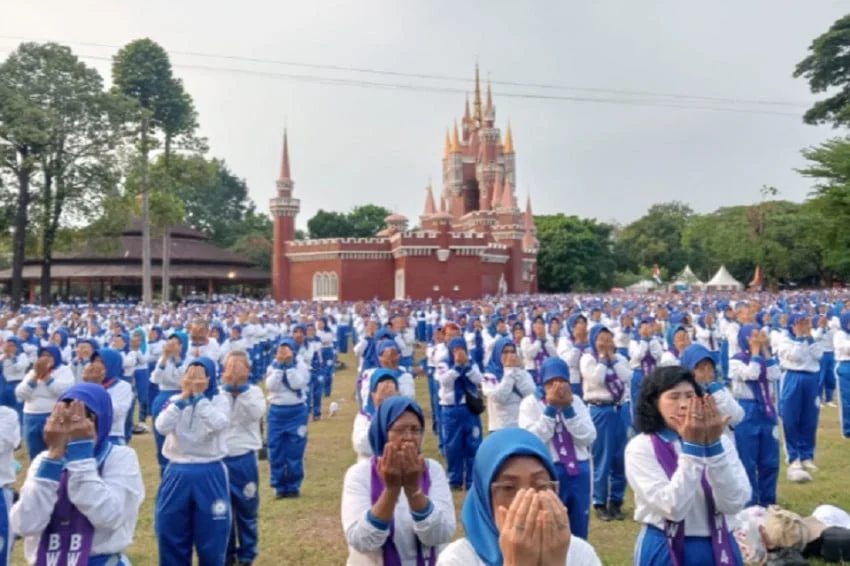
JAKARTA — The vibrant grounds of Taman Mini Indonesia Indah (TMII) in East Jakarta bore witness to an extraordinary gathering of health enthusiasts, practitioners, and senior citizens as more than 11,300 members of the Ling Tien Kung community converged from all corners of the Indonesian archipelago. The occasion marked the 21st anniversary of the founding of Ling Tien Kung, a unique therapeutic movement practice rooted in physical well-being, longevity, and self-healing. Beyond the celebratory atmosphere, the massive turnout underscored the profound nationwide reach and enduring popularity of a discipline that has quietly transformed the lives of tens of thousands of Indonesians over the past two decades.
The milestone event was not merely a moment for joyful reunion and communal reflection; it also served as the venue for the organization’s 4th National Coordination Meeting (Rapat Koordinasi Nasional, or Rakornas). This strategic assembly yielded critical resolutions aimed at institutionalizing the practice, safeguarding its core principles, and expanding its presence across Indonesia’s diverse provinces. By bringing together regional leaders, senior instructors, and dedicated practitioners, the anniversary celebration successfully bridged the gap between nostalgic commemoration and forward-looking organizational development.
A Historic Gathering of Practitioners Nationwide
The early morning hours at TMII saw an ocean of participants arriving in orderly groups, unified by their shared dedication to the principles of Ling Tien Kung. Representatives from Sumatra, Java, Kalimantan, Sulawesi, Bali, and Eastern Indonesia demonstrated the remarkable geographic dispersion of a movement that originated from humble beginnings. For many attendees, the journey to Jakarta was both a pilgrimage of gratitude and an opportunity to reconnect with fellow practitioners whom they had only known through regional training sessions.
The logistical coordination required to host over 11,300 individuals was substantial. Local chapter organizers, working in close collaboration with TMII management and security personnel, ensured that the massive assembly proceeded smoothly. Participants performed synchronized movement routines, filling the designated event areas with a palpable sense of harmony and collective focus. The visual spectacle of thousands of practitioners moving in unison served as a powerful testament to the discipline’s ability to foster social cohesion and mental clarity among individuals of varying ages, predominantly seniors seeking to maintain vitality in their golden years.
Chronology and Organizational Milestones: The Evolution of Ling Tien Kung
To understand the magnitude of the 21st-anniversary celebration, one must examine the trajectory of Ling Tien Kung from its inception to its current status as a nationally recognized health community.
The philosophy and physical movements of Ling Tien Kung were developed by the late Awiek Widjaja, affectionately known by practitioners as Lao Shi Awiek Widjaja. Seeking a natural method to combat the ailments of aging and restore optimal bodily function, the founder synthesized specific therapeutic movements designed to reactivate dormant physical energy, particularly focusing on the anal sphincter region and lower torso, which practitioners believe serve as the body’s primary gateway for vitality.
During its first decade, Ling Tien Kung grew largely through word-of-mouth in Surabaya and its surrounding areas in East Java. Informal training groups—often meeting in public parks, residential courtyards, and community halls—attracted retirees and individuals suffering from chronic joint pain, hypertension, and mobility issues who found relief through the practice.
As the healing testimonies multiplied, the need for formal structure became apparent. The establishment of the official Ling Tien Kung association marked a turning point, allowing for structured instruction, certified trainer programs, and standardized guidelines. Over the subsequent years, the community expanded beyond East Java, establishing vibrant chapters in Jakarta, West Java, Central Java, Bali, and major urban centers across the outer islands.
The milestone of the 21st anniversary reflects a two-decade journey of institutional maturation. From informal park gatherings to nationwide coordination meetings held at iconic venues like TMII, the organization has successfully transitioned from a localized grassroots healing method into a structured, well-governed national association.
Strategic Outcomes of the 4th National Coordination Meeting (Rakornas)
Concurrently with the anniversary celebrations, the 4th National Coordination Meeting addressed critical governance and operational challenges facing the organization. As Ling Tien Kung continues to attract new members, maintaining the integrity of its physical techniques has emerged as a top priority for the leadership.
The primary outcome of the Rakornas was the formal establishment of a standardized curriculum for basic-level movements. In the past, slight regional variations in instruction had begun to emerge as local chapters interpreted the founding teachings independently. The newly adopted standardization protocol ensures that whether a practitioner trains in Medan, Jakarta, Surabaya, or Makassar, the foundational exercises remain identical in form, intent, and execution. This uniformity is crucial for maintaining safety standards, preventing injury, and ensuring that certified instructors impart authentic methodologies.
Furthermore, the coordination meeting addressed administrative governance, membership database integration, and strategies for collaborating with local governments and public health agencies. By establishing clearer lines of communication between the central board and regional chapters, the organization aims to streamline event planning, facilitate knowledge sharing, and support newly established groups in remote regions.
Leadership Perspectives and Tributes to the Founder
Addressing the assembled masses, the General Chairman of the Indonesian Ling Tien Kung Association, retired Brigadier General Edy Prawoto, delivered a compelling address that balanced historical appreciation with strategic vision.
"The journey of 21 years of this organization has been profoundly marked by dedicated service, perseverance, shared struggles, and invaluable experiences that have shaped our development up to this very day," stated Edy Prawoto. He emphasized that the anniversary celebration transcends mere festivity, serving instead as a vital checkpoint for organizational evaluation and strategic pathfinding.
Edy also directed the audience’s attention to the foundational legacy of Awiek Widjaja, urging all members to honor the memory and vision of the creator. "We must continually remember and respect Awiek Widjaja as the founder and creator of Ling Tien Kung. It is my sincere hope that the spirit of togetherness and the core values passed down by our founder will forever remain safeguarded throughout our organizational journey," he added.
Echoing these sentiments, Shane Feldo Widjaja, serving as the Advisor to the Indonesian Ling Tien Kung Association, expressed profound gratitude to the thousands who traveled to make the event a historic success.
"We extend our deepest gratitude to all members who have attended today. Let us continuously strengthen our bonds of brotherhood, remain united, and walk together just as our beloved Lao Shi Awiek Widjaja always envisioned," Shane Feldo Widjaja remarked. His words struck a resonant chord with the audience, reinforcing the familial bonds that characterize the Ling Tien Kung community.
Broader Socio-Cultural Impact and Public Health Implications
The gathering at TMII highlights a broader, highly relevant socio-demographic trend in contemporary Indonesia: the active mobilization of the aging population toward preventative health and holistic wellness. With Indonesia experiencing a steady increase in life expectancy—projected to surpass 72 years—public health systems face mounting pressures related to non-communicable diseases, geriatric care, and the overall quality of life among senior citizens.
Grassroots wellness initiatives like Ling Tien Kung play a significant, albeit often underappreciated, role in alleviating the burden on the national healthcare system. By promoting daily physical activity, balance, social engagement, and mental resilience among older adults, such organizations contribute directly to active aging. Regular participation in group exercises mitigates social isolation—a critical psychological risk factor for the elderly—while encouraging self-care and discipline.
From a sociological perspective, the resilience of Ling Tien Kung over 21 years demonstrates the enduring appeal of community-based health models that integrate physical discipline with spiritual or philosophical camaraderie. Unlike commercialized fitness centers that often alienate older demographics, Ling Tien Kung provides an accessible, egalitarian environment where social status is checked at the park gate, and collective well-being takes precedence.
Future Outlook for the Ling Tien Kung Movement
As the 21st-anniversary celebration draws to a close and thousands of practitioners return to their respective hometowns, the leadership of the Ling Tien Kung Association faces a promising yet demanding future. The immediate task will be the rigorous implementation of the basic-level movement standardization agreed upon during the Rakornas. Regional trainers will undergo retraining to ensure seamless alignment with national guidelines.
Additionally, the association is exploring avenues to introduce the practice to younger demographics without diluting its core therapeutic philosophy. Engaging younger generations is viewed as essential for ensuring the long-term sustainability of the organization, even as its primary demographic remains older adults seeking restorative health solutions.
The historic assembly at Taman Mini Indonesia Indah has firmly established that Ling Tien Kung is not merely a passing wellness fad, but a resilient, well-organized national movement. Armed with renewed structural cohesion, standardized teaching methodologies, and an unwavering commitment to the vision of its founder, the association stands well-prepared to navigate its third decade of promoting health, unity, and vitality across the Indonesian archipelago.