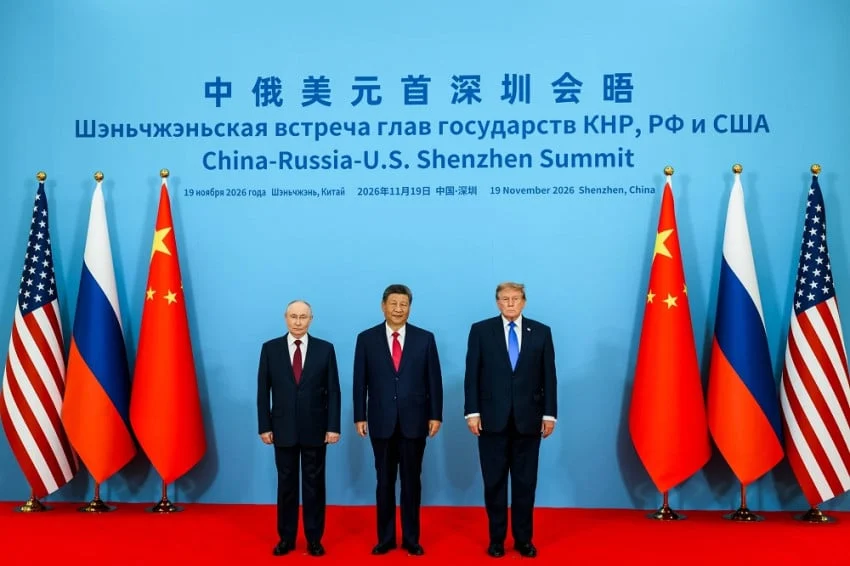
In a development that has sent ripples through the international diplomatic community, United States President Donald Trump has characterized his recent trilateral summit with Russian President Vladimir Putin and Chinese President Xi Jinping as a watershed moment in contemporary geopolitics. Following his return from the Asia-Pacific Economic Cooperation (APEC) summit in Shenzhen, President Trump articulated a vision of a new era defined by "fantastic" interpersonal relations between the world’s three preeminent superpowers. The meetings, which spanned four days, were positioned by the White House as a strategic pivot toward global stability, specifically addressing the existential anxieties surrounding nuclear proliferation and the risk of a third world war.
The diplomatic engagement in Shenzhen represents a significant departure from the cooling relations that have characterized the last decade of U.S.-Russia-China dynamics. As the global order shifts from a unipolar or bipolar framework toward a more complex trilateral reality, the implications of this summit are being scrutinized by policymakers, defense analysts, and global markets alike.
A New Framework for Global Governance
The APEC summit, traditionally focused on trade and economic integration, was effectively repurposed by the presence of the three leaders. While the summit hosted representatives from over 20 nations, President Trump noted that the periphery of the event was dominated by the trilateral interactions between Washington, Moscow, and Beijing. This structural shift underscores an uncomfortable reality for many smaller nations: the trajectory of global peace is increasingly dictated by the consensus—or lack thereof—between these three nuclear-armed powers.
During his post-summit press conference at the White House, President Trump emphasized that the chemistry between the three leaders was instrumental in moving beyond historical grievances. "The relationships among the three of us are fantastic," Trump stated, noting that the dialogue moved beyond superficial pleasantries to address the "shared responsibility" of preventing a nuclear catastrophe.
Chronology of the Diplomatic Breakthrough
The engagement in Shenzhen followed months of back-channel diplomacy aimed at de-escalating tensions that had reached a boiling point regarding the conflict in Ukraine and territorial disputes in the Indo-Pacific.
- Pre-Summit Negotiations (Late Summer): Diplomatic envoys from all three nations initiated a series of high-level meetings in neutral territories to establish an agenda that would prioritize nuclear risk reduction.
- Day 1-2 (The APEC Kickoff): Initial arrivals were marked by private bilateral meetings, with President Trump conducting preliminary talks with both President Putin and President Xi to gauge interest in a joint declaration.
- Day 3 (The Trilateral Summit): The historic trilateral session took place, focusing on the formation of a trilateral peace framework.
- Day 4 (Formalization): The issuance of the trilateral statement, which included commitments to expand hotlines between military commands and a pledge to adhere to international norms regarding territorial integrity.
Addressing the Ukraine Conflict: A Path to De-escalation
A central component of the discussions involved the ongoing conflict in Ukraine. For years, the U.S. and Russia have stood on opposite sides of this geopolitical divide, with China maintaining a position of "strategic neutrality." President Trump reported that his bilateral discussions with President Putin yielded a distinct shift in tone. According to the U.S. President, Moscow has signaled a newfound willingness to engage in a formal diplomatic process to reach a settlement.
While specific details of the proposed peace plan remain classified, reports suggest that the framework involves a multi-stage de-escalation process, the establishment of humanitarian corridors, and a long-term commitment to neutrality in the region. This development is significant, as it marks the first time since the inception of the conflict that all three major players have sat at the table to discuss a path forward that moves beyond military posturing.
Supporting Data and Geopolitical Context
To understand the weight of this meeting, one must look at the data regarding nuclear stockpiles and global defense spending. The United States, Russia, and China combined account for over 90% of the world’s nuclear warheads. According to the Federation of American Scientists, the current global inventory of nuclear weapons is estimated at approximately 12,500, with the vast majority held by these three nations.
Historically, periods of "fantastic" relations, as described by President Trump, have correlated with a reduction in global defense spending as a percentage of GDP. In the current fiscal climate, where the U.S. defense budget has hovered near $850 billion annually, any reduction in geopolitical friction could lead to significant budgetary reallocation. Furthermore, the global trade volume represented by the APEC nations accounts for roughly 60% of world GDP. A stable trilateral relationship provides the necessary security framework to bolster global supply chains, which have been severely strained by geopolitical volatility since 2020.
Official Responses and International Skepticism
While the tone from the White House is optimistic, international reactions remain guarded. European leaders have expressed a mixture of relief and concern—relief that the risk of nuclear escalation has been lowered, but concern that a trilateral arrangement might exclude the interests of smaller sovereign states.
Diplomatic analysts note that the success of this "trilateral peace" depends heavily on the internal political stability of the three nations. Critics of the agreement argue that verbal commitments are insufficient without robust, verifiable inspection mechanisms, particularly regarding nuclear arms. Furthermore, the history of broken treaties—such as the collapse of the INF Treaty—serves as a reminder that personal rapport between leaders does not always translate into long-term institutional stability.
"The summit is a necessary first step," said a senior fellow at a prominent Washington-based think tank. "However, the transition from ‘fantastic relationships’ to a sustainable architecture of global peace requires more than just a joint declaration. It requires a fundamental alignment of long-term strategic interests."
Implications for Future Global Stability
The primary question remains: does this rapprochement signal the end of the specter of World War III? By formalizing a trilateral dialogue, the leaders have created a "pressure relief valve." In the past, misunderstandings or miscalculations in the South China Sea or the Baltics could escalate rapidly due to a lack of direct, high-level communication. By establishing a framework for constant dialogue, the risk of a catastrophic accident is objectively lower.
However, the "Trilateral Declaration" is merely the beginning of a complex process. The coming months will be defined by follow-up meetings at the ministerial level to flesh out the technical details of the agreements on energy, Iran, and the Korean Peninsula. If these working groups can translate the leaders’ high-level rhetoric into policy, the global community may witness a period of unprecedented stability.
The Road Ahead
As the world watches the implementation of these agreements, the focus shifts to the upcoming G20 summit and subsequent international forums. The durability of the Trump-Putin-Xi alignment will be tested by domestic political pressures in all three capitals. For President Trump, the success of this mission provides a significant diplomatic victory as he seeks to reshape the U.S. role in global affairs. For Presidents Putin and Xi, the summit offers an opportunity to reintegrate their economies more deeply into the global system and stabilize their regional interests.
The "fantastic" nature of the meeting, while notable for its brevity and directness, underscores a return to a style of "great power diplomacy" that has been absent since the end of the Cold War. Whether this leads to a lasting peace or is merely a temporary pause in a long-term competition for global hegemony remains to be seen. What is clear, however, is that the strategic architecture of the 21st century is being rewritten in real-time, with Washington, Moscow, and Beijing firmly holding the pen.
In conclusion, the Shenzhen summit has undeniably shifted the global narrative. By prioritizing the prevention of nuclear war and the management of regional conflicts through direct trilateral coordination, the three superpowers have acknowledged that in an age of global interconnectedness, the costs of conflict are too high to sustain. The world now waits to see if these commitments will hold firm in the face of the inevitable geopolitical challenges that lie ahead.