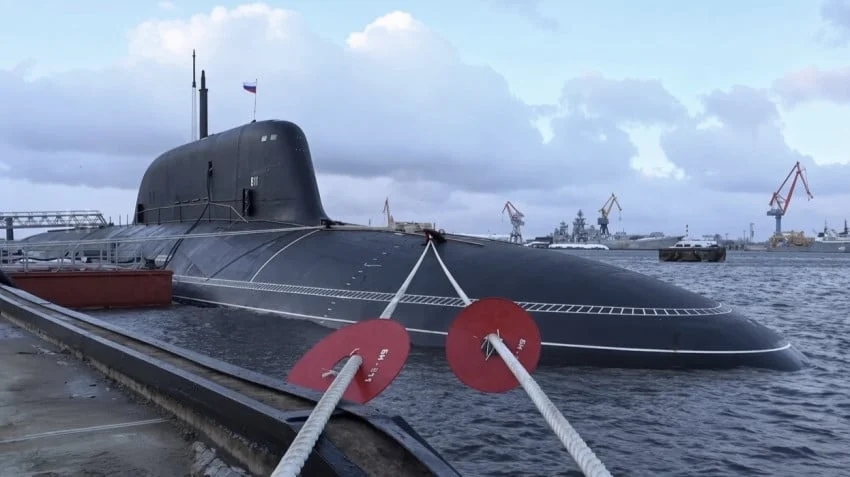
The Russian Federation has officially expanded its naval capabilities with the commissioning of the Perm, a cutting-edge, nuclear-powered attack submarine that distinguishes itself as the first of its class to carry the formidable Zircon hypersonic cruise missile as a standard component of its arsenal. The induction ceremony took place at the historic Sevmash shipyard situated in the northern Russian city of Severodvinsk. Russian President Vladimir Putin presided over the event, personally attending to witness the traditional raising of the naval flag aboard the vessel, a symbolic and official declaration of its operational readiness and entry into active military service.
The introduction of the Perm marks a significant technological milestone for the Russian Navy. By integrating ship-borne hypersonic capabilities directly into its standard nuclear submarine fleet, Moscow is signaling a profound shift in naval warfare tactics and strategic deterrence. As global powers increasingly compete for dominance in maritime chokepoints and polar regions, the deployment of the Perm underscores Russia’s persistent efforts to modernize its military hardware and project power far beyond its immediate coastal waters.
Main Facts of the Commissioning Ceremony
During the high-profile ceremony at the Sevmash shipbuilding facility, President Putin emphasized the technological prowess required to design and construct such an advanced vessel. He highlighted that Russia remains part of an elite group of nations possessing the industrial capacity, scientific infrastructure, and engineering expertise necessary to build nuclear-powered submarines capable of exerting global strategic significance.
The Perm belongs to the advanced Yasen-M class (also known as Project 885M), which represents an upgraded iteration of the original Yasen-class multi-role nuclear submarines. These vessels are globally recognized for their reduced acoustic signatures, advanced combat management systems, and versatile weapon payload configurations capable of targeting both land and maritime assets. The defining feature of the Perm, however, is its dedicated integration with the 3M22 Zircon hypersonic cruise missile system. This weapon is designed to travel at multiple times the speed of sound while maintaining high maneuverability, making it exceptionally difficult for modern integrated air defense and missile shield systems to intercept.
Chronology and Development Timeline of the Perm
The journey of the Perm from a blueprint concept to an operational naval asset spans nearly a decade, reflecting the complex and meticulous nature of modern nuclear submarine construction. The developmental chronology underscores the sustained investment Russia has channeled into its defense sector despite broader economic headwinds and international sanctions.
- July 2016: Official steel-cutting and keel-laying ceremony for the Perm takes place at the Sevmash shipyard, marking the physical beginning of construction for the sixth hull in the Yasen/Yasen-M program and the fifth specifically of the modernized Yasen-M variant.
- March 2023: The submarine is officially rolled out of the construction hall and floated out into the water during a grand launch ceremony, transitioning from assembly to the waterborne phase of its lifecycle.
- 2023–2025: The vessel undergoes an extensive and rigorous series of dockside trials, basin tests, and open-ocean sea trials. These evaluations test the nuclear reactor’s performance, hull integrity at depth, electronic warfare suites, navigation systems, and live-firing protocols for its integrated weaponry, including the Zircon hypersonic missile system.
- Late 2024 / Early 2025: The Perm successfully concludes all state and acceptance trials, clearing the final administrative and technical hurdles required for military service.
- Current Date: President Putin officially commissions the vessel at Sevmash, ordering the hoisting of the St. Andrew’s flag and formally assigning the submarine to the Russian Navy’s Pacific Fleet.
Strategic Deployment and Geographic Significance
Following its commissioning, the Perm has been designated to join the Russian Navy’s Pacific Fleet. This strategic assignment highlights Moscow’s growing focus on the Asia-Pacific theater and the Arctic region, both of which are central to the country’s long-term geopolitical and economic calculations.
President Putin explicitly noted during his address that the submarine will operate out of the Far East to protect national interests across the eastern maritime approaches, the increasingly contested Arctic shipping routes, and the broader sovereign borders of the Russian Federation. The Arctic, in particular, has transformed into a major arena of geopolitical competition due to retreating ice caps that uncover new commercial sea lanes and vast untapped natural resource reserves, including oil, natural gas, and rare minerals. A nuclear-powered submarine capable of operating covertly beneath polar ice sheets provides Moscow with an enduring strategic asset to assert sovereignty and secure these northern maritime domains.
Furthermore, the Yasen-M class vessels are engineered to serve as multi-role platforms. While traditional attack submarines primarily focus on anti-submarine warfare (ASW) and anti-surface warfare (ASuW), the Yasen-M design incorporates vertical launch system (VLS) silos capable of deploying long-range cruise missiles such as the Kalibr and Oniks, alongside the newly integrated Zircon. This dual capability allows the Perm to execute precision strikes against strategic land infrastructure deep within enemy territory, as well as hunt down hostile carrier strike groups and adversary submarines.
Supporting Data and the Broader Yasen-M Program
The Perm is not an isolated achievement but rather part of a broader, methodical modernization plan for the Russian underwater fleet. Over the past six years, the Sevmash enterprise and associated defense contractors have steadily accelerated the delivery schedule of advanced nuclear submarines to replace aging Soviet-era hulls that have neared the end of their operational lifespans.
According to statements released by Russian state leadership and defense ministry officials, the Perm is the fifth Yasen-M class submarine to be handed over to the Navy within a compressed timeframe. The industrial roadmap indicates that Russia intends to maintain this production tempo. President Putin confirmed that an additional five submarines—including three more Yasen-M variants alongside other strategic missile-carrying platforms—are scheduled for delivery to the Russian Navy no later than 2030.
This sustained production rate demonstrates the resilience of Russia’s defense-industrial base, which has managed to secure domestic supply chains for critical components, advanced metallurgy, electronics, and nuclear propulsion systems despite sweeping Western technology embargoes and financial restrictions implemented following the escalation of the conflict in Ukraine.
Technical Profile of the Zircon Hypersonic Missile Integration
The integration of the Zircon hypersonic cruise missile onto a nuclear-powered submarine platform represents a tactical evolution in modern naval warfare. While surface ships and land-based batteries have previously tested and deployed the Zircon system, its adaptation for subsurface launch from a Yasen-M platform introduces unique engineering and operational challenges.
Submarine-launched hypersonic missiles require robust ejection mechanisms, precise guidance handoffs upon clearing the water surface, and rapid booster ignition to transition into hypersonic flight regimes. The Zircon missile itself is reported by Russian defense sources to achieve speeds ranging from Mach 6 to Mach 9, with an operational range exceeding 500 to 1,000 kilometers, depending on the flight profile and target parameters.
The combination of a quiet, nuclear-powered platform like the Perm—which can approach adversary coastlines or naval formations undetected—and a hypersonic missile that drastically reduces warning times creates a formidable deterrent posture. Because hypersonic weapons fly within the upper atmosphere at extreme velocities and unpredictable trajectories, traditional radar systems designed to track ballistic missiles or subsonic cruise missiles face severe detection and interception hurdles. This capability effectively complicates the defensive calculations of any potential adversary operating naval forces within the operational radius of the Pacific Fleet.
Official Responses and International Implications
While Western defense analysts and military planners have closely monitored the progression of Russia’s hypersonic weapons program, the official Western response to the commissioning of the Perm has centered on vigilance, deterrence, and the acceleration of counter-hypersonic research.
NATO and allied Pacific nations—including the United States, Japan, and Australia—view the deployment of nuclear submarines armed with hypersonic missiles in the Pacific and Arctic theaters as a notable development in the regional security architecture. Naval strategists point out that the expansion of Russia’s subsurface fleet increases the complexity of anti-submarine warfare operations for allied navies in the Indo-Pacific. The ability of modern Russian attack submarines to remain submerged indefinitely, coupled with long-range strike options, necessitates continuous improvements in acoustic surveillance networks, space-based early-warning architecture, and layered naval air defense systems.
Conversely, Russian military leadership frames the modernization of the fleet strictly through the lens of strategic defense and parity. Moscow maintains that the introduction of advanced weapon systems is necessary to maintain global strategic stability in the face of expanding global missile defense networks and the forward deployment of allied military assets near Russian borders. By continuously upgrading naval platforms, Russia seeks to ensure that its sea-based nuclear and conventional deterrence remains credible, flexible, and capable of operating contested environments.
Future Outlook for Russian Naval Modernization
Looking ahead toward the close of the decade, the operational integration of the Perm will serve as a testing ground for future tactics involving submarine-based hypersonic warfare. The lessons learned from the deployment of the Perm will likely influence the operational doctrines of the remaining Yasen-M submarines currently under construction at Sevmash.
As the Russian Navy works toward its 2030 target for the delivery of additional strategic subsurface platforms, the balance of naval power in both the Arctic and the Pacific will remain a focal point of international security discussions. The commissioning of the Perm is not merely a ceremonial milestone for the Russian defense sector; it is a clear indicator of the technological trajectory defining modern naval competition among major global powers, where speed, stealth, and precision strike capabilities dictate the future of maritime dominance.