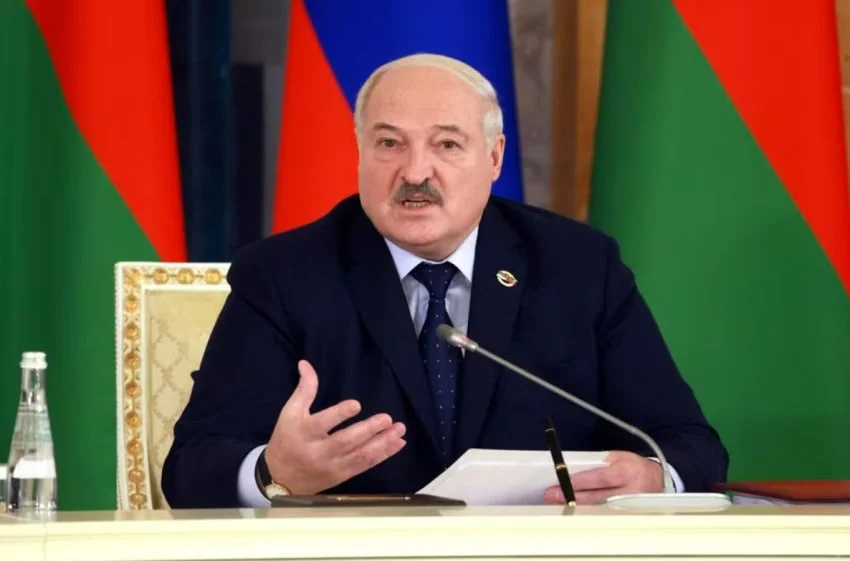
In a striking departure from the standard rhetoric shared between the Kremlin and its closest regional ally, Belarusian President Alexander Lukashenko has publicly scrutinized the historical justifications used by Vladimir Putin to initiate the full-scale invasion of Ukraine. In a wide-ranging interview with the French publication Le Point, the long-time Belarusian leader challenged the Kremlin’s narrative that historical ties to the medieval state of Kyivan Rus provide a legitimate legal or moral basis for territorial annexation. By drawing a sharp analogy to the Mongol Empire’s historical dominion over Russian lands, Lukashenko has introduced a rare note of public dissonance into the relationship between Moscow and Minsk.
The Historical Revisionism Debate
The ideological foundation for the Kremlin’s "Special Military Operation" has consistently relied on the assertion that Ukraine lacks legitimate statehood, a claim frequently articulated by President Putin in essays and speeches. Putin has argued that Russians and Ukrainians are "one people" and that the formation of the Ukrainian state was an artificial construct of the Soviet era. Central to this argument is the historical significance of Kyivan Rus, a federation of East Slavic tribes that existed from the 9th to the 13th centuries. The Kremlin claims that since the historical capital of this federation was Kyiv, the modern Russian state is its sole rightful successor.
Historians and political analysts in the West have long characterized these assertions as a form of weaponized historical revisionism. They argue that the geopolitical realities of the 21st century cannot be dictated by the borders of medieval entities. However, the significance of Lukashenko’s recent comments lies in the source; as the primary political and military partner of Moscow, Belarus has served as a staging ground for Russian forces since February 2022. For the leader of a state that is deeply integrated into the Union State with Russia to openly mock the Kremlin’s historical logic marks a significant shift in diplomatic discourse.
The Mongol Analogy and Its Implications
During the interview with Le Point, Lukashenko attempted to dismantle the Kremlin’s logic by applying it to a different historical epoch. "If we follow the argument that territory belongs to Russia because it was part of a historical state, then we must look at the Mongol-Tatar Yoke," Lukashenko noted. He argued that if historical precedent dictated current borders, then much of modern Russia would technically fall under the claim of Mongolia, given the Golden Horde’s extensive control over the Russian principalities for centuries.
This statement, while delivered in the context of an interview that remained largely supportive of Moscow’s geopolitical stance, serves as a profound critique of the "historical rights" doctrine. By framing the argument as an absurdity, Lukashenko is effectively signaling that while he remains a political ally, he is unwilling to fully embrace the ideological extremes of Putin’s historical crusade. Analysts suggest that this might be a calculated effort by Lukashenko to maintain a degree of maneuverability on the international stage, particularly as Belarus faces unprecedented sanctions and isolation alongside its Russian partner.
Chronology of Tensions and Alliances
To understand the gravity of these remarks, one must view them through the timeline of the ongoing conflict and the deepening integration of Belarus into Russia’s strategic sphere.
- February 2022: Belarus serves as a primary staging ground for Russian troops invading northern Ukraine, specifically in the push toward Kyiv.
- March 2022: International sanctions against Belarus intensify as the West views Minsk as a co-belligerent in the invasion.
- 2023: Russia announces the deployment of tactical nuclear weapons to Belarusian territory, further binding the two nations’ defense architectures.
- 2024: Lukashenko’s rhetoric begins to show subtle signs of divergence, emphasizing the need for peace negotiations while maintaining public loyalty to Putin.
The relationship between the two leaders has historically been transactional. Lukashenko has often played the role of a bridge between East and West, though he has become increasingly dependent on Moscow for economic survival following the 2020 Belarusian protests, which were suppressed with strong Russian backing.
Data and Geopolitical Reality
The economic dependence of Belarus on Russia is stark. Data from the World Bank and the Eurasian Economic Commission indicates that over 50% of Belarus’s foreign trade is conducted with Russia. Furthermore, the Russian military presence in Belarus—facilitated by joint military drills and the stationing of personnel—has transformed the country into a strategic buffer zone for the Kremlin.
Despite this, the demographic and social reality in Belarus is more complex. While the state apparatus is aligned with Moscow, public sentiment regarding the war in Ukraine has remained largely cautious. Lukashenko is acutely aware of the potential for internal instability, which explains why he has avoided committing the Belarusian military to direct combat inside Ukraine despite repeated pressure from certain factions within the Kremlin.
Official Responses and Diplomatic Friction
While the Kremlin has not issued a formal rebuttal to Lukashenko’s comments, silence from the Russian Foreign Ministry is often interpreted as a sign of underlying friction. Observers note that Putin views himself as a student of history, and challenges to his historical interpretations are often taken personally. By labeling Putin a "clever and smart politician" in the same interview, Lukashenko attempted to soften the blow of his critique, likely hoping to avoid a diplomatic rupture that Belarus cannot currently afford.
However, the damage to the narrative cohesion of the "Special Military Operation" is tangible. When the most important ally of a state questions the very premise of that state’s military actions, it weakens the ideological credibility of the campaign. For Ukraine and its Western partners, these comments are a clear indicator that the Kremlin’s narrative is not universally accepted, even among those closest to the decision-making table in Moscow.
Broader Impact and Future Outlook
The implications of this discourse extend beyond mere rhetorical disagreements. As the war of attrition continues, the ideological justifications for the conflict will likely be tested further. If leaders within the Russian sphere of influence begin to question the foundational myths of the war, the Kremlin may find it increasingly difficult to sustain public support for a prolonged conflict.
Furthermore, this development highlights the complexity of the "Union State" relationship. Lukashenko is a survivor; he has navigated decades of geopolitical shifts by balancing between East and West. By injecting a note of skepticism into his public statements, he may be preparing for a post-conflict scenario where Russia is significantly weakened. If the historical justification for the war is seen as flawed, it becomes easier for smaller states in the region to eventually distance themselves from the fallout of the invasion.
In conclusion, while Lukashenko remains the most reliable regional ally of Vladimir Putin, his questioning of the historical logic behind the war in Ukraine represents a significant fracture in the monolithic narrative the Kremlin has sought to project. Whether this is a momentary lapse in discipline or a strategic pivot, it underscores the precarious nature of the Russia-Belarus alliance. As the geopolitical landscape continues to evolve, the adherence to these historical myths will remain a central point of contention, not just between Russia and the West, but within the very alliances the Kremlin relies upon to maintain its influence. The historical revisionism that served to ignite the conflict is now beginning to be used by its own architects’ allies as a tool to distance themselves from the consequences of that ideology.