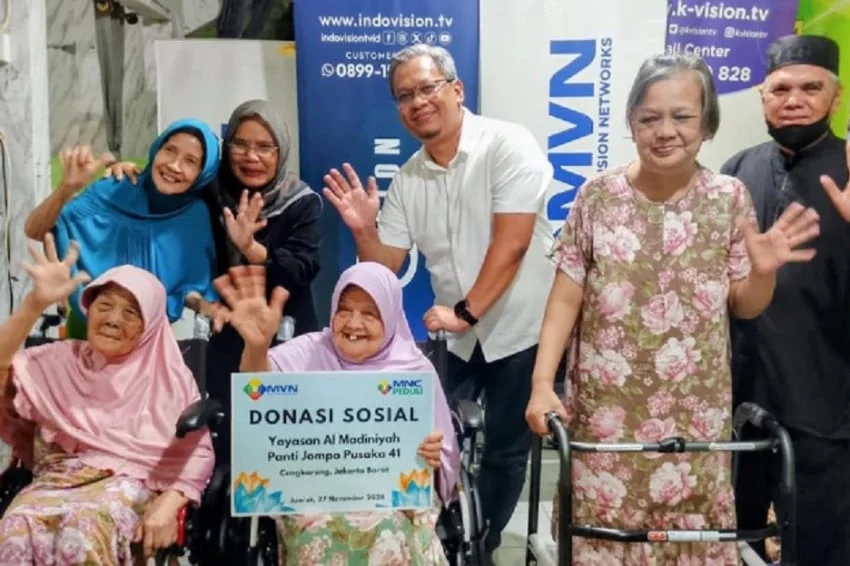
The commitment to social welfare and elderly care in West Jakarta received a significant boost on Friday, November 27, 2026, as PT MNC Vision Networks Tbk, operating under the philanthropic arm of MNC Peduli, successfully delivered a donation of mobility equipment to Panti Jompo Pusaka 41. The facility, managed by Yayasan Al-Madiniyah in Cengkareng, serves as a vital sanctuary for elderly residents who often face physical limitations that restrict their daily independence. The handover ceremony, which took place at the facility’s premises, included the provision of six high-quality wheelchairs and six walker aids, items specifically selected to address the urgent mobility requirements of the residents.
Strengthening Institutional Support for the Elderly
The event was marked by a symbolic handover ceremony attended by the leadership of both organizations. Ferry Aryanto, representing PT MNC Vision Networks Tbk, personally presented the aid to Iis Ismawati, the head and proprietor of Panti Jompo Pusaka 41. This initiative is part of a broader corporate social responsibility (CSR) strategy aimed at improving the quality of life for vulnerable groups in urban environments.
For many nursing homes in the Greater Jakarta area, the procurement of medical-grade mobility aids remains a persistent challenge. Limited operational budgets often prioritize nutritional and medical needs, leaving equipment maintenance or replacement as a secondary concern. By directly supplying durable mobility aids, MNC Peduli aims to alleviate this operational burden, allowing the foundation to reallocate its limited financial resources toward other critical areas such as healthcare monitoring and nutritional support.
The Critical Need for Mobility Aids in Aging Populations
The aging process is often accompanied by a decline in musculoskeletal strength, balance, and coordination. For the elderly, the inability to move freely—whether to access dining areas, communal spaces, or medical facilities—can lead to severe social isolation and a decline in mental well-being. According to health experts, access to mobility aids such as walkers and wheelchairs is not merely about physical transportation; it is a fundamental factor in maintaining the dignity and psychological health of the elderly.
Iis Ismawati emphasized that the donation arrived at a critical juncture. "This is truly extraordinary because the donation is long-term. These items are durable, and as our residents pass away, these tools can be rotated and utilized by new residents who enter our care. It perfectly matches the current, pressing needs of our facility," she stated during the event. She further elaborated that the scarcity of such equipment had previously hindered the daily activities of the residents, making it difficult for caregivers to provide the necessary mobility support during routine daily tasks.
Corporate Social Responsibility and the MNC Peduli Mission
MNC Peduli has established itself as a recurring participant in community development across Indonesia. Through its various pillars of action—which include health, education, and social development—the organization seeks to foster sustainable impacts rather than providing short-term relief. The collaboration with Panti Jompo Pusaka 41 is a reflection of this ethos. By targeting the specific logistical gaps within the foundation, MNC Peduli is addressing the "micro-needs" that often go overlooked by larger governmental assistance programs.
The selection of Cengkareng, a densely populated area in West Jakarta, as the site for this initiative reflects a strategic focus on urban social welfare. High-density urban zones often feature facilities that operate under significant strain due to the high volume of individuals in need of care. By providing aid in these specific locations, the impact of the donation is maximized, reaching a high number of beneficiaries in a concentrated environment.
Chronology of the Initiative
The preparation for this donation began several weeks prior to the handover on November 27, 2026. Following an assessment of the facility’s needs by the CSR team at MNC Vision Networks, the organization identified that mobility was the primary pain point for the residents. The procurement process prioritized durability and safety, ensuring that the equipment met health standards appropriate for geriatric use. The logistical coordination ensured that the equipment was ready for immediate use upon arrival, minimizing the downtime between the identification of the need and the fulfillment of the solution.
Data-Driven Analysis of Elderly Care Challenges
The necessity for such private-sector intervention is supported by broader demographic data. Indonesia is currently experiencing a demographic shift, with the percentage of the elderly population steadily increasing. According to national statistical data, the dependency ratio—the ratio of those typically not in the labor force (the young and the elderly) to those in the labor force—is shifting as the population ages. This creates an increased demand for geriatric care facilities.
However, the supply of high-quality nursing homes and support facilities has not scaled at the same rate as the population growth. Consequently, independent foundations like Yayasan Al-Madiniyah are tasked with filling a significant gap in social services. Private sector participation, such as that demonstrated by PT MNC Vision Networks Tbk, acts as an essential buffer, providing the capital and logistical support required to maintain standard care levels in a sector that is frequently underfunded.
Impact and Future Implications
The long-term impact of this donation extends beyond the immediate provision of six wheelchairs and six walkers. By improving the mobility of the residents, the foundation can facilitate better engagement programs, such as group exercises, social interactions in common areas, and easier access to medical examinations. When residents are mobile, their overall health outcomes tend to improve due to increased physical activity and reduced risk of complications related to prolonged bed rest, such as muscle atrophy or pressure ulcers.
Furthermore, this act of philanthropy sets a precedent for other corporations operating in the telecommunications and infrastructure sectors. It highlights the importance of localized CSR efforts that respond directly to the community’s requirements rather than engaging in broad, abstract social initiatives. The transparency of the process, coupled with the clear, measurable outcome (the specific number of tools provided), serves as a model for effective corporate giving.
Reflections from the Ground
The sentiment expressed by the management at Panti Jompo Pusaka 41 serves as a testament to the emotional and physical relief provided by the donation. The phrase "this supports our grandmothers to want to live longer" captures the essence of the intervention—hope. Providing the elderly with the means to move independently provides them with a sense of agency, which is often lost in institutional settings.
Looking ahead, the collaboration between private entities and non-profit care foundations is likely to remain a cornerstone of social welfare in Indonesia. As the government continues to work on expanding healthcare coverage, the role of corporate entities in supplying physical infrastructure and specialized equipment will remain vital. The success of the November 27 event underscores the effectiveness of direct, need-based support, proving that small-scale, targeted investments can produce profound improvements in the lives of the most vulnerable members of society.
In conclusion, the initiative undertaken by PT MNC Vision Networks Tbk at Panti Jompo Pusaka 41 is more than a routine CSR activity; it is a vital contribution to the logistical framework of geriatric care. By addressing the mobility needs of the residents, the organization has demonstrated a commitment to tangible, sustainable social impact. As the foundation continues its mission, the newly provided equipment will serve as a permanent asset, ensuring that the elderly residents of Cengkareng can navigate their daily lives with greater ease, dignity, and independence. The event stands as a clear example of how corporate resources can be effectively utilized to solve specific, pressing social challenges, fostering a healthier and more supportive environment for the nation’s aging population.