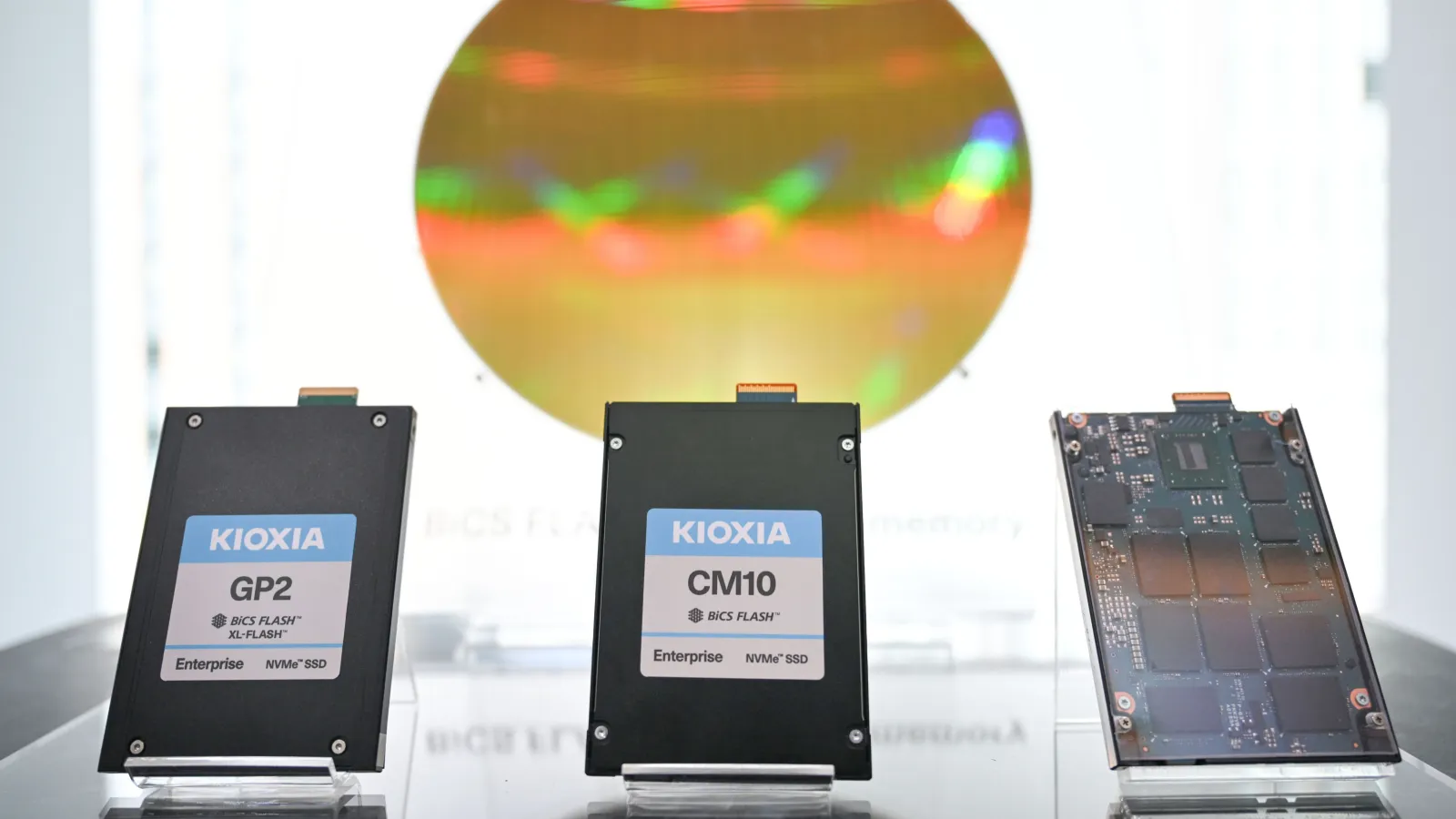
The exponential growth of artificial intelligence models, particularly large language models (LLMs) and complex machine learning architectures, has introduced a critical hardware bottleneck: GPU memory capacity. As training datasets and parameter counts swell into the hundreds of billions, even the most advanced Graphics Processing Units struggle to house entire models and datasets within their native High Bandwidth Memory (HBM). To circumvent this physical limitation, memory and storage manufacturer Kioxia has teamed up with computing giant NVIDIA to pioneer an innovative architectural approach. By leveraging ultra-high-performance NVMe Solid-State Drives, the collaboration aims to expand the effective memory capacity of enterprise-grade GPUs to a staggering petabyte scale, fundamentally reshaping how high-performance computing clusters handle massive data workloads.
Understanding the Memory Bottleneck in Modern AI Workloads
For years, High Bandwidth Memory has served as the gold standard for GPUs, offering unmatched data transfer speeds necessary to keep high-speed parallel processors fed with information. However, HBM is inherently expensive to manufacture, physically constrained by space limitations on the silicon interposer, and limited in total capacity compared to traditional system RAM or storage drives. When an AI training or inference task requires processing datasets that dwarf the available HBM, systems often suffer from severe performance degradation. Data must be constantly swapped back and forth between the host system and the accelerator, creating a massive I/O bottleneck that leaves expensive GPU cores sitting idle.
To resolve this challenge, Kioxia and NVIDIA have focused on bridging the latency gap between high-speed GPU accelerators and persistent storage. Rather than relying solely on traditional memory hierarchies, the two companies are developing a specialized ecosystem where high-capacity storage can act as a seamless extension of the GPU memory space. This approach promises to alleviate the physical memory ceiling that currently constrains researchers and enterprise data centers.
The Technological Framework: NVIDIA SCADA and Storage-Next
At the core of this joint initiative is the integration of NVIDIA’s cutting-edge software and hardware frameworks, specifically Scaled Accelerated Data Access (SCADA) and Storage-Next, combined with Kioxia’s enterprise-class NVMe SSD technology. This specialized software-hardware stack is engineered to allow GPUs to directly access and manipulate data stored on high-speed SSDs with minimal CPU intervention and ultra-low latency.
Crucially, the architecture is optimized for handling random access patterns and small block sizes—operations that traditionally cripple standard storage devices when subjected to the rigorous demands of parallel computing. By streamlining the data pathway from flash storage directly to the accelerator, the system ensures that large-scale AI datasets can be processed fluidly without forcing developers to downscale their models or compromise on dataset fidelity.
Industry observers have noted conceptual parallels between this new architecture and familiar operating system mechanisms, such as the Windows Page File or Linux swap space, which temporarily utilize storage drives as overflow memory when physical RAM is exhausted. However, industry engineers emphasize that the Kioxia and NVIDIA implementation operates on an entirely different scale. Designed for enterprise data centers and server clusters, this system delivers throughput, parallelism, and latency reduction that far exceed traditional consumer-grade virtual memory solutions.
Proof of Concept: Inside the NVIDIA GB200 NVL72 Testbed
To demonstrate the viability of this ambitious concept, Kioxia and NVIDIA deployed a rigorous proof-of-concept configuration utilizing state-of-the-art enterprise hardware. The testing environment was anchored by the NVIDIA GB200 NVL72 system, an advanced architecture comprising 18 interconnected server nodes designed for intensive AI and high-performance computing (HPC) workloads.
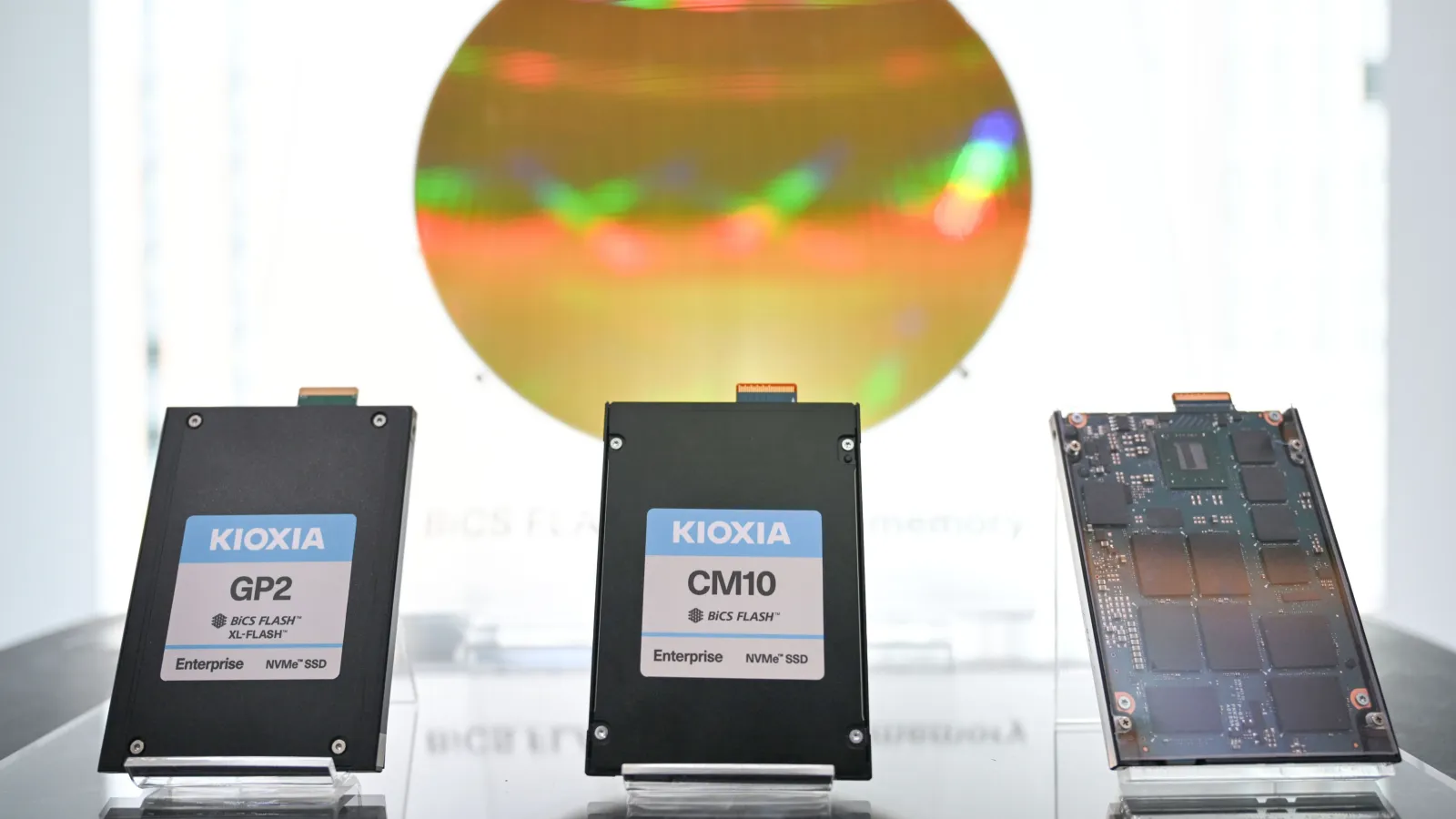
Integrated into this multi-node environment were 144 units of Kioxia XD8 Series NVMe SSDs, with each drive offering a capacity of 7.68 terabytes. This dense storage array yielded a cumulative raw storage capacity of approximately 1.1 petabytes across the cluster. When translated to architectural utility, this configuration successfully provided nearly 60 terabytes of additional flash-based memory capacity dedicated to each individual server node, creating a massive tiered memory pool accessible by the system’s GPUs.
Target Applications: Tackling Massive Databases and Graph Neural Networks
The primary objective of expanding effective GPU memory to a petabyte scale is to unlock new classes of computational workloads that were previously hindered by hardware constraints. In their initial testing phases, Kioxia and NVIDIA specifically targeted the processing of database systems containing up to two trillion vectors, with each vector sized at 512 bytes.
This capability is critically important for several emerging technological fields, most notably vector databases used in advanced semantic search, retrieval-augmented generation (RAG) systems, and recommendation engines. Furthermore, the architecture holds significant promise for Graph Neural Networks (GNNs), which are heavily utilized in molecular modeling, financial fraud detection, and social network analysis. GNNs notoriously struggle with memory management due to the interconnected nature of their datasets, making a petabyte-scale memory pool a potential game-changer for researchers in these domains.
Current Status and Commercialization Outlook
Despite the promising technical achievements demonstrated in the proof-of-concept phase, both Kioxia and NVIDIA have maintained a measured approach regarding commercial deployment. The current initiatives remain in the evaluation and research stage, with engineers and product strategists rigorously assessing long-term durability, thermal performance, sustained I/O latency, and software ecosystem compatibility.
Because enterprise AI infrastructure demands absolute reliability and predictable performance under continuous load, transitioning this technology from a laboratory proof-of-concept to a commercially viable product will require extensive refinement. Industry analysts expect that while initial pilot deployments could appear in specialized research institutions or hyperscale cloud providers within the next few years, widespread commercial availability will depend heavily on the evolution of both PCIe standards and enterprise flash durability metrics.
Broader Implications for the AI Hardware Market
The collaboration between Kioxia and NVIDIA highlights a broader shift in the artificial intelligence hardware landscape. As the physical and economic limits of scaling HBM become increasingly apparent, the industry is looking beyond traditional silicon boundaries toward heterogenous computing models. By blurring the line between storage and memory, hardware manufacturers are discovering innovative ways to sustain the relentless scaling demands of modern artificial intelligence.
If successful, this architectural paradigm could democratize access to massive AI training capabilities, allowing smaller organizations to train and deploy trillion-parameter models without requiring prohibitively expensive clusters of HBM-heavy accelerators. As Kioxia and NVIDIA continue to refine their joint solutions, the enterprise hardware sector moves one step closer to solving the memory wall, paving the way for the next generation of artificial intelligence advancement.