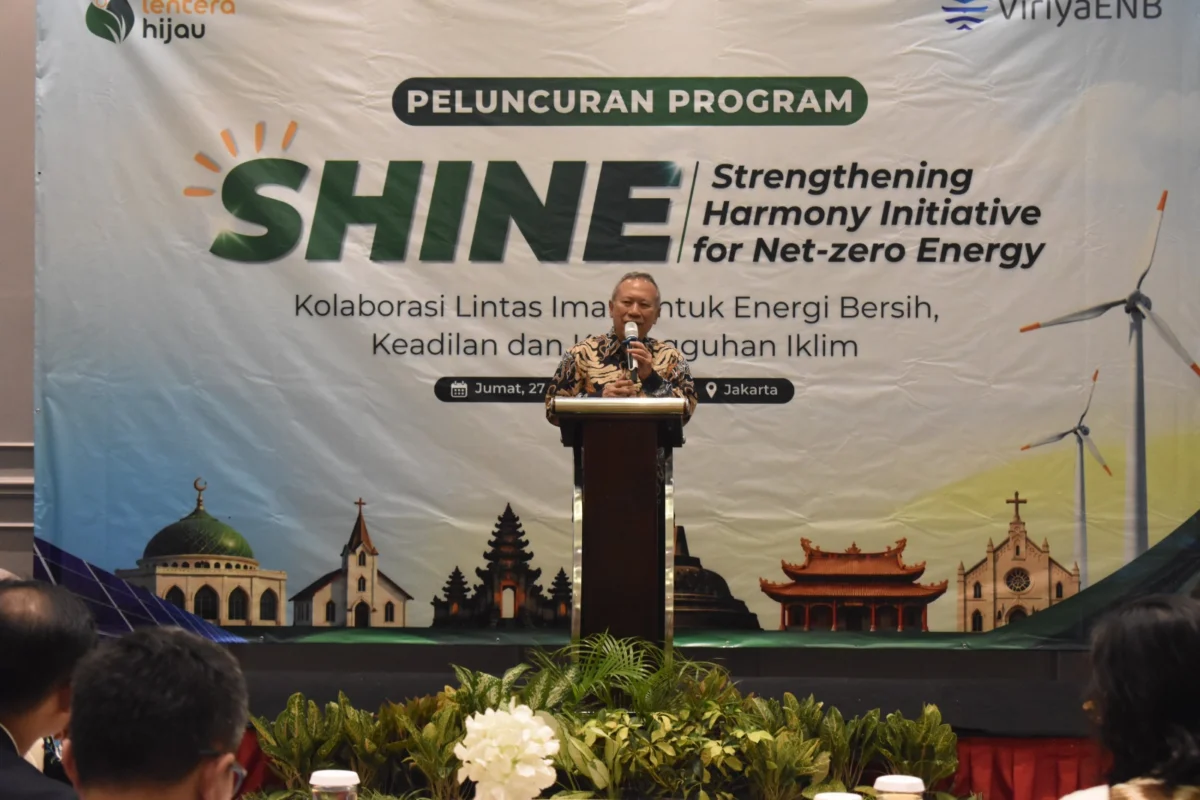
JAKARTA — In an emphatic call to action bridging spirituality and environmental stewardship, Professor Syafiq A. Mughni, Chairman of the Central Leadership (PP) of Muhammadiyah, has declared that environmental preservation and the ethical treatment of all living creatures are foundational components of religious practice. Speaking at a high-profile interfaith gathering in East Jakarta, Mughni stressed that traditional interpretations of faith—which have historically focused heavily on the vertical relationship between humanity and the Creator, as well as horizontal relations among people—must urgently expand to incorporate a profound ecological responsibility.
The remarks were delivered during the official launch of the SHINE (Strengthening Harmony Initiative for Net-zero Energy) program. Initiated by Lentera Hijau Indonesia, the program convened under the overarching theme of Cross-Faith Collaboration for Clean Energy, Justice, and Climate Resilience. The event brought together environmentalists, religious scholars, civil society leaders, and policymakers at the Swiss-Belinn Hotel in Cawang, reflecting a growing coalition of faith-based organizations mobilizing to address the accelerating climate crisis in Southeast Asia’s largest economy.
Expanding Religious Ethics to Encompass Ecological Sustainability
During his keynote address, Mughni unpacked the Islamic ethical concept of ihsan, traditionally translated as excellence or perfection in acts. He argued that ihsan should not be sequestered solely to ritual worship or interpersonal philanthropy, but must actively govern how humanity interacts with animals, plants, and ecosystems.
"Do not be a source of suffering," Mughni stated firmly, challenging the audience to reconsider daily habits and industrial practices that degrade the natural world. He illustrated his point by referencing the explicit traditions and teachings of Prophet Muhammad concerning the humane treatment of animals, noting directives that even slaughter must be conducted with utmost care to minimize distress. Furthermore, Mughni reminded attendees of historical Islamic jurisprudence forbidding the unnecessary destruction of trees and vegetation, even during times of armed conflict. These ancient injunctions, he noted, demonstrate that environmental protection is not a modern, secular import, but an intrinsic value embedded within classical religious ethics.
"Good relations with God and with humans do not mean we can exclude our good relationship with the living creatures in nature," Mughni asserted. He challenged religious leaders and clerics across denominations to mainstream ecological perspectives into their weekly sermons, educational curricula, and community organizing. By infusing religious discourse with environmental consciousness, faith leaders can establish a shared moral foundation to confront systemic challenges such as energy poverty, rampant environmental degradation, and intensifying climate anomalies.
Revisiting Islamic Jurisprudence: The Case for Eco-Ijtihad
A central pillar of Mughni’s address was the urgent need for contemporary Islamic jurisprudence (fiqh) to evolve through independent reasoning (ijtihad). For centuries, traditional Islamic legal theory has centered around the preservation of five core universal necessities: religion, life, intellect, lineage, and property. Mughni argued that in the face of twenty-first-century ecological collapse, this framework is incomplete without formally integrating the preservation of the environment and all living organisms.
"We need creativity; we need ijtihad to state that we must also protect living creatures and our environment as the natural habitat of humankind," he explained.
This call for eco-ijtihad resonates with a broader global movement among Islamic scholars and theologians who are reviving traditional environmental ethics—often referred to as Islam and Ecology or green fiqh. By reinterpreting sacred texts through a lens of sustainability, Islamic institutions in Indonesia are increasingly issuing religious edicts (fatwas) against deforestation, wildlife trafficking, and carbon-heavy practices. Muhammadiyah itself has established a robust environmental wing, positioning sustainability as a core operational and theological mandate for its vast network of schools, universities, hospitals, and social institutions.
The Context and Chronology of the SHINE Program Launch
The unveiling of the Strengthening Harmony Initiative for Net-zero Energy (SHINE) on Friday, November 27, marks a strategic milestone in Indonesia’s civil society engagement with climate policy. Lentera Hijau Indonesia, the driving force behind SHINE, designed the initiative to bridge the gap between grassroots religious communities and national energy transition goals.
The chronology of the event unfolded over a full-day seminar and workshop series, beginning with opening remarks from environmental activists detailing Indonesia’s current climate vulnerabilities. Situated squarely within the Pacific Ring of Fire and possessing the world’s third-largest tropical rainforests, Indonesia faces acute exposure to rising sea levels, extreme weather events, deforestation pressures, and heavy reliance on fossil fuels—particularly coal, which still accounts for more than half of the nation’s electricity generation.
Following the morning technical sessions, the plenary featuring PP Muhammadiyah Chairman Syafiq A. Mughni served as the emotional and intellectual centerpiece of the launch. The session underscored the unique leverage held by religious leaders in a deeply pious society like Indonesia. Unlike purely political or technocratic appeals, moral arguments grounded in faith have the power to shift cultural norms, consumer behaviors, and community-level resistance to renewable energy infrastructure.
The afternoon panels shifted toward practical implementation, exploring how interfaith coalitions could advocate for localized clean energy solutions, such as solar microgrids for remote communities, waste reduction programs in houses of worship, and transparent monitoring of national net-zero commitments.
Broader Impacts, Supporting Data, and Policy Implications
Mughni’s call to action arrives at a critical juncture for Indonesia’s environmental trajectory. According to recent data from the Ministry of Environment and Forestry, Indonesia has committed to reducing its greenhouse gas emissions by 31.89% independently, or up to 43.26% with international support, by 2030 under its Enhanced Nationally Determined Contribution (ENDC). Furthermore, the government has pledged to achieve net-zero emissions by 2060 or sooner, backed by the multi-billion-dollar Just Energy Transition Partnership (JETP) signed with international partners.
However, analysts frequently point out that bridging the gap between high-level policy pledges and grassroots execution remains a monumental challenge. Bureaucratic hurdles, economic inertia, and the entrenched political economy of coal continue to stall rapid decarbonization. This is precisely where faith-based organizations (FBOs) like Muhammadiyah—which boasts tens of millions of members and runs thousands of educational and health facilities nationwide—play an indispensable catalytic role.
By embedding climate action into the moral lexicon of everyday believers, FBOs can socialize complex concepts like renewable energy and carbon neutrality, translating them into ethical imperatives. When a religious authority frames solar energy adoption or waste reduction not merely as economic choices, but as acts of divine gratitude and stewardship (amanah), compliance and community engagement rise significantly.
Looking to the Future: Generational Responsibility
In his concluding remarks, Mughni brought the focus back to intergenerational justice, urging all stakeholders to weigh the long-term consequences of current policy and lifestyle choices. He reminded the audience that the Earth is a shared home that must be safeguarded not just for contemporaries, but for descendants who will inherit the ecological debt of the present generation.
"Maintaining the earth is a form of gratitude for God’s grace, as well as an effort to prevent losses and disasters in the future," Mughni concluded.
As initiatives like SHINE gain momentum, the convergence of religious authority and environmental activism in Indonesia offers a compelling model for global climate action. By reframing the fight against climate change from a peripheral technical challenge to a central moral duty, leaders like Syafiq A. Mughni are helping to forge a resilient, values-driven pathway toward a sustainable and net-zero future.