Within the foundational framework of Muhammadiyah, a modernist and reformist Islamic organization established in Indonesia in 1912 by K.H. Ahmad Dahlan, strict adherence to rational theology, scriptural textualism, and the eradication of superstitious beliefs, syncretism, and mysticism (known locally as tahayul, bid’ah, and churafat) is paramount. The movement explicitly rejects the notion of personal karomah—mystical or miraculous privileges traditionally attributed to saints or spiritual elites in certain strands of traditionalist Islam. Yet, despite this rigorous institutional rationalism, the historical annals of Muhammadiyah are paradoxically intertwined with gripping, cinematic accounts of its prominent leaders surviving perilous situations that outsiders frequently interpreted as manifestations of supernatural invulnerability or extraordinary physical mastery.
Among the most celebrated and fiercely debated historical narratives within the movement are those surrounding Ki Bagus Hadikusumo, a towering intellectual, national hero, and former leader of Muhammadiyah who faced a lethal ambush in the turbulence of post-independence Indonesia, and KH. Abdurrahman, a formidable grassroots builder of the movement in Pekajangan, Central Java, whose martial arts prowess and physical tenacity became legendary. Far from promoting occultism, these historical episodes offer a profound window into the intersection of personal conviction, political turmoil, physical resilience, and the socio-historical realities of Indonesia during the mid-20th century.
The Ambush on the Rails: The 1952 Ki Bagus Hadikusumo Incident
The first major historical narrative, carrying elements often romanticized by the public as mystical immunity, centers on Ki Bagus Hadikusumo. The account was meticulously preserved and recounted by Djarnawi Hadikusumo, drawing upon original documentations written by prominent journalist and freedom fighter Yunan Nasution. According to these historical records, the incident unfolded in 1952 during a high-stakes train journey from Yogyakarta to Jakarta.
At the time, Ki Bagus Hadikusumo—a central figure in the Sarekat Islam movement, the Investigating Committee for Preparatory Work for Independence (BPUPKI), and the Muhammadiyah leadership—was traveling to the national capital to attend crucial parliamentary sessions. The early 1950s in Indonesia were characterized by profound political instability, armed insurgencies, and regional rebellions. Among the most volatile paramilitary factions of the era was the Darul Islam/Tentara Islam Indonesia (DI/TII), a movement seeking to establish an Islamic state in Indonesia through armed struggle against the newly recognized republican government.
As the locomotive traversed a remote stretch of track, it entered a zone of active insurgent activity. Suddenly, the train carrying Ki Bagus became the target of a vicious, coordinated ambush by armed DI/TII elements. Heavy gunfire erupted, riddling the wooden and metal carriages with rapid-fire rounds. Pandemonium ensued inside the passenger cars. Terrified passengers dropped to the floor, crawling between seats and covering their heads to evade the incoming hail of hot lead tearing through the thin metal skin of the train.
Amidst the chaos, Ki Bagus Hadikusumo remained an anomaly of calm. Accounts from contemporary witnesses note that he had been sitting quietly by the window, deep in philosophical and political contemplation, seemingly oblivious to the immediate peril. Because of his stationary position by the window, he unwittingly became a primary target for the barrage of bullets directed systematically at the carriage. A leather traveling bag placed on the overhead rack directly above his seat was pierced repeatedly, catching several projectiles.
Miraculous Discoveries at Hotel Des Indes
The full extent of the close brush with death only became apparent hours later, long after the train had successfully broken through the ambush zone and completed its journey to Jakarta. Upon checking into the prestigious Hotel Des Indes—a landmark colonial-era hotel later renamed Hotel Indonesia—Ki Bagus proceeded to unpack his luggage.
The moment he unzipped his perforated travel bag, a powerful, aromatic wave filled the hotel room. One of the bullets that had shredded the luggage had shattered a glass bottle of expensive perfume packed inside. The fragrant liquid had completely saturated his clothes and personal items, leaving the bottle nearly empty.
However, the ruined perfume was soon eclipsed by a far more astonishing discovery. Upon removing his traditional black velvet peci (cap)—the iconic nationalist headwear popularized by President Sukarno and worn widely by Indonesian leaders—Ki Bagus found that a bullet had struck the cap with tremendous force. The impact had physically hurled the peci from his head during the height of the shooting. Upon inspection, the projectile had forcefully penetrated the outer velvet layer of the cap but had miraculously failed to pierce the inner lining. The deformed lead bullet was found neatly lodged within the structural folds of the fabric, having completely bypassed his skull.
President Sukarno’s Interrogation and Ki Bagus’s Theological Response
Word of the harrowing journey and the physical evidence of the unpenetrated peci quickly spread through Jakarta’s political circles, eventually reaching President Sukarno himself. Known for his keen interest in both secular politics and the spiritual dimensions of the Indonesian independence struggle, Sukarno was deeply fascinated by stories of extraordinary survival.
Intrigued by what the public was already whispering about as supernatural immunity or protective spells (ilmu kebal), President Sukarno summoned or directly questioned Ki Bagus Hadikusumo. With a mixture of personal curiosity and political intrigue, Sukarno asked the veteran Islamic scholar directly, "What is your prayer, Kangmas (elder brother)?"—implying an inquiry into the specific esoteric formulas, mantras, or mystical rituals utilized to achieve invulnerability.
Ki Bagus Hadikusumo’s response was a masterclass in orthodox Islamic theology, firmly dismantling any notions of personal magic or esoteric sorcery. According to historical transmissions, Ki Bagus replied with unwavering theological clarity:
"I told him that prayer itself is incapable of achieving happiness or repelling catastrophe. Prayer is merely a petition. But when Allah has granted a petition, no one can reject it, and if Allah refuses that petition, no one has the power to help. And I told him further that all events and human destinies have been ordained by Allah with His decree."
This response encapsulated the core creed of Muhammadiyah: absolute monotheism (tauhid), rejection of superstition, and total reliance on the divine decree (qada and qadar) rather than occult practices. For Ki Bagus, surviving the volley of bullets was not a testament to his personal magical powers, but rather a manifestation of divine protection within the pre-ordained span of his earthly life.
KH. Abdurrahman: The Rugged Martial Artist and Community Builder of Pekajangan
Shifting the geographic focus from the national political stage of Jakarta and Yogyakarta to the industrial and trading hub of Pekajangan in Pekalongan, Central Java, the intersection of physical prowess and Islamic reformism manifests in a completely different, yet equally compelling, manner. The biography Hidup KH. Abdurrahman, published by the Pekajangan Muhammadiyah Branch Leadership, immortalizes KH. Abdurrahman as a foundational patriarch of community development and social activism in the region.
Physically, Abdurrahman was portrayed as a man of formidable stature, possessing a robust build, broad shoulders, and an undeniably authoritative, uncompromising presence. Despite his high standing within the community, he was quintessentially a man of action rather than bureaucracy. Historical accounts indicate that although he was once formally appointed as the Chairman of the Pekajangan Branch, he held the administrative office for merely a week, finding desk-bound organizational duties tedious compared to the dynamic work of direct community engagement.
Instead of navigating committee meetings and bureaucratic minutiae, KH. Abdurrahman dedicated his life to grassroots philanthropy, building the physical and institutional infrastructure of Muhammadiyah in Pekalongan, and traveling extensively as an energetic mubalig (Islamic preacher) propagating the reformist theology of the movement.
Traditional Scholarly Itinerancy and Mastery of Pencak Silat
In alignment with the educational traditions of 19th and early 20th-century Indonesian Islamic scholars (ulama), KH. Abdurrahman undertook a rigorous intellectual pilgrimage, studying under various renowned traditional masters (kiai). His educational journey took him to prominent Islamic boarding schools (pesantren), including studying under Kiai Amin at the Banyuurip Pondok, Kiai H. Agus at the Kenayagan Pondok, Kiai Abdurrahman Thoif at the Wonoyoso Pondok, and Kiai H. Idris at the legendary Jamsaren Pondok in Solo.
Despite his extensive traditional background, Abdurrahman maintained a pragmatic approach to institutional procedures. While he rarely partook in formal legislative debates or parliamentary-style deliberations during congresses, he made it a point to regularly attend the national Congresses and Muktamar of Muhammadiyah, participating in these supreme legislative gatherings at least three times.
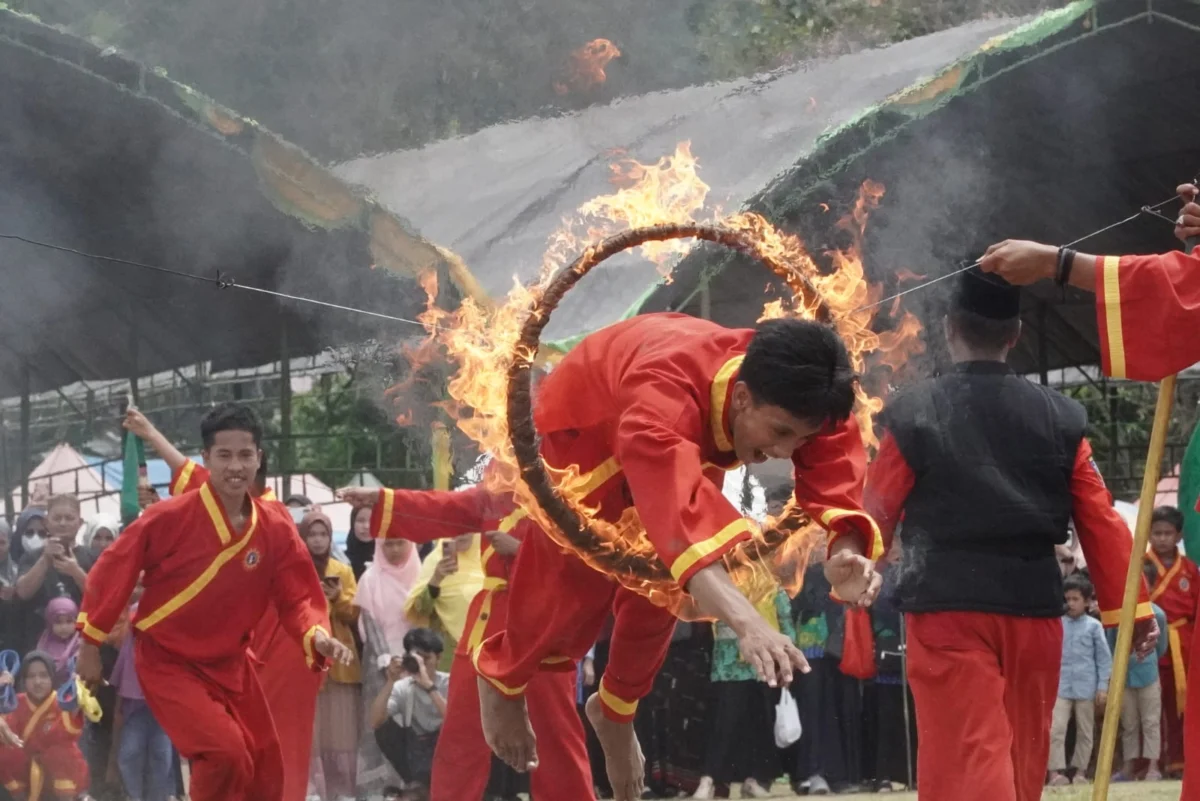
However, his presence at these national congresses was far from passive. Beyond attending ideological sessions, KH. Abdurrahman was known to enliven the atmosphere of the Muhammadiyah Congress in Yogyakarta through unexpected athletic displays. On multiple occasions, he engaged in energetic pencak silat (traditional Indonesian martial arts) sparring demonstrations alongside another prominent Muhammadiyah luminary, KH. Mas Mansur. Congress attendees watched in absolute astonishment as these senior religious leaders exhibited remarkable agility, speed, and technical mastery in martial arts, all while exchanging lighthearted banter and laughter.
The Midnight Intruder Incident in Pekajangan
The true extent of KH. Abdurrahman’s physical training and martial arts proficiency was violently tested one night at his home in Pekajangan. In an era when rural and semi-urban policing was scarce, residential burglaries targeting community leaders were not uncommon. Late one night, a notorious local criminal and self-proclaimed master of physical invulnerability—a notorious thief relying on underworld reputations—managed to breach the perimeter and break into KH. Abdurrahman’s house with the intent of stealing valuables.
Awakened by the intrusion, KH. Abdurrahman did not panic, nor did he immediately cry out for outside intervention or run to summon the neighbors. Instead, in a display of calculated self-reliance and physical confidence, he calmly walked to the main entrance of his home and locked the heavy wooden doors from the inside, trapping the intruder with him inside the house.
Moments later, muffled sounds of a fierce physical struggle—described by historical chroniclers with the expressive Javanese onomatopoeia gedebag-gedebug (heavy thuds, scuffling, and crashing furniture)—echoed through the night air. Awakened by the violent commotion emanating from the kiai’s residence, anxious neighbors quickly rushed to the scene. Beating on the exterior walls and doors, the neighbors urgently pleaded with KH. Abdurrahman to unlock the doors so that a collective mob of local residents could rush inside, capture the intruder, and deliver immediate street justice.
To the utter shock of the gathered crowd, KH. Abdurrahman flatly rejected their pleas. From behind the locked wooden door, his firm, booming voice rang out into the dark street:
"Let me discipline this wretched scoundrel myself—this braggart criminal who boasts of his invulnerability!"
For a short while longer, the sounds of the intense internal altercation continued. Then, absolute silence fell over the house. A few moments later, the heavy bolts of the front door were slowly slid back, and the door swung open from the inside.
Standing in the doorway was a composed KH. Abdurrahman, completely unfazed and breathing steadily. On the floor behind him lay the notorious burglar, battered, thoroughly subdued, and completely incapable of movement. The once-feared criminal, who had relied on local myths of physical invulnerability, was swiftly handed over by the kiai to the formal colonial or republican police authorities, bringing a decisive end to his criminal escapades.
Fact-Based Historical Analysis and Sociological Implications
Analyzing these two historical accounts within the broader context of Indonesian history reveals several critical socio-political dimensions. First, the juxtaposition of official Muhammadiyah rationalism against popular folklore highlights the complex relationship between modernist Islamic movements and the deeply syncretic cultural landscape of 20th-century Nusantara. While the institutional leadership consistently preached against mysticism and superstition, individual leaders operating in high-stress environments were frequently mythologized by the general public.
In the case of Ki Bagus Hadikusumo, the narrative of surviving an assassination attempt reflects the extreme physical dangers faced by Indonesian nationalist leaders during the tumultuous transition from Dutch and Japanese colonialism to sovereign independence. Armed separatist movements, ideological schisms, and political assassinations formed the backdrop of everyday life in the 1950s. That Ki Bagus survived a point-blank train ambush was attributed by his contemporaries to divine providence, yet the public imagination, deeply steeped in traditional folklore, naturally gravitated toward explanations of personal invulnerability. By attributing his survival to standard Islamic theology—framing it purely as the execution of divine decree (qada and qadar)—Ki Bagus successfully neutralized the superstitious implications while validating the miraculous nature of his preservation.
Similarly, the legend of KH. Abdurrahman illustrates the archetype of the 19th and early 20th-century Indonesian kiai—figures who were expected to be simultaneously spiritual guides, intellectual mentors, institutional builders, and physical defenders of their communities. In colonial and post-colonial Java, where state security apparatuses were weak or partisan, religious leaders frequently functioned as community protectors. Abdurrahman’s mastery of pencak silat and his physical confrontation with an underworld intruder underscore a pragmatic understanding of self-defense that complemented, rather than contradicted, his religious duties.
Furthermore, these narratives serve a vital historiographical function within the collective memory of mass organizations like Muhammadiyah. They humanize historical icons who are often elevated to stoic, academic figures in formal textbooks. By recording moments of vulnerability, physical conflict, wit, and theological firmness, these stories bridge the gap between abstract ideology and lived human experience.
Conclusion: Bridging Myth and Modernity
Ultimately, the historical accounts of Ki Bagus Hadikusumo’s perforated peci and KH. Abdurrahman’s midnight defeat of a martial arts burglar do not validate the existence of occult personal invulnerability or mystical karomah as understood in traditionalist folklore. Instead, they stand as profound historical testimonies to the resilience, courage, and unwavering theological grounding of early Muhammadiyah architects.
Operating in an era defined by political violence, armed rebellion, and social upheaval, these figures demonstrated that physical survival and community leadership required a combination of situational alertness, physical preparedness, and, above all, an absolute surrender to the divine will. By firmly grounding their experiences in orthodox Islamic monotheism, leaders like Ki Bagus Hadikusumo ensured that even in the face of miraculous survival, the credit remained directed solely toward the Creator, cementing a legacy of rational faith that continues to define the Muhammadiyah movement to the present day.