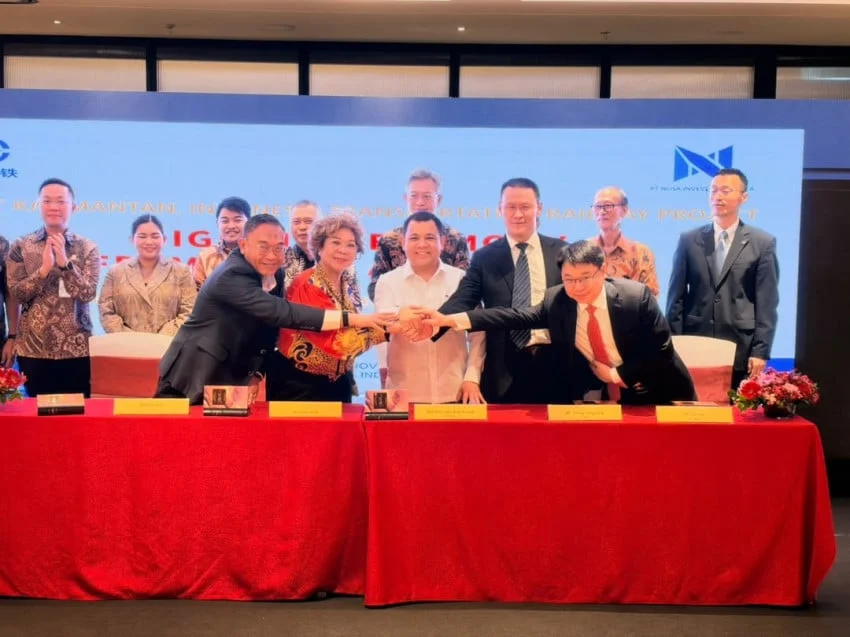
The ambitious plan to establish a modern, integrated railway network across the island of Kalimantan has advanced significantly following the official signing of a strategic Framework Agreement between PT Nusa Investama Utama and the prominent Chinese state-owned construction giant, China Railway Engineering Corporation (CREC). The high-profile ceremony, held in Jakarta on Wednesday, November 25, 2026, marks a foundational milestone in realizing the Trans-Kalimantan Railway Project, an infrastructure initiative designed to fundamentally transform regional mobility, industrial logistics, and economic connectivity across the Indonesian portion of Borneo.
The agreement serves as the formal starting point for collaborative development between the Indonesian private sector and international engineering expertise. Initially focusing on connecting East Kalimantan with Central Kalimantan, the broader vision of the project encompasses an extensive rail corridor that will eventually extend into South Kalimantan and encompass other vital regional territories. By bridging vast geographical expanses that have historically relied heavily on road networks and river transport, the upcoming railway network promises to usher in a new era of logistical efficiency and equitable regional development.
Strategic Alignment with National Infrastructure Priorities
The momentum behind the Trans-Kalimantan railway development aligns closely with broader national strategic objectives aimed at decentralizing economic growth away from the island of Java. Speaking at the formal signing ceremony, Indonesian Minister of Transportation Dudy Purwagandhi emphasized that the acceleration of railway networks outside of Java stems directly from the strategic vision and active initiation of President Prabowo Subianto.
Minister Dudy underscored that the government places high priority on enhancing inter-regional connectivity to support the equitable distribution of goods, services, and human capital. He voiced strong expectations that the collaborative effort between PT Nusa Investama Utama and CREC will not remain restricted to East Kalimantan. Instead, the project is envisioned to evolve organically into an expansive, interconnected Trans-Kalimantan network that bridges multiple provinces, thereby supporting the newly established national capital region and its surrounding industrial clusters.
The formal proceedings, officially titled the East Kalimantan, Indonesia Transportation Railway Project Signing Ceremony Framework Agreement, unfolded under the watchful eye of senior diplomatic and corporate figures. Alongside Minister Dudy Purwagandhi, the event was witnessed by the Ambassador of the People’s Republic of China to Indonesia, Wang Lutong. The presence of high-ranking diplomats highlights the enduring bilateral cooperation between Indonesia and China, particularly within the framework of large-scale infrastructure financing and execution.
High-Level Corporate Presence and Stakeholder Involvement
The significance of the partnership was further underscored by the attendance of notable corporate leaders and industry magnates. Among the distinguished guests were Haji Andi Syamsuddin Arsyad—widely known as Haji Isam—representing the leadership of Jhonlin Group, and Dewi Kam, representing the leadership of PT Sumberenergi Sakti Prima (SSP) Group. On the international front, Zhang Yongkang, President of CREC International Engineering Company, attended alongside approximately 300 key business leaders, investors, and industrial stakeholders.
The participation of major domestic conglomerates such as Jhonlin Group and SSP Group signals strong private-sector confidence in the commercial viability of the railway project. These business groups maintain substantial operational interests in Kalimantan—spanning mining, energy, agriculture, and land transport—making them both primary stakeholders and future beneficiaries of a reliable, high-capacity bulk transport system. Their involvement bridges the gap between state-level policy frameworks and ground-level commercial execution.
Scope of the Framework Agreement and Technical Roadmap
Under the terms of the newly minted Framework Agreement, PT Nusa Investama Utama and CREC have established the foundational parameters necessary to advance the project from a conceptual proposal into a technically rigorous engineering blueprint. The immediate phase of cooperation involves comprehensive preparatory studies and technical evaluations designed to mitigate risks and ensure regulatory compliance.
Specifically, the agreement mandates joint research and data collection across several critical domains:
- Technical and Engineering Specifications: Assessing the challenging terrain, soil stability, and topographical demands of laying heavy rail lines across Kalimantan’s diverse landscapes, which include tropical forests, wetlands, and undulating terrain.
- Feasibility Studies: Conducting rigorous financial, economic, and operational viability assessments to determine projected passenger volumes, freight capacities, and long-term return on investment.
- Spatial and Territorial Planning: Aligning the proposed rail corridors with provincial and national spatial plans (Rencana Tata Ruang Wilayah/RTRW) to prevent land-use conflicts and ensure seamless integration with existing municipal infrastructure.
- Environmental Impact Assessments (AMDAL): Evaluating potential ecological footprints, protecting local biodiversity, and implementing sustainable mitigation strategies to minimize disruption to rainforest ecosystems and indigenous communities.
- Safety and Operational Protocols: Establishing international standard safety frameworks for both passenger and freight transit, incorporating modern signaling, telecommunications, and automated train control systems.
- Execution and Contracting Schemes: Determining public-private partnership models, procurement timelines, funding structures, and phased construction milestones.
Phased Implementation Strategy for the Trans-Kalimantan Network
The logistical roadmap for the Trans-Kalimantan Railway Project envisions a methodical, phased rollout to manage financial exposure and operational complexity. Construction will commence in East Kalimantan, leveraging the region’s burgeoning economic significance driven by industrial development and the proximity of the new national capital.
In Phase One, the rail infrastructure will establish a high-capacity trunk line connecting East Kalimantan with Central Kalimantan. This initial segment is deemed critical for unlocking trapped value in regional commodity markets, particularly coal, palm oil, minerals, and manufactured goods. By providing a reliable alternative to road-based trucking, the railway will drastically reduce transportation costs and alleviate wear and tear on provincial highways.
Subsequent phases of the master plan anticipate expanding the rail network southward into South Kalimantan, effectively linking major ports, economic hubs, and population centers. Further expansions are projected to integrate northern and western regions of the island, creating a unified transportation backbone that supports the economic integration of the entire Indonesian territory in Borneo.
Background Context: The Evolution of Kalimantan’s Transportation Infrastructure
For decades, infrastructural development on the island of Kalimantan has lagged behind Java and Sumatra, constrained by challenging geographical conditions, low population density relative to land area, and dense tropical rainforests. Historically, transportation networks relied heavily on sprawling river systems for inland penetration and maritime shipping for inter-island trade. While road construction has expanded significantly over the past twenty years—most notably through the progressive development of the Trans-Kalimantan Highway—road transport alone remains insufficient to handle high-volume, heavy-industrial freight efficiently and sustainably.
The introduction of a railway network represents a paradigm shift in regional development policy. Discussions regarding a Kalimantan railway have surfaced periodically over the past decade, driven by the need to optimize logistics for the region’s vast natural resource endowments. However, previous proposals frequently stalled due to high capital expenditure requirements, complex regulatory hurdles, and logistical challenges associated with difficult terrain.
The current resurgence of the project under the administration of President Prabowo Subianto reflects a renewed political will to utilize foreign direct investment and international engineering partnerships—particularly with Chinese enterprises renowned for rapid rail construction capabilities—to overcome historical bottlenecks. CREC, as one of the world’s largest construction and engineering conglomerates, brings decades of specialized experience in constructing railways across difficult topographies, including high-speed and heavy-haul networks both within China and across international markets.
Macroeconomic Implications and Regional Development Impact
Economists and logistics experts anticipate that the realization of the Trans-Kalimantan Railway will yield profound structural changes for the regional economy. By lowering logistics costs—which currently constitute a significant percentage of operational expenditures for Kalimantan-based industries—the railway will enhance the global competitiveness of regional commodities.
Key anticipated impacts include:
- Industrial Efficiency: Providing a dedicated freight corridor for mining, agricultural, and forestry products, thereby decongesting provincial roads and reducing carbon emissions per ton-kilometer of freight moved.
- Passenger Mobility: Offering a safe, fast, and weather-resistant public transit alternative for local populations, fostering greater labor mobility and social integration between provinces.
- Regional Growth Poles: Stimulating secondary economic development around designated railway stations and logistical hubs, encouraging the growth of localized manufacturing, warehousing, and service sectors.
- Strategic Integration: Strengthening the logistical supply chains feeding into regional ports and supporting the broader economic ecosystem surrounding the new national capital.
Challenges and Future Outlook
Despite the optimism surrounding the signing ceremony, industry analysts emphasize that the project still faces notable hurdles before physical construction can commence on a large scale. Financing structures, land acquisition processes, and adherence to stringent environmental regulations will require meticulous coordination between federal ministries, provincial authorities, private-sector partners, and international financiers.
The completion of the feasibility studies and environmental impact assessments outlined in the Framework Agreement will serve as the litmus test for the project’s viability. As PT Nusa Investama Utama and CREC begin translating their shared vision into actionable engineering data, all eyes will remain on Jakarta and Kalimantan to monitor how this monumental infrastructure initiative progresses through its formative stages.
With high-level political backing, robust corporate sponsorship, and experienced international engineering execution, the Trans-Kalimantan Railway Project stands poised to redefine the economic geography of Borneo, transforming an island of vast natural wealth into a tightly integrated, modern industrial powerhouse.