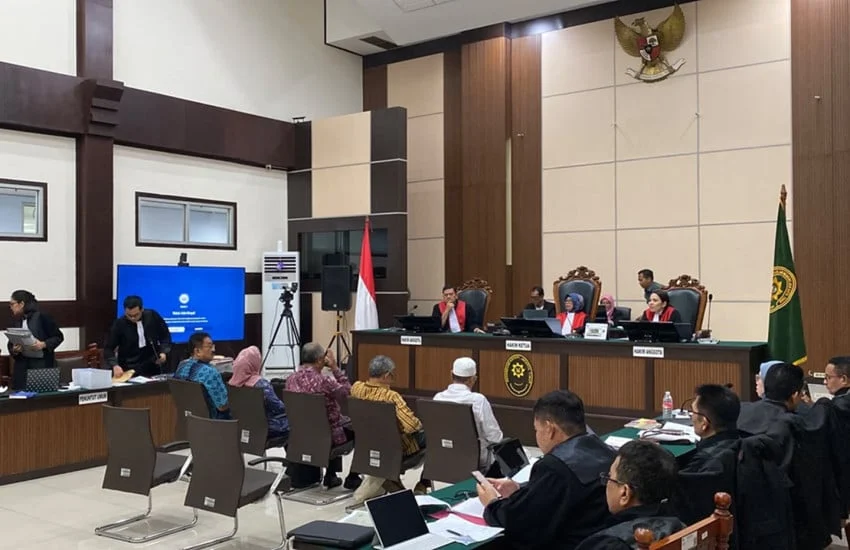
The legal proceedings surrounding the controversial case of former Indonesian President Joko Widodo’s university diploma took a dramatic turn at the East Jakarta District Court on Wednesday, November 25, 2026. During the ongoing trial regarding allegations of document forgery involving prominent critic Roy Suryo, the defense team formally requested a completely independent re-examination of the disputed diploma by a fresh forensic laboratory team. The core argument presented by Roy Suryo’s legal counsel rests heavily on an unprecedented challenge to the integrity of the original police forensic investigation, pointing directly to the high-profile legal troubles currently facing former National Police Chief, General Listyo Sigit Prabowo.
Abdul Gafur Sangadji, the lead defense attorney representing Roy Suryo, raised deep skepticism inside the courtroom regarding the validity of the previous laboratory findings. He formally petitioned the presiding panel of judges to authorize a brand-new forensic examination of the document. Gafur argued that the initial forensic tests, which served as the foundation for bringing criminal charges against his client, were conducted under a police leadership that has since collapsed amidst severe criminal accusations. By casting doubt on the institutional impartiality of the Indonesian National Police during the previous investigative phase, the defense hopes to dismantle the prosecution’s primary physical evidence.
Background Context of the Controversy
The debate surrounding the educational credentials of Indonesia’s seventh president has remained a lingering point of contention among various political commentators, activists, and legal figures for several years. What initially began as online speculation and public discourse eventually escalated into formal legal battles as individuals persistently challenged the authenticity of the academic records. Roy Suryo, a well-known telematics expert and outspoken critic of the former administration, became deeply entangled in the controversy through his public commentary and analytical assertions regarding the document’s physical characteristics.
As the accusations gained traction, law enforcement agencies stepped in, treating the claims not merely as freedom of speech, but as deliberate defamation and the spreading of unverified information intended to undermine state institutions. Roy Suryo was subsequently named a suspect, arrested, and brought to trial under strict legal scrutiny. Throughout the preliminary investigations, the National Police’s forensic laboratory (Labfor) conducted rigorous examinations of the diploma, ultimately concluding that the document was genuine. This conclusion formed the bedrock of the state’s case against the defendant, effectively branding his claims as baseless fabrication.
The Implication of General Listyo Sigit Prabowo’s Case
The dynamic of the trial shifted profoundly following recent developments at the highest levels of Indonesia’s security apparatus. General Listyo Sigit Prabowo, who commanded the Indonesian National Police during the peak of the diploma investigation, has recently been designated as a criminal suspect in an entirely separate, high-stakes conspiracy case. Authorities confirmed that Listyo Sigit and several associates are facing grave charges of treason (makar) and illegal wiretapping directed against sitting President Prabowo Subianto.
According to investigative findings released by law enforcement agencies, the conspiracy and unauthorized surveillance activities involving the former police chief and his co-conspirators took place prior to President Prabowo Subianto’s official inauguration. This monumental scandal has sent shockwaves through the nation’s political and legal establishments, calling into question the administrative integrity, objective neutrality, and operational transparency of numerous high-profile investigations overseen by Listyo during his tenure.
Capitalizing on this unfolding institutional crisis, Roy Suryo’s legal team seized the opportunity to discredit the evidentiary foundation of their client’s prosecution. Inside the courtroom, attorney Abdul Gafur Sangadji emphasized the timing and leadership under which the original diploma verification took place.
"As additional information, the examination of Jokowi’s diploma by the forensic laboratory was carried out at a time when two key police officials—including Listyo Sigit Prabowo, who today has been officially designated as a suspect for wiretapping President Prabowo—held absolute authority," Gafur stated before the panel of judges on Wednesday, November 25, 2026.

By tying the previous forensic validation directly to a disgraced former police chief now accused of treasonous plots against the current head of state, the defense aims to persuade the judiciary that the original findings may have been politically influenced, compromised, or fundamentally flawed.
Chronology of the Trial and Defense Strategy
The hearing on November 25, 2026, marked a critical phase in the long-running judicial process. The defense’s strategic pivot from debating technical forensic markers to attacking the credibility of the institution itself represents a calculated maneuver. Rather than arguing pixel densities, paper textures, or ink compositions—arguments that previous forensic experts easily dismissed—the defense is now utilizing institutional corruption and systemic compromise as their primary shield.
The chronology of events leading up to this point highlights a complex intersection of politics and criminal law:
- Initial Public Discourse: Public figures and internet sleuths begin questioning the authenticity of the former president’s university degree, prompting widespread digital debates.
- Formal Law Enforcement Intervention: The Indonesian National Police launch an investigation into the dissemination of unverified claims, classifying certain statements as criminal defamation and dissemination of false information.
- Arrest and Indictment of Roy Suryo: Following expert evaluations and preliminary police findings, Roy Suryo is formally named a suspect and committed to trial at the East Jakarta District Court.
- The Labfor Conclusion: Police forensic laboratories release official reports authenticating the diploma, which the prosecution utilizes as unyielding physical evidence against the defense.
- The Collapse of Police Leadership: General Listyo Sigit Prabowo faces sudden downfall as he and his associates are named suspects in a high-profile treason and illegal wiretapping conspiracy against President Prabowo Subianto.
- The Defense’s Rebuttal: Leveraging the disgrace of the former police chief, Roy Suryo’s legal team formally petitions the East Jakarta District Court for a complete, independent re-examination of the diploma on November 25, 2026.
Legal Implications and Potential Outcomes
The demand for a repeated forensic examination places the presiding judges at the East Jakarta District Court in a delicate position. Under Indonesian criminal procedural law, the defense has the right to challenge evidence presented by the state. However, granting a request for a secondary forensic test on a matter that has already undergone extensive institutional review requires compelling legal justification.
Legal analysts observing the trial note that while the downfall of General Listyo Sigit Prabowo provides dramatic rhetorical leverage for the defense, establishing a direct causal link between his current criminal status and the falsification of a specific forensic report will remain a steep legal challenge. Prosecutors are expected to argue that forensic laboratory evaluations are conducted by career technicians and forensic scientists bound by professional codes, peer review, and scientific methodology, independent of the personal or political actions of the agency’s top commander.
Conversely, the defense maintains that an environment of command pressure and institutional bias could easily infiltrate sensitive political investigations, thereby invalidating any presumption of objective neutrality. If the judges accept the defense’s argument and approve a neutral, third-party forensic review—potentially involving independent academic institutions or international experts—it could set a profound legal precedent for how contested physical evidence is re-evaluated in politically sensitive cases.
Broader National Impact and Public Reaction
The intersection of a legacy political controversy and a modern high-level security crisis has captured the intense scrutiny of the Indonesian public. Civil society organizations, legal watchdogs, and political observers are closely monitoring the East Jakarta District Court proceedings, recognizing that the implications stretch far beyond the individual fate of Roy Suryo.
The case touches upon core issues of institutional trust, the separation of investigative authority from political influence, and the reliability of state-sanctioned forensic science. As the judiciary weighs whether to grant the defense’s request for a new laboratory analysis, the trial continues to serve as a focal point for broader national discussions regarding accountability, the integrity of the justice system, and the lingering echoes of past political eras within contemporary Indonesian jurisprudence. The court is expected to reconvene in the coming weeks to issue a formal ruling on the defense’s petition for a renewed forensic investigation.