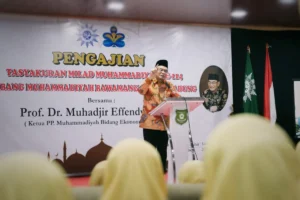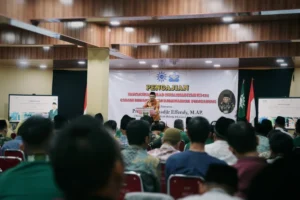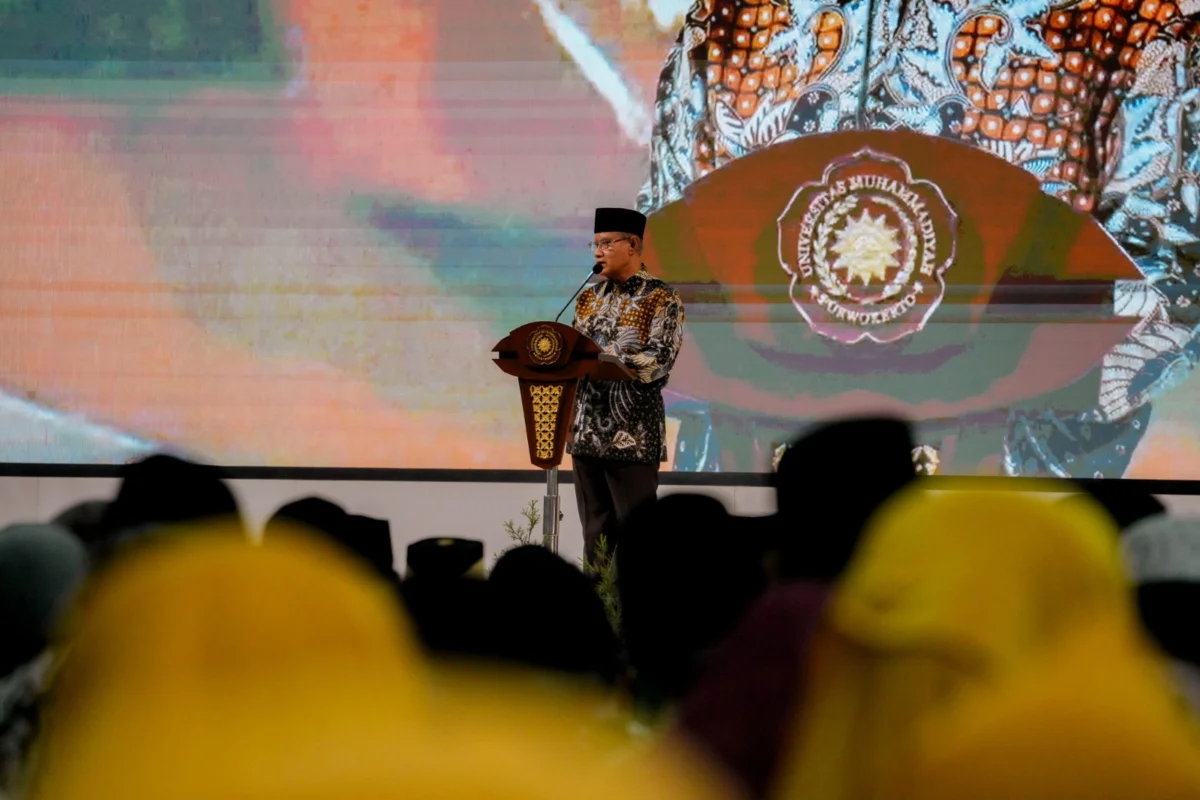
The Central Board Chairman of Muhammadiyah, Prof. Dr. Haedar Nashir, delivered a compelling address emphasizing that Islamic propagation, or dakwah, must function as an instrument of societal enlightenment and spiritual revival rather than a platform for condemnation. Speaking before thousands of members, scholars, and local dignitaries on Sunday, November 22, at the Ukhuwah Islamiyah Auditorium of Universitas Muhammadiyah Purwokerto (UMP) in Central Java, Haedar urged the massive Islamic organization to adopt proactive, compassionate, and constructive methodologies when addressing social and religious challenges within the broader community.
The occasion marked the grand culmination of the 114th-anniversary celebrations of Muhammadiyah, coordinated jointly by the regional chapters of Banyumas and Central Java. The event served as a major gathering point for the organization’s faithful, drawing widespread attention from regional religious leaders, academics, and civil society participants who converged on the Ahmad Dahlan Campus 1 to reflect on more than a century of religious, educational, and social contributions made by Muhammadiyah to the Indonesian republic.
The Core Philosophy of Constructive Dakwah
During his keynote speech, Haedar underscored the necessity for Muhammadiyah members to steer clear of harsh judgment and cynical reproach when encountering perceived religious deviations or societal shortcomings. Instead of isolating communities or dismissing traditional practices through aggressive theological confrontation, the organization’s adherents must take direct responsibility for elevating the religious literacy and moral framework of the public through wise and empathetic engagement.
"Do not continually judge them, do not continually revile them. If there is something amiss in the religious life of society, we are the ones who must enliven it," Haedar stated emphatically to an attentive auditorium of scholars and community representatives.
This philosophy, according to the chairman, is rooted deeply in the foundational teachings of Muhammadiyah’s supreme founder, K.H. Ahmad Dahlan. Haedar referenced the historical wisdom of the organization’s founder, noting that Islam inherently represents an illuminating and radiant force of divine guidance. However, this inherent brilliance often appears obscured or dimmed not due to any inherent flaw in the faith itself, but rather because of the inadequate behavioral reflections and spiritual practices of its adherents.
Consequently, the primary duty of contemporary Muhammadiyah preachers, educators, and social workers is to clear away these behavioral obstructions, allowing the true light of Islamic values to permeate daily communal existence. While constructive criticism remains an essential component of social reform, Haedar maintained that it must consistently be communicated through ethical frameworks, absolute fairness, and deep wisdom. He encapsulated this methodological approach by citing an Arabic maxim: "Ad-da’wah lil muwajahah, laisa ad-da’wah lil mu’aradhah," reinforcing the principle that propagation must be oriented toward substantive reform, compassionate engagement, and collaborative problem-solving rather than confrontational opposition or antagonistic posturing.
Chronology and Background of the Anniversary Event
The commemorative events in Purwokerto formed a crucial part of a nationwide series of milestones celebrating Muhammadiyah’s 114 lunar years—or 112 solar years—of institutional existence since its establishment in Yogyakarta on November 18, 1912. Over the past century, Muhammadiyah has evolved into one of the world’s most influential Muslim non-governmental organizations, operating thousands of educational institutions, hospitals, orphanages, and economic enterprises across the Indonesian archipelago.
The regional celebration in Banyumas and Central Java began weeks prior with localized community service projects, free health clinics, environmental clean-up initiatives, and academic seminars designed to address contemporary socioeconomic challenges. The culmination on Sunday, November 22, brought these diverse streams of community outreach together under one roof. The choice of Universitas Muhammadiyah Purwokerto as the host venue highlighted the vital role that higher education institutions play within the modern Muhammadiyah network, bridging traditional Islamic scholarship with modern scientific inquiry and community development.
Morning proceedings commenced with traditional Quranic recitations, cultural performances by student organizations, and official progress reports delivered by the regional leadership of Muhammadiyah Banyumas. Local government officials, including representatives from the Banyumas regency administration and Central Java provincial offices, were also in attendance, signaling the strong collaborative ties that exist between civil society Islamic organizations and state apparatuses in fostering regional stability and social welfare.
Institutional Implications and Sociological Analysis
Sociological analysts and religious studies experts observing the trajectory of Muhammadiyah note that Haedar Nashir’s address addresses a critical tension within modern Indonesian Islam. In an era marked by the rapid proliferation of digital media, polarized public discourse, and the rise of sensationalized religious commentary, grassroots preachers frequently face temptations to adopt exclusionary or judgmental tones to capture public attention.
By explicitly steering the organization away from this trend, Haedar reinforces Muhammadiyah’s long-standing institutional identity as a champion of "Enlightened Islam" (Islam Berkemajuan). This theological framework prioritizes education, social welfare, gender equality, national integration, and universal human rights, positioning faith as a dynamic catalyst for civilizational progress rather than a rigid set of exclusionary rules.
The implications of this policy directive are profound for the thousands of schools, universities, and preaching bureaus operating under the Muhammadiyah umbrella. Educators and religious instructors are now expected to integrate these empathetic, constructive methodologies into their daily curricula and outreach programs. By fostering an institutional culture that emphasizes patient mentorship over moral superiority, Muhammadiyah aims to solidify its position as a stabilizing, unifying force in an increasingly diverse and complex democratic society.
Furthermore, this strategic emphasis on constructive engagement directly supports national development goals. By addressing social ills through collaborative community building—such as poverty alleviation, healthcare expansion, and educational enhancement—rather than ideological disputes, Muhammadiyah continues to serve as an indispensable partner to the Indonesian government in addressing structural vulnerabilities across rural and urban populations alike.
Broader Impacts on National Religious Discourse
The message delivered by Haedar Nashir in Purwokerto resonates far beyond the borders of Central Java, offering a timely reminder to the broader Indonesian Islamic landscape regarding the ethics of public communication. In a national ecosystem where religious sensitivities frequently intersect with political dynamics, the insistence on ethical, fair, and wisdom-based advocacy serves as a stabilizing counterweight to sectarian friction.
Religious tolerance experts have frequently praised Muhammadiyah’s moderate, institutionalized approach to social governance. The organization’s ability to maintain a nationwide network of social services while continuously engaging in internal theological self-reflection ensures its continued relevance across generations. As the organization looks ahead to the remainder of its second century of operation, the directives issued by its central leadership in Purwokerto provide a clear roadmap for maintaining moral authority through compassion, intellectual rigor, and unwavering commitment to public welfare.
Ultimately, the grand culmination of the 114th anniversary in Purwokerto did not merely celebrate historical longevity; it re-anchored Muhammadiyah’s contemporary mission in the timeless prophetic tradition of bringing mercy, light, and constructive transformation to humanity. Through a steadfast rejection of cynicism and an embrace of proactive community stewardship, the organization continues to chart a course defined by constructive engagement and enduring societal contribution.