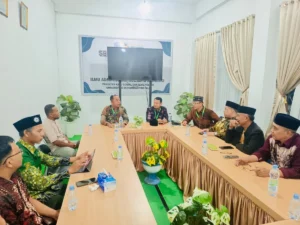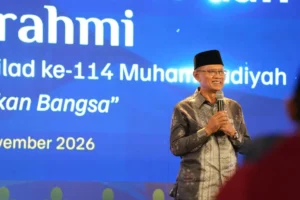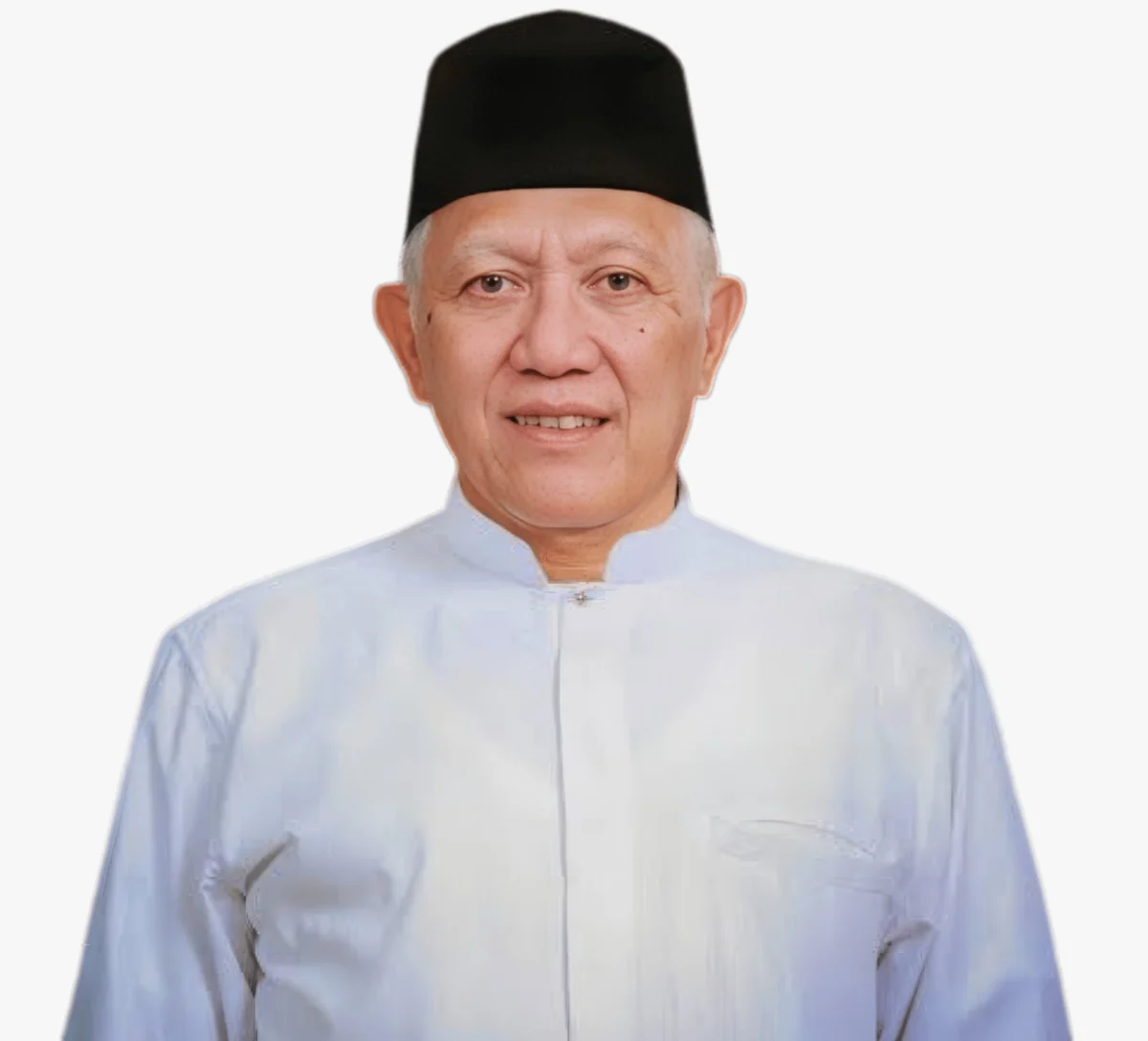
The Executive Board of Nahdlatul Ulama (PBNU), Indonesia’s largest Islamic organization, has formally extended its congratulations to Muhammadiyah on the auspicious occasion of its 114th anniversary. The congratulatory message was delivered directly by PBNU General Chairman Abdul Hakim Mahfudz, widely known as Gus Kikin, on Wednesday, November 11. This gesture underscores the enduring spirit of ukhuwah islamiyah (Islamic brotherhood) and national unity between Indonesia’s two premier socio-religious pillars, whose collaborative legacies have profoundly shaped the socio-cultural, educational, and political landscape of the archipelago for well over a century.
The official statement from PBNU reflects a deep institutional appreciation for Muhammadiyah’s prolonged journey through Indonesia’s historical milestones, spanning the twilight of the Dutch colonial era, the turbulent struggle for independence, the nation-building phases of the Old and New Orders, and into the vibrant democratic landscape of the contemporary reform era. By acknowledging Muhammadiyah’s century-long trajectory, PBNU highlighted how the organization founded by K.H. Ahmad Dahlan in 1912 has consistently positioned itself at the vanguard of Islamic reform, societal emancipation, and civil society development in Southeast Asia.
Comprehensive Contributions to National Development
In his official remarks, Gus Kikin elaborated on the multifaceted contributions delivered by Muhammadiyah across various strategic sectors. He emphasized that the organization’s footprint extends far beyond traditional religious proselytization (dakwah), weaving itself into the very fabric of Indonesia’s modern social infrastructure. Specifically, he pointed to monumental advancements in formal education, public health services, social welfare initiatives, and grassroots community empowerment programs.
Muhammadiyah’s network of educational institutions—spanning thousands of primary and secondary schools, vocational training centers, and over 170 higher education institutions including esteemed universities—has played an instrumental role in elevating the intellectual capacity of the Indonesian populace. Concurrently, its extensive healthcare network, comprising general hospitals, maternity clinics, and mobile health units, has served as a critical backbone for public health accessibility, particularly for marginalized and underserved communities across the archipelago. Through systematic poverty alleviation programs, disaster response operations coordinated by Muhammadiyah Disaster Management Center (MDMC), and orphanages, the organization has institutionalized philanthropy and humanitarian service as core tenets of progressive Islamic theology.
According to PBNU, these tangible contributions have collectively transcended sectarian boundaries, delivering broad-based benefits that resonate not only with the global Islamic community (ummah) but also with the wider canvas of Indonesian multiculturalism and universal humanity.
Historical Context and the Evolution of Muhammadiyah
To fully contextualize the significance of PBNU’s congratulatory message, one must examine the historical genesis and institutional evolution of Muhammadiyah. Established on November 18, 1912, in the royal city of Yogyakarta by K.H. Ahmad Dahlan—a pioneering Islamic scholar and official (Khatib) at the Great Mosque of Yogyakarta—Muhammadiyah emerged during a period of profound colonial subjugation, widespread illiteracy, and rigid traditionalism.
Inspired by reformist ideals popularized across the Middle East by thinkers such as Muhammad Abdu and Rashid Rida, K.H. Ahmad Dahlan sought to purify Islamic practices in the Dutch East Indies from syncretic deviations while simultaneously modernizing religious education. He integrated Western pedagogical models into traditional Islamic boarding school systems, famously pioneering institutional schooling that taught both religious sciences and secular subjects like arithmetic, geography, and European languages. Furthermore, drawing heavily upon the theological imperatives found in Surah Ali Imran (Verse 104) of the Qur’an—which calls for a community dedicated to enjoining good, forbidding evil, and promoting righteousness—Muhammadiyah institutionalized social action as the ultimate manifestation of faith.
Over the subsequent decades, the organization expanded exponentially. The establishment of its women’s wing, Aisyiyah, in 1917 marked a revolutionary milestone in Southeast Asian Islamic history, empowering women through education, healthcare, and economic independence long before modern feminist movements gained formal traction in the region. Through successive national congresses (Muktamar), Muhammadiyah continuously adapted its strategic vision, responding effectively to the shifting paradigms of Indonesian statehood.
Chronology of Interfaith Synergy and Institutional Collaboration
The relationship between Nahdlatul Ulama, established in 1926 by K.H. Hasyim Asy’ari, and Muhammadiyah has historically been characterized by a dynamic interplay of theological nuance, organizational independence, and profound national solidarity. While minor methodological differences regarding local cultural integration and legal jurisprudence (fiqh) occasionally distinguished their early years, both organizations share a foundational commitment to Ahlussunnah wal Jama’ah principles in a broader societal context and, most importantly, a shared vision for Indonesian nationalism.
Chronologically, key milestones in modern PBNU-Muhammadiyah relations include:
- The Pre-Independence Era: Both K.H. Ahmad Dahlan and K.H. Hasyim Asy’ari were disciples of the visionary scholar K.H. Saleh Darat in Semarang, establishing a deep intellectual kinship that predated their respective organizational foundings.
- The Independence Struggle: Members and leaders of both organizations actively participated in the defense of the Republic, notably during the pivotal Battle of Surabaya in November 1945, galvanized by K.H. Hasyim Asy’ari’s historic "Resolution of Jihad" (Resolusi Jihad) and supported by Muhammadiyah’s youth wing, Hizbul Wathan.
- The Reform Era (1998–Present): Faced with the complex challenges of democratization, globalization, and rising sectarian tensions, leadership figures from both PBNU and Muhammadiyah have consistently maintained a united front. They have functioned as moral barometers of the nation, frequently issuing joint declarations to safeguard religious moderation, national pluralism, and democratic integrity.
The recent statement by Gus Kikin on the occasion of Muhammadiyah’s 114th anniversary represents the continuation of this institutional harmony, reaffirming that organizational boundaries do not preclude a unified dedication to the Republic of Indonesia.
Official Statements and Institutional Reactions
The congratulatory remarks delivered by the PBNU leadership elicited positive responses across the broader spectrum of Indonesian civil society. Analysts and organizational representatives noted that such public displays of solidarity between NU and Muhammadiyah—often colloquially referred to as the "two wings of Indonesian Islam"—send a powerful message of unity to the grassroots level.
In academic and religious circles, observers emphasized that Indonesia’s unique brand of moderate Islam (Islam Nusantara and Berkemajuan) owes its structural resilience precisely to the complementary nature of these two entities. While Nahdlatul Ulama traditionally exercises deep grassroots influence through its expansive network of traditional Islamic boarding schools (pesantren) and rural communities, Muhammadiyah has historically maintained a strong presence in urban centers, modern educational institutions, and formal socio-economic structures.
Spokespersons from various civil society organizations noted that Gus Kikin’s message transcends mere diplomatic courtesy. It serves as a deliberate reaffirmation of the "inclusive nationalism" championed by Indonesia’s founding fathers. By publicly lauding Muhammadiyah’s achievements, PBNU reinforced the narrative that the advancement of Islam in Indonesia is inextricably linked to the intellectual, educational, and humanitarian empowerment of all citizens, irrespective of background.
Broader Impact and Implications for National Civilization
The observance of Muhammadiyah’s 114th anniversary and the warm felicitations offered by PBNU carry significant implications for the future of national civilization, particularly in an era marked by geopolitical polarization, digital misinformation, and the global resurgence of exclusionary religious identities.
-
Countering Religious Extremism: The unbroken, harmonious alliance between NU and Muhammadiyah serves as a formidable theological and social bulwark against religious radicalism, extremism, and intolerance. By modeling mutual respect and collaborative civic engagement, both organizations provide a practical blueprint for peaceful coexistence in a diverse society.
-
Strengthening Civil Society Resilience: As Indonesia navigates complex socio-economic transitions, the institutional capacity of both organizations remains vital for public welfare. Their extensive networks in healthcare and education relieve considerable pressure on state apparatuses, acting as stabilizing forces during national crises, economic downturns, and natural disasters.
-
Promoting Global Islamic Discourse: On the international stage, the collaborative synergy between Indonesia’s largest Islamic movements projects a compelling model of enlightened, progressive Islam. Their collective emphasis on education, democracy, gender equity, and humanitarianism challenges orientalist stereotypes and offers valuable insights to the global ummah regarding how faith can successfully harmonize with modernity and democratic governance.
Concluding Remarks
In his concluding remarks on Wednesday, Gus Kikin encapsulated the collective hope of millions of Indonesians regarding the ongoing mission of the reformist movement.
“Semoga Muhammadiyah semakin maju dan terus memberikan manfaat bagi umat, bangsa, dan kemanusiaan,” stated Gus Kikin, expressing wishes for the organization’s continued advancement and enduring utility for the religious community, the nation, and humanity at large.
This sentiment was echoed across various media platforms, reinforcing the core premise that the longevity of institutions like Muhammadiyah is measured not merely by the passage of years, but by the depth of their positive impact on human civilization. As Muhammadiyah steps into its 115th year, the endorsement and camaraderie extended by PBNU stand as a testament to the enduring strength of Indonesia’s Islamic civil society—a partnership rooted in historical legacy, sustained by mutual respect, and dedicated to the perpetual realization of a just, prosperous, and enlightened nation.
Reported by Bhisma.