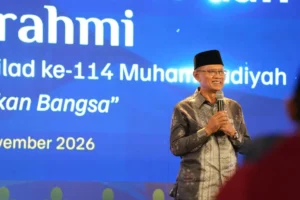
The modern era offers unprecedented opportunities for personal growth, career advancement, and self-discovery, yet it frequently leaves individuals grappling with a profound sense of existential disorientation. Navigating the complexities of contemporary life requires more than just achieving secular milestones; it demands a clear understanding of one’s fundamental purpose of existence. Addressing this pressing spiritual and philosophical dilemma, Asep Setiawan, a prominent member of the Tarjih and Tajdid Council of the Central Board of Muhammadiyah, delivered a compelling lecture at the KH Ahmad Dahlan Mosque, located within the campus of Universitas Muhammadiyah Yogyakarta (UMY). Held on Thursday, November 5, the gathering served as a vital reminder for students, academics, and the broader public to anchor their life choices in divine principles, transcending the superficial pursuits of the material world.
The discourse, which drew a large crowd of university students and local community members, focused heavily on the intersection of modern identity formation and traditional Islamic teleology. As young adults increasingly face pressure to conform to societal expectations, professional demands, and digital-age distractions, lectures of this nature provide a crucial compass. The setting—a major Islamic higher education institution—further amplified the message, targeting a demographic that stands at the crossroads of intellectual awakening and professional formulation. By integrating classical Islamic jurisprudence and philosophical reflections with the realities of twenty-first-century youth culture, the event underscored the continuous relevance of Muhammadiyah’s educational and spiritual outreach.
Existential Reflection and the Divine Purpose of Creation
At the core of Asep’s lecture was an invitation to engage in deep existential introspection, framed through the lens of Islamic theology. Initiating his discourse, he directed the congregation’s attention to Surah Al-Mu’minun, verse 115, which explicitly challenges humanity to consider whether they were created aimlessly and whether they believe they will never be returned to their Creator. This rhetorical question serves as a foundational motif in Islamic ethics, urging individuals to evaluate the intentionality behind their daily actions, moral choices, and overarching life trajectories.
Asep elaborated that human existence is neither a cosmic accident nor an open-ended experiment without accountability. Rather, Allah has designed human life with precise intentions, furnishing mankind with comprehensive divine guidance through the Al-Qur’an and sending a succession of prophets as living exemplars of ethical conduct. This theological framework establishes that human autonomy is paired with moral responsibility. Consequently, every individual is expected to navigate the world with a conscious awareness of their ultimate origin and destination.
Reinforcing the transient nature of earthly existence, Asep invoked the universally recognized Islamic axiom, inna lillahi wa inna ilaihi raji’un—truly, to Allah we belong and truly, to Him we shall return. He reminded the audience that physical bodies, intellectual capacities, temporal wealth, and social statuses are not permanent possessions but divine trusts. Because life on Earth constitutes a brief preliminary phase, the choices made in the present directly dictate one’s spiritual standing and ultimate reality in the afterlife. Echoing this sentiment with a modern motivational cadence, he urged the congregation, "You live only once, so live a meaningful life. Be the best version of yourself."
Philosophical Metaphors and the Universal Quest for Provision
To bridge abstract theological concepts with accessible human experiences, Asep utilized powerful cultural and philosophical metaphors. He likened the worldly life to a brief stopover on a long journey home, where the ultimate destination is paradise. In articulating this concept, he referenced the well-known Javanese philosophical adage urip ing donya mung mampir ngombe, which metaphorically describes life in this world as merely stopping for a quick drink of water during a long trek. This imagery effectively diminishes the illusion of permanence that often traps individuals in an endless cycle of accumulating material wealth and social prestige.
Expanding on the metaphor of travel, Asep emphasized that any serious journey requires adequate preparation and provisions. In the context of the journey toward the hereafter, he cited Surah Al-Baqarah, verse 197, which commands believers to gather provisions, explicitly noting that the best provision is taqwa (piety and God-consciousness). He contrasted the ephemeral nature of worldly achievements—such as physical beauty, social status, and financial accumulation—with the enduring value of righteous deeds (amal saleh).
During his critique of contemporary materialism, Asep highlighted a prevailing paradox in modern spending habits. He expressed concern over how easily individuals allocate substantial financial resources for dining at upscale cafes or purchasing luxury goods at modern shopping centers, yet display extreme reluctance when it comes to giving charity (sedekah), even in modest amounts. He argued that true financial investment lies in acts of charity and public benevolence, whereas the material goods accumulated with such fervor will inevitably degrade, become obsolete, and ultimately be left behind upon death.
Navigating Youthful Ambitions and the Perils of Aimlessness
A significant portion of the lecture was dedicated to addressing the psychological and sociological realities of the younger generation, particularly university students. In an era dominated by rapid technological disruption, economic uncertainty, and intense peer competition, young people frequently experience decision fatigue and existential drift. Asep cautioned against the dangers of living life merely by following the crowd, drifting wherever cultural currents or societal pressures push them.
Instead, he challenged students to cultivate deliberate life goals, conduct thorough evaluations before making pivotal choices, and ensure that their personal and professional trajectories align with principles that secure well-being in both the worldly sphere and the hereafter (dunia wal akhirat). For university students navigating the rigorous academic landscape of UMY, this guidance serves as an antidote to hyper-individualism and utilitarianism, encouraging a holistic approach to personal development that integrates intellectual rigor with spiritual grounding.
Furthermore, Asep underscored the indispensable role of participating in gatherings of knowledge (majelis ilmu) as a practical strategy for maintaining moral and spiritual direction. He referenced the authentic tradition of the Prophet Muhammad SAW, who stated that whoever traverses a path seeking knowledge, Allah will facilitate for them a path toward paradise (man salaka tariqan yaltamisu fihi ilman sahhalallahu lahu tariqan ilal-jannah). Regular attendance at such educational and spiritual forums acts as a necessary counterweight to the relentless demands of modern employment, academic deadlines, and social obligations, preventing individuals from losing sight of their primary purpose in the hustle of daily existence.
Socio-Religious Implications and Institutional Context
The timing and venue of Asep Setiawan’s lecture reflect broader socio-religious trends within Indonesian civil society, particularly within reformist Islamic organizations like Muhammadiyah. As one of the country’s largest Islamic movements, Muhammadiyah consistently utilizes its extensive network of educational institutions—spanning from early childhood education to premier universities like UMY—to address moral and spiritual challenges arising from rapid modernization and globalization.
Sociological analyses of contemporary Indonesian youth indicate a growing demand for spiritual authenticity amidst secularizing pressures. While economic development and digital connectivity offer vast educational and career horizons, they concurrently contribute to rising rates of anxiety, burnout, and a sense of alienation. By contextualizing classical Islamic teachings within modern developmental frameworks, scholars and preachers affiliated with Muhammadiyah provide a vital bridge between traditional faith and contemporary problem-solving.
The emphasis on taqwa, purposeful living, and charitable investment also carries significant socio-economic implications. In a developing nation striving to achieve equitable growth and poverty alleviation, the religious imperative toward charity and social solidarity—highlighted by Asep’s critique of consumerist excess—reinforces institutional efforts in philanthropy. Muhammadiyah itself operates a vast array of hospitals, orphanages, and disaster relief units funded largely through religious endowments and community donations. Consequently, individual spiritual discipline directly translates into collective social welfare.
Conclusion: A Holistic Vision for a Meaningful Life
The comprehensive discourse delivered by Asep Setiawan at the KH Ahmad Dahlan Mosque encapsulates the enduring mission of Islamic scholarship: to guide humanity through the complexities of existence by anchoring temporal actions in eternal truths. By weaving together Quranic exegesis, traditional philosophical wisdom, and direct appeals to the realities faced by modern youth, the lecture offered a robust framework for personal transformation.
Ultimately, the message resonates far beyond the walls of the UMY campus. It serves as a universal reminder that finding one’s identity is an incomplete endeavor without a concurrent commitment to discovering and fulfilling one’s ultimate purpose. Whether through mindful decision-making, the prioritization of righteous deeds over transient material accumulations, or the continuous pursuit of knowledge in communal gatherings, individuals are encouraged to navigate their brief worldly journey with intention, dignity, and a steadfast focus on the hereafter.