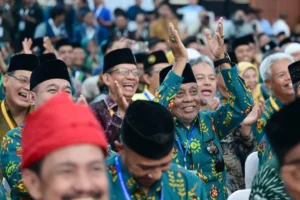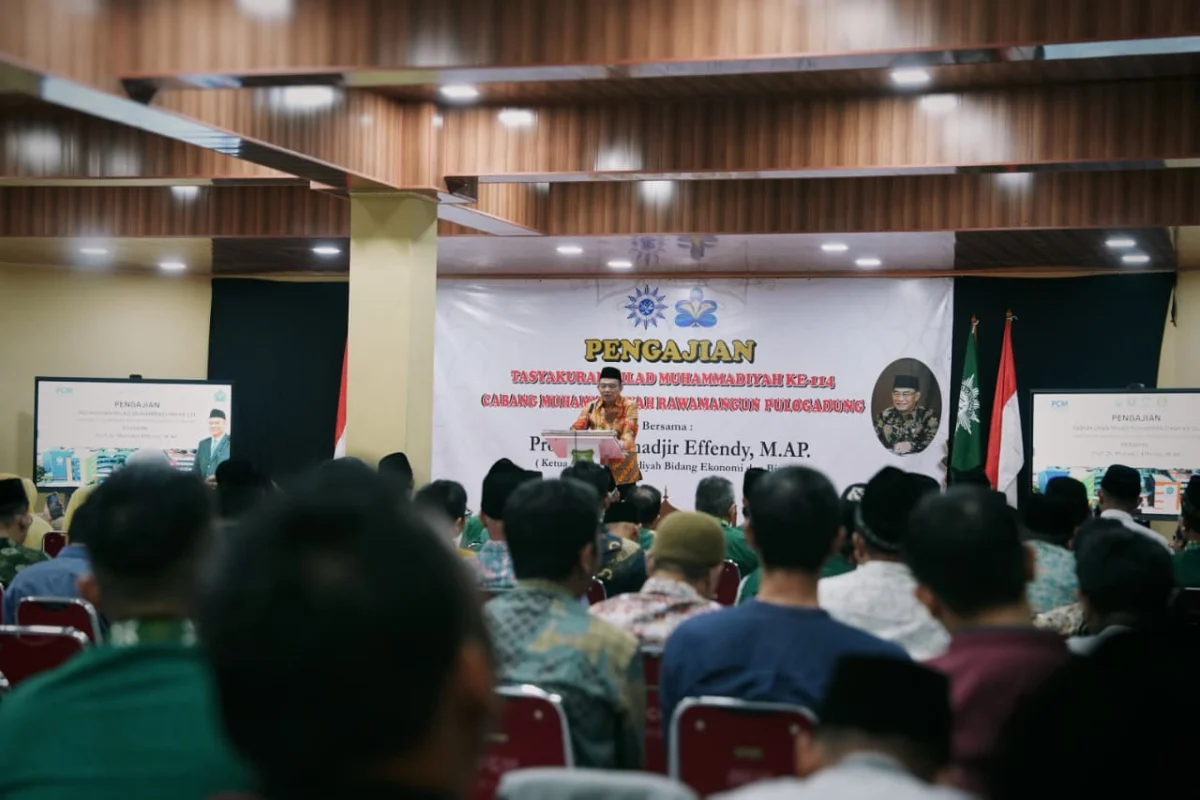
The Pimpinan Cabang Muhammadiyah (PCM) Rawamangun recently hosted a momentous celebration honoring the tireless dedication of employees serving within its various Amal Usaha Muhammadiyah (AUM) institutions. Held on Saturday, November 21, at the Aula Moch Sjarief located within the SMP Muhammadiyah 31 complex in East Jakarta, the event served a dual purpose: celebrating the 114th Milad (anniversary) of Muhammadiyah through a traditional Pengajian Tasyakuran, and publicly recognizing the long-serving staff whose daily labor sustains the organization’s educational, social, and health services.
The gathering brought together regional leaders, organizational members, educators, health workers, and administrative personnel to reflect on more than a century of Muhammadiyah’s contributions to Indonesian society. Amidst prayers, communal reflections, and milestone addresses, the spotlight firmly centered on workforce recognition. Long-serving employees received substantial rewards reflecting their tenure: staff members with a decade of continuous service were presented with 5-gram gold bars, while those who had dedicated two decades of their lives to the Persyarikatan were awarded fully funded Umrah pilgrimages to Mecca.
This high-profile recognition event, however, quickly transcended mere ceremonial celebration. It evolved into a critical platform for high-level institutional introspection, led by Prof. Dr. Muhadjir Effendy, Chairman of the Central Leadership (PP) Muhammadiyah. Addressing the audience, Muhadjir delivered a profound address that recalibrated the organizational ethos regarding workforce welfare, reinterpreted foundational historical doctrines, and laid out a strategic blueprint for sustainable economic independence across grassroots chapters.
Contextualizing the Milad and the Evolution of AUM
To fully understand the significance of the PCM Rawamangun event, one must examine the institutional framework of Muhammadiyah. Founded in 1912 by KH Ahmad Dahlan in Yogyakarta, Muhammadiyah has evolved into one of the largest Islamic socio-religious organizations in Indonesia. Its vast network spans thousands of educational institutions—ranging from primary schools to major universities—alongside hospitals, clinics, orphanages, and economic enterprises collectively known as Amal Usaha Muhammadiyah.
These institutions operate as the tangible manifestations of Muhammadiyah’s theology of action, inspired by Surah Al-Ma’un, which emphasizes practical social responsibility, poverty alleviation, and community upliftment. However, the sheer scale of AUM operations introduces complex administrative and financial challenges. As Muhammadiyah branches expand across urban centers like East Jakarta, the sustainability of these institutions increasingly relies on professional management, stable financing, and, crucially, the well-being of the personnel executing daily operations.
The event organized by PCM Rawamangun directly addresses this operational reality. By formally acknowledging employees who have served for 10 and 20 years, the branch underscored a vital institutional transition: moving away from viewing staff merely as voluntary religious workers toward recognizing them as professional assets whose retention is vital for institutional longevity.
Reframing Historical Wisdom: The True Intent of KH Ahmad Dahlan
A central highlight of Muhadjir Effendy’s keynote address was his deliberate effort to correct a widespread misinterpretation of a famous historical maxim coined by Muhammadiyah founder KH Ahmad Dahlan: "Hidup-hidupilah Muhammadiyah, jangan mencari penghidupan di Muhammadiyah" (Enliven Muhammadiyah, do not seek a livelihood in Muhammadiyah).
For decades, this maxim has occasionally been misconstrued—sometimes exploited—as a justification for underpaying teachers, medical personnel, and administrative staff working within AUM institutions. Under this flawed interpretation, working for Muhammadiyah was framed strictly as an act of uncompensated, pure volunteerism, where expecting competitive market wages was viewed as contrary to the spirit of jihad and service.
Muhadjir firmly rejected this notion, providing a historically grounded and ethically rigorous reinterpretation of the founder’s intent. He clarified that KH Ahmad Dahlan directed this warning specifically at organizational leaders and administrators, cautioning them against using Muhammadiyah as a vehicle for personal enrichment, political patronage, or self-aggrandizement. The instruction was never meant to serve as an excuse to depress wages or neglect the basic human rights and financial security of rank-and-file workers.
“Jangan sampai guru, karyawan, dan perawat yang mengabdikan hidupnya untuk Muhammadiyah tidak kita jamin kehidupannya secara layak,” Muhadjir stated emphatically during his address, translating to a firm directive that teachers, administrative staff, and nurses who dedicate their lives to the movement must be guaranteed a decent standard of living.
This policy stance represents a vital modernization of labor ethics within Indonesia’s religious non-profit sector. By explicitly tying organizational legitimacy to employee welfare, PP Muhammadiyah is signaling that modern Islamic philanthropy cannot ethically rely on labor exploitation disguised as piety.
Strategic Roadmap: Economic Independence and the Endowment Fund
Addressing workforce welfare on a systemic level requires structural financial transformation. During the event, Muhadjir outlined the core challenges facing AUM sustainability and introduced forward-looking economic strategies designed to secure long-term financial resilience for grassroots chapters like PCM Rawamangun.
He identified employee and institutional welfare as a paramount organizational priority that requires urgent structural attention. Relying solely on fluctuating tuition fees, fluctuating patient revenues, or ad-hoc public donations is no longer sufficient to guarantee the long-term financial health of AUM institutions or the competitive compensation of their workers.
To resolve this structural vulnerability, Muhammadiyah’s central leadership is actively developing institutional endowment funds (dana abadi). These financial instruments are designed to generate stable, recurring investment yields that can be directly channeled into subsidizing institutional operations, upgrading infrastructure, and securing competitive retirement and salary frameworks for educators and health workers.
Furthermore, Muhadjir urged PCM Rawamangun to proactively pursue economic self-sufficiency by diversifying local revenue streams, developing productive business units, and rigorously optimizing organizational assets. True independence, he argued, cannot be achieved without robust internal financing mechanisms.
“Muhammadiyah tidak mungkin tumbuh berkembang tanpa memiliki sumber pembiayaan sendiri,” Muhadjir remarked, emphasizing that sustainable growth is inextricably linked to independent revenue generation.
Expanding the Local Retail Footprint: The Mentari Mart Initiative
As a practical application of this economic self-reliance strategy, the leadership specifically highlighted the expansion of the Mentari Mart retail initiative. Mentari Mart is a modern retail chain concept developed within the Muhammadiyah ecosystem to compete in the contemporary retail landscape while retaining community-oriented economic principles.
Muhadjir challenged PCM Rawamangun to scale up its commercial footprint by expanding the Mentari Mart network to establish more than 20 operational outlets throughout the local district. By integrating modern retail management with a loyal consumer base drawn from the extended Muhammadiyah community—including school parents, alumni, mosque congregations, and health clinic patients—the branch can capture steady commercial margins.
The surplus revenue generated from these commercial units is intended to flow directly back into the local treasury, creating a closed-loop economic ecosystem. This financial buffer directly supports the social and educational programs managed by PCM Rawamangun, while simultaneously generating funds to improve employee remuneration packages and staff incentive programs, such as the gold awards and Umrah packages recently distributed.
Broader Implications and Analytical Outlook
The convergence of workforce recognition, theological reinterpretation, and economic strategizing at the PCM Rawamangun Milad celebration offers significant insight into the broader trajectory of contemporary Islamic civil society organizations in Indonesia.
First, it highlights a generational shift in human resource management within faith-based institutions. As private sector employment and state civil service roles offer increasingly competitive compensation and benefits, non-profit religious organizations face severe talent drain if they fail to modernize their human capital strategies. By rewarding long-term staff with high-value incentives like gold and religious pilgrimages—while pushing for systemic wage security—PCM Rawamangun and PP Muhammadiyah are demonstrating that institutional loyalty must be reciprocated with tangible material security.
Second, the insistence on economic independence through initiatives like endowment funds and modern retail networks points toward a resilient model of organizational sustainability. In an era marked by shifting philanthropic trends and macroeconomic uncertainties, institutions that diversify their income sources beyond traditional donor dependency are vastly better positioned to fulfill their long-term social missions.
Finally, Muhadjir Effendy’s public clarification of KH Ahmad Dahlan’s historical teachings helps purge institutional culture of lingering misconceptions regarding labor compensation. By establishing fair wages and structural welfare provisions as a moral imperative rather than an optional corporate perk, Muhammadiyah reinforces its foundational identity as a progressive, reformist movement dedicated to human dignity, social justice, and systemic empowerment.
As PCM Rawamangun looks forward beyond its milestone 114th Milad celebration, the dual commitment to honoring dedicated personnel and building unshakeable economic self-reliance establishes a compelling benchmark for hundreds of other Muhammadiyah regional branches across the Indonesian archipelago.