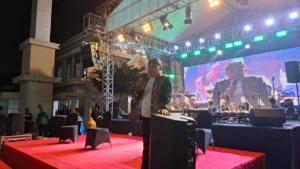
Disasters are rarely isolated events or purely natural occurrences; rather, they are the culmination of complex historical processes, systemic policy failures, and accumulated environmental degradation over time. This critical perspective was articulated by Busyro Muqoddas, Chairperson of the Central Board (PP) of Muhammadiyah, during his keynote address at the National Seminar titled Interfaith in Action: Lessons from One Year of the Sumatra Disaster Response to Strengthen an Inclusive and Sustainable Humanitarian Ecosystem.
The seminar, held on Thursday, November 26, at PKU Gamping Hospital in Sleman, Yogyakarta, was a collaborative initiative organized by the Muhammadiyah Disaster Management Center (MDMC) PP Muhammadiyah in partnership with the Humanitarian Forum Indonesia (HFI). The event brought together religious leaders, academics, environmental activists, and humanitarian workers to evaluate the long-term impacts of natural disasters, particularly focusing on the devastating events that struck regions in Sumatra a year prior.
Unpacking the Nexus Between Politics and Natural Disasters
Reflecting on the catastrophic natural events that hit North Sumatra, West Sumatra, and Aceh, Busyro recalled being approached by journalists just five days after the tragedy to offer an expert assessment. At the time, he emphasized the necessity of rigorous academic and scientific investigation to determine whether the catastrophes were strictly natural or if they were anthropogenic disasters exacerbated by political agendas and flawed policymaking.
Utilizing a phenomenological approach to examine the sequence of events, Busyro argued that disasters are inextricably linked to preceding social phenomena, including structural violence and political radicalization. This methodological framework allows researchers and policymakers to look beyond immediate physical symptoms—such as flash floods, landslides, and collapsed infrastructure—and analyze the underlying conditions that enable such vulnerabilities to manifest.
Drawing a parallel to urban environmental crises, Busyro referenced the recurring, chronic flooding in Jakarta, which is frequently dismissed by officials as merely "water sent from upstream regions." He recalled that during a period when the Corruption Eradication Commission (KPK) operated with robust independence, the institution conducted comprehensive, multi-sectoral studies from upstream to downstream. These assessments involved collaboration with university academics and professional civil society organizations, ultimately concluding that while environmental destruction appears as a physical consequence, the true root cause is deeply rooted in political interests and governance failures.
According to Busyro, contemporary environmental degradation is heavily influenced by systemic regulatory frameworks, including the implementation of National Strategic Projects (PSN), the controversial Job Creation Law (Undang-Undang Cipta Kerja), the Mining Law (Undang-Undang Minerba), and the systemic weakening of anti-corruption oversight bodies such as the KPK. These policy instruments, he argued, often prioritize short-term economic growth and corporate extraction over ecological sustainability and public safety, leaving vulnerable communities to bear the catastrophic human and economic costs.
The Role of Interfaith Collaboration in Humanitarian Action
Despite the sobering analysis of structural vulnerabilities, the seminar also served as a platform to highlight constructive pathways forward, specifically through cross-sectoral and interfaith cooperation. Busyro strongly endorsed the involvement of diverse religious and faith-based communities in humanitarian relief and environmental advocacy.
Engaging interfaith networks in humanitarian work is vital for making religious faith tangible, practical, and responsive to real-world crises, Busyro noted. By moving beyond insular theological discourse, religious communities can unite under shared values of compassion, justice, and ecological stewardship to address systemic injustices and support affected populations regardless of background.
However, Busyro also issued a cautionary note regarding the co-optation of moral and religious authorities by corporate and political interests. Referring to preliminary research concerning nickel mining operations in Morowali, Central Sulawesi, and Halmahera, North Maluku, he highlighted troubling trends where extractive revenues are allegedly utilized to influence prominent religious figures. Such tactics—sometimes involving the funding of pilgrimages, religious tourism, or institutional donations—operate as a form of soft terrorism designed to pacify critical voices among religious communities and social activists alike.
To counter these pressures, Busyro invoked the philosophical insights of Pope Francis regarding truth, beauty, and goodness (la verità, la bellezza, la bontà), emphasizing that the true mission of religious institutions and moral leaders must remain centered on spreading truth, virtue, and welfare rather than serving pragmatic political agendas. He underscored a universal moral accountability, stating that individuals and institutions who enact good will harvest its positive outcomes, while those responsible for harmful policies—such as unchecked extractive projects and environmentally damaging strategic initiatives—will ultimately face the systemic and societal suffering they help generate.
Background and Chronology of the Sumatra Disasters
The seminar’s focal point—evaluating one year of humanitarian response to the Sumatra disasters—refers to a series of high-intensity hydro-meteorological catastrophes that struck several provinces in Sumatra, causing widespread devastation, loss of life, and the displacement of tens of thousands of residents.
In late 2024 and throughout the preceding response cycle, heavy rainfall triggered massive flash floods and cold-lava flows (lahar dingin), particularly around the slopes of Mount Marapi in West Sumatra, alongside severe inundations in North Sumatra and Aceh. These disasters paralyzed regional economies, destroyed vital bridges and road networks, and buried entire residential neighborhoods under layers of mud, rock, and debris.
In the immediate aftermath, humanitarian coalitions, including the MDMC and HFI member organizations, deployed rapid response teams to establish emergency shelters, distribute clean water, provide medical services, and manage community kitchens. However, as the emergency phase transitioned into recovery and rehabilitation, humanitarian actors increasingly recognized that relief efforts alone are insufficient without addressing the root environmental drivers of disaster vulnerability. Deforestation, unregulated land conversion for agriculture, upstream mining operations, and inadequate watershed management were repeatedly identified by environmental experts as critical multipliers of the disaster’s severity.
Implications for Environmental Governance and Policy
The discussions at the Sleman seminar underscore a growing consensus among Indonesian civil society organizations, academics, and faith-based humanitarian networks that disaster risk reduction (DRR) must be integrated with broader governance reforms. The critique of National Strategic Projects (PSN) and deregulation policies highlights ongoing tensions between rapid infrastructural development and ecological sustainability in Indonesia.
Critics and environmental advocates argue that fast-tracking large-scale projects without rigorous environmental impact assessments (AMDAL) and genuine public consultation often exacerbates ecological fragility. Deforestation for mining and industrial plantations strips away natural buffers against extreme weather events, turning routine seasonal heavy rainfall into catastrophic disasters. Furthermore, the weakening of regulatory watchdogs and anti-corruption institutions creates an environment where oversight is compromised, allowing unchecked exploitation of natural resources to persist unchecked.
Moving Forward: Fostering an Ecologically Friendly Faith
Concluding his address, Busyro issued a collective call to action directed at Humanitarian Forum Indonesia, academic institutions, and civil society organizations. He urged stakeholders to formulate new paradigms and practical methodologies aimed at "grounding a faith that is environmentally friendly" (membumikan iman yang ramah lingkungan).
Clarifying that Muhammadiyah and its partner organizations are not fundamentally opposed to national development or industrial projects, Busyro emphasized that development must be conditioned upon strict environmental sustainability and social justice. The objective is to bridge theology and ecology, transforming religious teachings into active catalysts for environmental conservation and climate resilience.
Through initiatives like the Interfaith in Action seminar, humanitarian networks in Indonesia hope to foster a more inclusive, sustainable, and critically aware humanitarian ecosystem—one equipped not only to respond effectively when disasters strike, but also to challenge the structural and political root causes that put vulnerable populations in harm’s way in the first place.