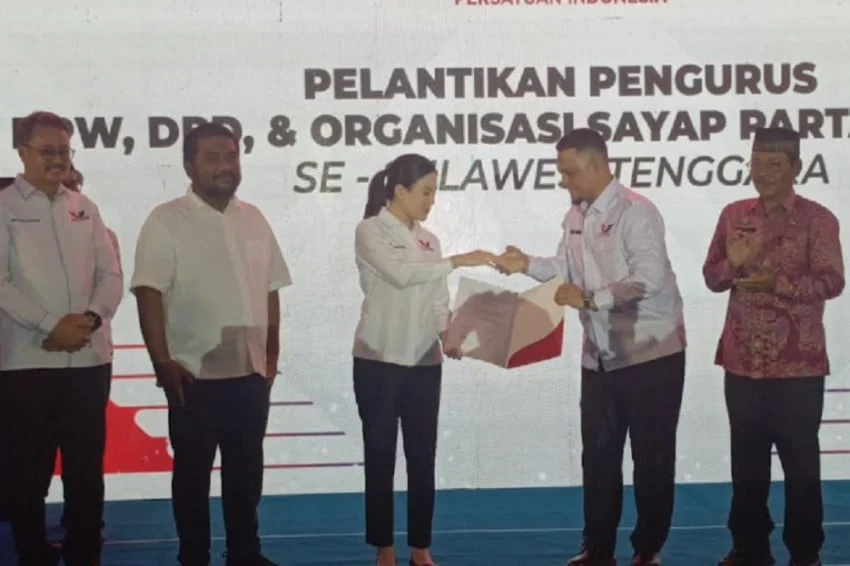
The political landscape of Southeast Sulawesi experienced a significant milestone as the Chairperson of the Central Executive Board (DPP) of the Perindo Party, Angela Tanoesoedibjo, officially inaugurated the administrators of the Regional Executive Board (DPW) and Municipal/Regency Executive Boards (DPD) across the province. The grand consolidation event took place at the prestigious Phinisi Ballroom of the Claro Hotel in Kendari on Friday, November 27, 2026. This high-profile gathering brought together hundreds of party cadres, regional leaders, and local supporters, marking a crucial step in Perindo’s strategic preparations for future political engagements and grassroots development.
During the formal inauguration ceremony, Angela Tanoesoedibjo delivered an inspiring address that emphasized the critical importance of regional adaptability, structural readiness, and direct community engagement. She expressed her profound appreciation for the dedication demonstrated by the newly appointed administrators, highlighting their acute capability to identify and address the genuine, everyday needs of the people of Southeast Sulawesi. The event served not only as a structural handover of leadership mandates but also as a powerful rallying cry for party members to anchor their political missions in the realities of local socio-economic conditions.
Comprehensive Structural Consolidation in Southeast Sulawesi
The strategic decision by the Perindo central leadership to visit Kendari and personally oversee the inauguration underscores the high priority placed on the Southeast Sulawesi region. Regional expansion and structural reinforcement are vital components of the party’s broader national blueprint. By solidifying the leadership tiers at both the provincial (DPW) and regency/city (DPD) levels, the party aims to create an unbroken chain of command and communication from the national headquarters down to the sub-district and village levels.
Political analysts observing the event noted that direct interventions by top-tier national figures like Angela Tanoesoedibjo significantly boost local morale. Following the inauguration, the newly inducted DPW and DPD members immediately initiated internal consolidation meetings. These sessions were designed to streamline organizational workflows, evaluate existing territorial networks, and map out priority areas where Perindo can deliver targeted community assistance and localized advocacy.
In her address, Angela emphasized that political legitimacy is earned through consistent, tangible contributions to society. She noted that modern political parties must transcend traditional election-cycle mobilization and instead function as continuous pillars of support for ordinary citizens. This philosophy forms the bedrock of Perindo’s operational ethos, prompting its leaders to urge all newly sworn-in officials to immerse themselves in local community issues—ranging from economic empowerment for micro, small, and medium enterprises (MSMEs) to agricultural and fisheries development, which are vital to Southeast Sulawesi’s economy.
Full Support and Strategic Backing from the Central Leadership
A central theme of Angela Tanoesoedibjo’s speech was the unwavering commitment of the DPP to empower its regional chapters. Building a robust political infrastructure requires reliable logistical, strategic, and moral backing from the top down. Angela assured all assembled cadres that the central headquarters is fully prepared to mobilize resources and provide comprehensive support to ensure local programs achieve maximum impact.

"We must be able to understand what is currently needed in this region—Southeast Sulawesi. And I am extremely pleased that the Chairman and the entire leadership lineup are fully capable of understanding these local needs. Rest assured, we from the DPP are providing full support for our initiatives among the community," Angela stated during the ceremony.
This explicit pledge of full backing is expected to accelerate the implementation of various party initiatives tailored to Southeast Sulawesi’s unique geographical and demographic characteristics. Comprising a mix of mainland territories and rich island clusters, the province presents distinct logistical and economic challenges. By empowering local DPD boards who possess intimate knowledge of their respective territories, the party ensures that its policies are both contextually relevant and efficiently executed.
Broader Implications and Strategic Vision for National Development
The event in Kendari is part of a nationwide series of structural refreshments and inaugurations spearheaded by the Perindo leadership. As Indonesia continues to navigate complex socio-economic landscapes, political parties are increasingly judged by their capacity to offer practical solutions to everyday struggles, such as inflation, job creation, and regional equity.
Angela reiterated that the ultimate objective of political organization is nation-building in its truest sense. She challenged the newly inducted administrators to view their positions not merely as titles of prestige, but as heavy responsibilities demanding selfless service. The presence of the Perindo Party, she argued, must be felt directly and positively by every segment of the Indonesian population, fostering inclusive growth and social welfare.
"When I perform the inauguration of the DPW and DPD for Southeast Sulawesi today, I am emphasizing the fundamental question of how we build the nation," Angela explained. This philosophical approach aligns with Perindo’s long-standing identity as a party centered on economic nationalism, unity, and welfare creation.
Immediate Next Steps and Future Outlook
Following the culmination of the official ceremonies and photo sessions, the leadership of the Southeast Sulawesi DPW transitioned directly into tactical planning sessions. Immediate priorities include finalizing administrative documentation across all regional branches, conducting orientation workshops for newly minted DPD members, and launching localized community service programs designed to establish immediate goodwill and visibility.
The successful execution of the Kendari inauguration demonstrates Perindo’s methodical approach to organizational resilience. By pairing top-level administrative oversight with grassroots empowerment, the party is systematically fortifying its foundation. As the political cycle progresses, the effectiveness of these newly minted boards in translating central directives into localized victories will serve as a crucial barometer of Perindo’s growing influence in Eastern Indonesia.