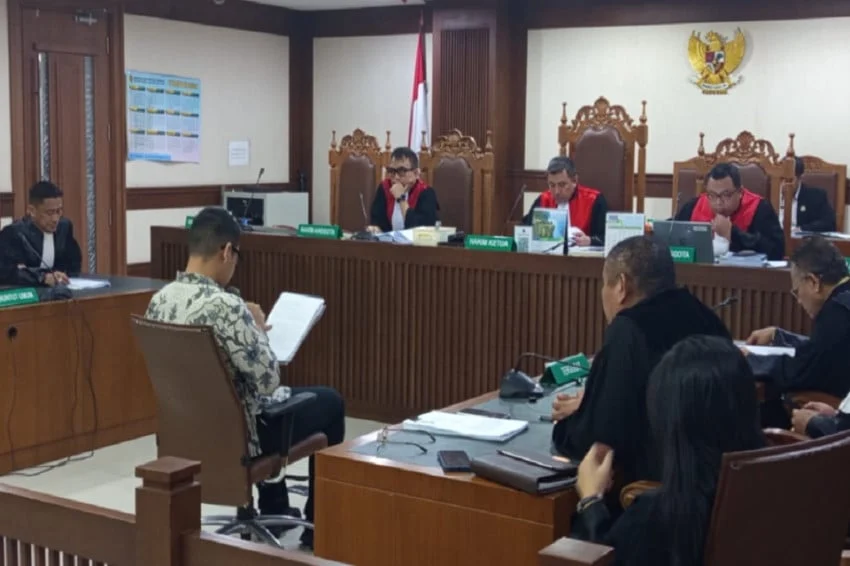
The Central Jakarta District Court recently played host to a tense legal showdown as the ongoing trial regarding alleged extortion and criminal intimidation reached a critical juncture. Jaksa Penuntut Umum (JPU)—the state prosecution team—formally responded to the defense strategies deployed by the legal representatives of the defendant, Bangun Paulus Tudungta, widely known in the proceedings as BPT. The core of the prosecution’s latest response centers on the dismissal of the defense’s closing statement, or pleidoi, which JPU representatives characterized as inherently subjective and designed primarily to shield the accused from the gravity of the charges leveled against him.
The proceedings underline a complex legal battle involving accusations of severe financial coercion and threats directed at the complainant, Vincent Leo Karlius. As the trial progresses toward its final stages, the legal community and observers alike are closely monitoring the Central Jakarta District Court for what is expected to be a landmark ruling on the boundaries of legal extortion, the standards of evidentiary support in criminal cases, and the interpretation of intimidation under the Indonesian Criminal Code (KUHP).
Prosecution Response to the Defense Pleidoi
Following a rigorous court session at the Central Jakarta District Court on the evening of Wednesday, November 25, 2026, lead prosecutor Andri Saputra stepped forward to address the media regarding the contents of the defense’s pleidoi. According to Andri, the arguments presented by Bangun Paulus Tudungta and his defense counsel failed to objectively dismantle the state’s case, leaning instead on partisan interpretations of the trial proceedings.
"That pleidoi is a right granted by the law to the defendant and his team of advocates. Naturally, in our view, the pleidoi tends to be rather subjective, because they naturally stand in a position that favors the defendant," Andri stated to reporters outside the courtroom.
The prosecution was addressing specific claims made by the defense team, who had argued vehemently that the charges against BPT lacked the necessary minimum threshold of two valid pieces of evidence as mandated by Indonesian criminal procedural law. Furthermore, the defense maintained that the interaction between the defendant and the victim, Vincent Leo Karlius, did not meet the legal criteria for extortion and criminal intimidation.
Despite these robust denials, Andri maintained an unwavering stance regarding the integrity of the prosecution’s case. He emphasized that while it is standard procedure for defense attorneys to advocate fiercely for their clients—often resulting in a skewed or one-sided presentation of facts—the state relies strictly on the objective accumulation of evidence brought to light during the trial phases.
"That is their opinion, and it is entirely valid in my view," Andri remarked. "However, we remain confident because, as I said, advocates naturally lean toward subjectivity. They must side with the defendant. As for us, we operate according to the facts of the trial, and in our view, the charges have been proven."
Chronology and Background of the Case
The legal saga involving Bangun Paulus Tudungta did not materialize overnight; it is the culmination of a protracted dispute that has wound its way through preliminary investigations, grand jury-style indictments, and months of testimonial hearings. The case officially entered the judicial docket at the Central Jakarta District Court following formal complaints filed by Vincent Leo Karlius, who alleged that he had been subjected to continuous pressure, systemic threats, and unlawful demands for monetary compensation.
According to court documents and preliminary investigative files, the relationship between BPT and Vincent Leo Karlius deteriorated over a business disagreement that allegedly spiraled into coercive tactics. The prosecution alleges that the defendant leveraged threats of reputational damage and legal complications to extract financial gains from the victim. These actions formed the bedrock of the initial police reports, which subsequently triggered a thorough criminal investigation by law enforcement agencies.
Throughout the investigative phase, defense teams for BPT consistently argued that the financial transactions in question were part of legitimate commercial negotiations rather than illicit extortion. However, as the case moved from the police desks to the Attorney General’s office and finally into the courtroom, the prosecution found sufficient probable cause to elevate the matter to a full public trial.
Over the subsequent months, the Central Jakarta District Court heard testimonies from multiple witnesses, including the victim, financial analysts, and associates of both parties. Each side sought to establish a distinct narrative: the prosecution portraying a calculated scheme of intimidation and extortion, and the defense painting a picture of a misunderstood financial misunderstanding weaponized through the criminal justice system.
Legal Framework and Statutory Charges
At the heart of the legal arguments is the precise application of the Indonesian Criminal Code (KUHP). The prosecution has formally anchored its indictment on Article 483 paragraph (1) letter a of the KUHP, which specifically addresses the criminal acts of making threats and engaging in coercion intended to compel an individual to perform an action against their will or to surrender valuable assets.
Legal analysts observing the trial note that proving a case under Article 483 requires the prosecution to satisfy strict evidentiary standards. The state must demonstrate not only that verbal or psychological pressure was applied by the defendant, but also that a direct causal link exists between this pressure and the victim’s compliance or distress.
During the presentation of the state’s case, prosecutors introduced digital communications, financial transfer records, and witness accounts intended to prove that the threats made by Bangun Paulus Tudungta were explicit and actionable. In contrast, the defense argued that these communications were taken out of context and misinterpreted by investigators who failed to grasp the underlying commercial dynamic between the two men.
Upcoming Replik and the Road to the Verdict
With the preliminary defense arguments addressed, the judicial timeline marches forward. Prosecutor Andri Saputra confirmed that the state will formally submit its replik—the formal legal response to the defense’s pleidoi—on Thursday, November 26, 2026. This document is expected to systematically dismantle the defense’s claims point-by-point and reaffirm the prosecution’s foundational arguments.
"We will reinforce our demands; we have already detailed the elements that have been proven to violate Article 483 paragraph 1 letter a of the KUHP regarding intimidation," Andri explained. "Regarding the final outcome, we will leave it to the wisdom of the panel of judges to decide."
The submission of the replik will be followed by the duplik (the defense’s response to the prosecution’s replik), after which the panel of presiding judges will deliberate behind closed doors to draft their final verdict. Legal experts anticipate that the sentencing phase, should the court find the defendant guilty, could set an important precedent for how the Indonesian judiciary handles complex overlapping disputes involving commercial friction and allegations of criminal extortion.
Broader Implications for Commercial and Legal Ethics
Beyond the immediate fate of Bangun Paulus Tudungta, this high-profile trial has sparked broader discussions within Indonesia’s legal and business communities regarding the thin line between aggressive negotiation tactics and criminal coercion. As the economy modernizes, business disputes frequently spill over into the public sphere, raising questions about how the state should mediate conflicts where financial stakes are high and personal reputations hang in the balance.
Observers note that cases involving allegations of extortion require courts to exercise extreme caution to ensure that criminal law is not utilized as a shortcut to resolve civil or commercial disagreements. Conversely, the strict enforcement of statutes protecting individuals from intimidation remains essential to maintaining public order and preventing powerful actors from exploiting vulnerable counterparts through fear and coercion.
As the Central Jakarta District Court prepares for the next phase of the trial with the submission of the state’s replik, all eyes remain fixed on the judicial bench. The final ruling will not only determine the legal culpability of Bangun Paulus Tudungta but will also serve as a judicial barometer for how similar white-collar extortion cases are adjudicated in the nation’s capital.