
The fragile security landscape of Indonesia’s Papua Pegunungan region has once again claimed the life of an innocent civilian, highlighting the persistent dangers faced by transportation workers operating in remote interior routes. Aris Sanda, a long-haul travel driver originally from Toraja, South Sulawesi, and affectionately known by his community as Bapak Tasya, met a tragic end after his vehicle was intercepted by an armed separatist faction along the critical transportation corridor connecting Wamena to Mbua in Jayawijaya Regency. What began as a routine commercial transit journey concluded in horror, with the victim discovered dead inside his charred vehicle near the picturesque yet isolated Lake Habema area.
The incident has sent shockwaves through local communities, transport unions, and national legislative bodies alike, intensifying ongoing debates regarding civilian safety, logistical security, and the broader socio-political complexities of the Papua conflict. As law enforcement and military apparatuses ramp up investigative efforts, the brutal killing has underscored the profound human cost borne by everyday workers who facilitate vital economic and passenger links across challenging geographical terrains.
Anatomy of an Interception: Chronology of Events
The sequence of events unfolded on Tuesday, September 15, commencing in the early morning hours. Around 06:00 Eastern Indonesia Time (WIT), Aris Sanda was operating his commercial "lajuran" transport vehicle, navigating the rugged roadway from Wamena toward Mbua in Jayawijaya Regency. Transporting a number of passengers and essential logistical items, Sanda’s vehicle was part of the standard daily traffic relying on this vital artery to sustain commerce and mobility between highland settlements.
According to official operational summaries provided by Lieutenant Colonel Inf M. Wirya Arthadiguna, Head of Information for the Habema Joint military command (Koops TNI Habema), the transit routine was abruptly shattered near the Lake Habema junction, situated around Gunung Boy in Trikora District. A heavily armed faction materialized along the roadway, signaling the vehicle to halt.
Upon stopping, the armed individuals subjected both the driver and his passengers to mandatory checks and interrogations. In a tactical maneuver that spared the general passengers, the armed group ordered the travelers to turn around and return safely toward Wamena. However, Aris Sanda was singled out, separated from the rest of the civilian contingent, and forcibly abducted by the armed assailants, who escorted him deeper into the remote terrain surrounding Lake Habema.
Captivity and Circulating Digital Evidence
As security forces quickly mobilized initial search protocols following reports of the vehicle’s disappearance, chilling details regarding Sanda’s final hours began to emerge through digital channels. The driver was reportedly subjected to captivity and coercion by the armed elements before his execution.
A digital video recording rapidly circulated across various media platforms and messaging applications, providing a disturbing visual record of the unfolding crisis. In the footage, Sanda is visible standing in the middle of a remote roadway, flanked and surrounded by multiple armed individuals brandishing weapons. The video captured moments of duress, during which the civilian driver was allegedly coerced into holding the separatist Bintang Kejora (Morning Star) flag while making enforced statements concerning the political status of Papua.
National police investigators and joint military intelligence units immediately incorporated these digital artifacts into their formal forensic workflows, analyzing the metadata, audio cues, and background geography to verify the timeline of coercion and to identify the specific individuals present during the ordeal.
Discovery of the Remains Amid Difficult Terrain
The pursuit to locate Sanda faced immediate environmental hurdles. On Wednesday, September 16, specialized units from Koops TNI Habema launched extensive search and sweep operations across the high-altitude topography surrounding Lake Habema. Initial assessments during the early hours of Wednesday were hampered by severe weather patterns, including dense fog, freezing temperatures, and rugged terrain that drastically limited visibility and impeded motorized vehicular progress.
Despite these logistical constraints, the joint task force pressed forward. Within hours of the initial morning setback, the search parties successfully located the grim remains of Sanda’s commercial vehicle. The automobile had been intentionally set ablaze, reduced to a blackened, structural shell resting in the remote wilderness.
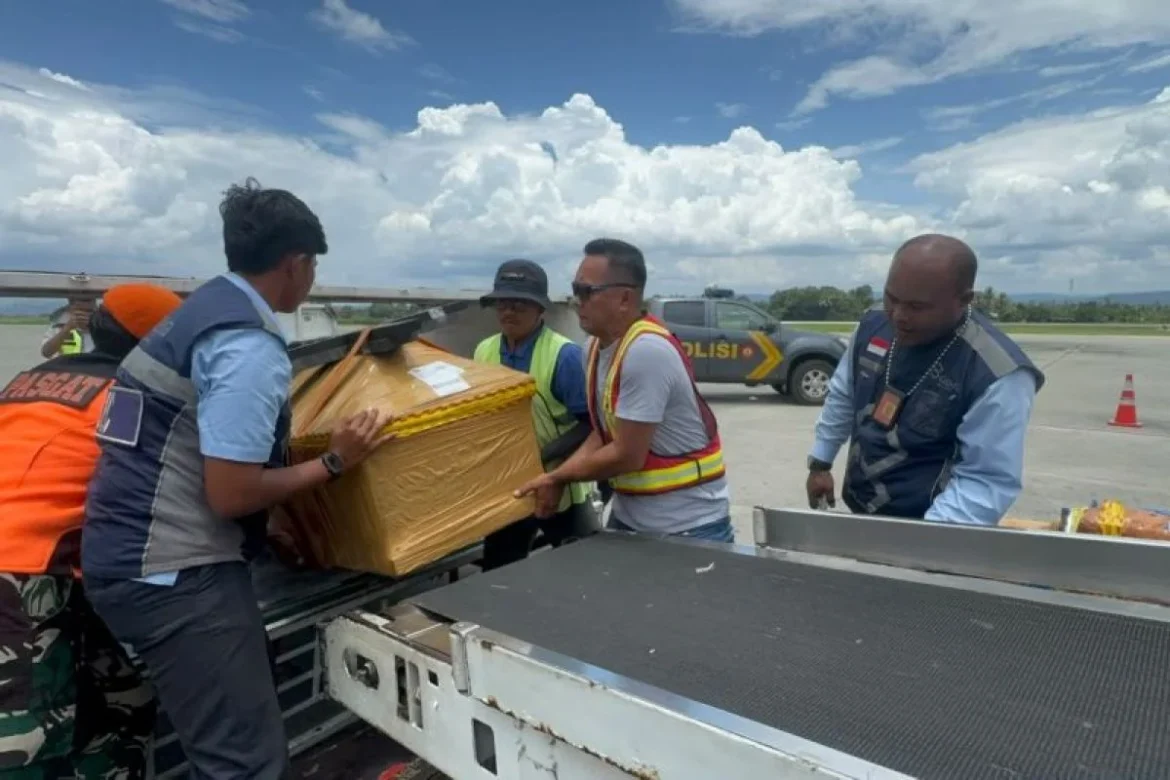
Upon closer inspection, the charred remains of Aris Sanda were discovered inside the burnt vehicle cabin. The extreme heat of the fire had caused significant structural damage to both the transport automobile and the victim’s remains. Tactical teams immediately secured the perimeters for forensic processing, subsequently executing a solemn evacuation protocol to transport the body out of the highlands. The remains were initially transferred to the Wamena Regional General Hospital (RSUD) for preliminary forensic identification, post-mortem examinations, and identification procedures before being prepared for final repatriation to his grieving family in Makassar and Toraja.
Official Investigations and Attribution of Responsibility
Following the recovery of the body, a joint investigative team comprising personnel from the Indonesian National Police (Polri) and the Indonesian National Armed Forces (TNI) executed a thorough crime scene investigation (Olah TKP). Investigators meticulously combed the areas surrounding both the initial interception point and the final vehicle combustion site, recovering ballistic fragments, personal artifacts, and vehicular debris to reconstruct the exact manner of execution.
Preliminary security assessments place responsibility for the atrocity squarely on elements linked to the West Papua National Liberation Army (TPNPB), specifically factions operating under the command structure of OPM Kodap III Ndugama. The TNI has maintained that Sanda was an innocent civilian worker simply fulfilling his professional duties—transporting civilian passengers and regional provisions across a public highway—when he was targeted.
Authorities have intensified targeted operations to track down the perpetrators, emphasizing that the deliberate targeting, abduction, psychological coercion, and subsequent murder of a non-combatant driver constitute severe violations of basic humanitarian principles and criminal law. Law enforcement agencies continue to synthesize witness testimonies, digital forensic data from the circulating videos, and ballistic evidence to build a comprehensive prosecution file.
Socio-Economic Implications and Public Reactions
The killing of Aris Sanda has reverberated far beyond the immediate boundaries of Jayawijaya Regency, igniting widespread national anxiety regarding the safety of civilian logistics workers and public transportation operators in Papua’s interior highlands. Because "lajuran" drivers serve as the economic lifeblood of isolated communities—hauling staple foodstuffs, medical goods, and civilian commuters across hostile geographies—such attacks threaten to sever vital supply chains, driving up the cost of living and instilling a climate of paralyzing fear.
The incident has triggered sharp reactions from high-ranking political figures and parliamentary committees. Representatives from Commission I of the House of Representatives (DPR RI) vocally condemned the attack, characterizing the execution of a civilian driver as a direct, unacceptable assault on the safety and fundamental human rights of ordinary citizens working in the region. Lawmakers underscored that regardless of ongoing political and security disputes, civilians must remain strictly protected under humanitarian norms, and commercial transit workers should never be converted into targets of political violence.
Concurrently, institutional bodies such as the Regional Representative Council (DPD RI) special committees have seized upon the tragedy to reiterate urgent calls for a holistic evaluation of the central government’s security paradigms and conflict-resolution strategies in Papua. Observers note that incidents of this magnitude starkly expose the vulnerabilities inherent in maintaining civil infrastructure and commercial mobility across vast, under-resourced territories where insurgent factions retain tactical mobility.
As investigations proceed through the remainder of the week, the family, colleagues, and broader Torisan diaspora mourn a hardworking provider whose life was cut short by political conflict. For the authorities, the challenge remains not only bringing the direct perpetrators to justice through rigorous legal frameworks but also restoring a baseline of operational security that ensures no other civilian worker must navigate a highway under the constant shadow of violence.
