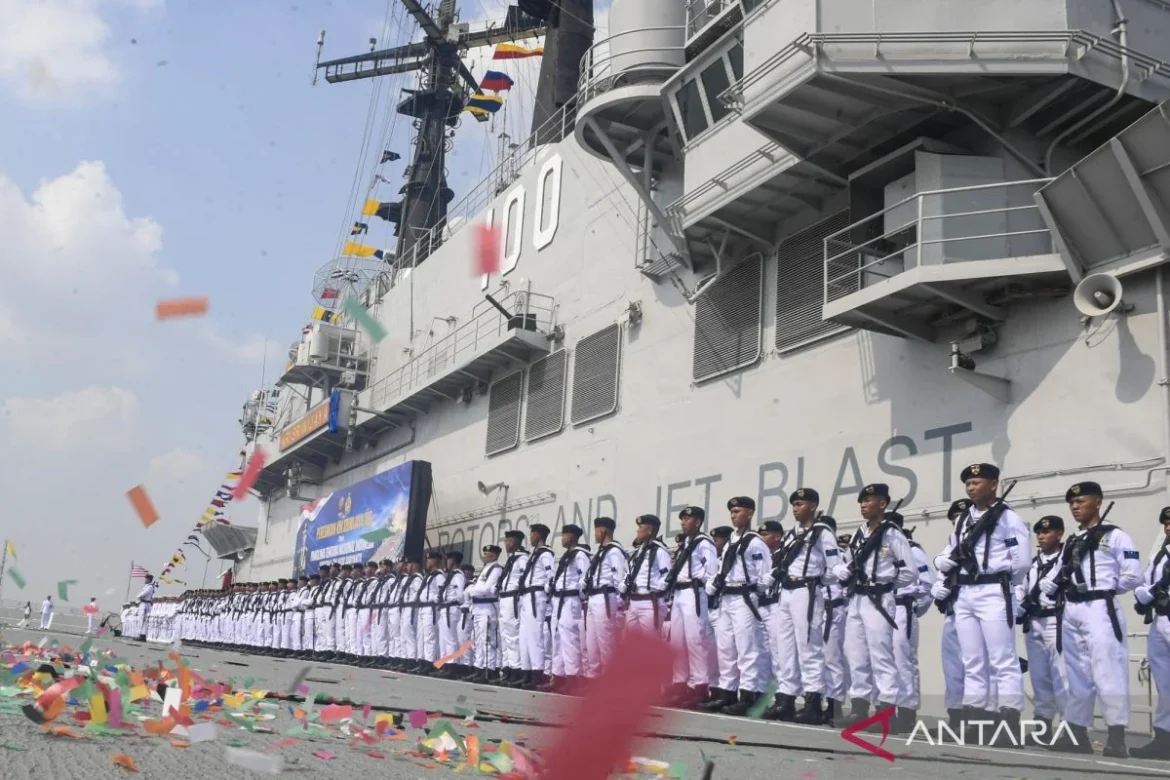
The Indonesian archipelago has entered a new era of maritime defense following the arrival of the former Italian Navy aircraft carrier, the ITS Giuseppe Garibaldi (C551), which docked at Pier 107 of Tanjung Priok Port in North Jakarta. This momentous event marks a critical turning point for the Indonesian Navy (Tentara Nasional Indonesia Angkatan Laut, or TNI AL), as the vessel is slated to become the first true aircraft carrier in the history of the national military fleet.
The arrival has instantly galvanized public interest and sparked intense strategic discussions regarding the definition, operational utility, and geopolitical implications of operating a floating airbase. Originally commissioned by the Italian Navy in the late 1980s, the veteran ship will undergo a comprehensive transition process before being officially renamed KRI Sriwijaya. The formal handover ceremony, which will include the symbolic striking of the Italian colors and the hoisting of the Red and White flag, is scheduled for September 24, 2026, at the historic Tanjung Priok naval facility.
Strategic Context and Chronology of the Acquisition
The path toward Indonesia acquiring its maiden aircraft carrier has been unfolding through quiet diplomatic and defense channels over recent years. Defense analysts note that the acquisition aligns with Indonesia’s broader strategic posture to modernize its "Minimum Essential Force" (MEF) framework into a more robust, blue-water capable maritime force. As an archipelagic nation comprising over 17,000 islands, projecting power, securing vital sea lanes of communication (SLOCs), and ensuring rapid response capabilities across millions of square kilometers of maritime territory present unique logistical challenges.
The timeline of the acquisition crystallized in mid-2026, culminating in the trans-continental voyage of the vessel from the Mediterranean to Southeast Asia. Following its arrival on September 18, 2026, the ship entered a tightly coordinated preparatory phase. The upcoming commissioning ceremony on September 24 will formalize its integration into the TNI AL. High-level diplomatic engagements have paralleled the arrival, with executive branch officials—including confirmations from the Ministry of State Secretariat—coordinating meetings between Indonesian leadership and visiting delegations from the Italian Navy to honor the bilateral defense partnership that facilitated the transfer.
Deconstructing the Asset: What Makes a True Aircraft Carrier?
The public discourse surrounding the arrival of KRI Sriwijaya has brought to light widespread curiosity about the mechanics and military classifications of aircraft carriers. In naval terms, a vessel’s designation is not merely a function of its sheer tonnage or physical length, but rather its architectural design and operational purpose. While destroyers, frigates, and corvettes routinely carry shipboard helicopters to expand their tactical horizons, they fundamentally operate as surface combatants equipped with missile batteries and deck guns as their primary armament.
Conversely, a dedicated aircraft carrier is engineered from the keel up as a mobile, floating aviation base. Its defining structural features include an extensive flight deck, an internal hangar bay equipped for aircraft maintenance and ordnance storage, sophisticated aviation fuel management systems, and specialized air-traffic control infrastructure. These systems allow the vessel to launch, recover, service, and sortie fixed-wing aircraft or rotary-wing assets far beyond the operational tether of land-based airfields.
The ITS Giuseppe Garibaldi, boasting a displacement of over 10,000 tons and a distinctive ski-jump ramp, was originally built to operate Vertical/Short Take-Off and Landing (VSTOL) aircraft such as the AV-8B Harrier II, alongside various antisubmarine and utility helicopters. Its inclusion in the TNI AL inventory dramatically alters the tactical baseline of the Indonesian fleet, providing an unprecedented capability to project air power over maritime zones devoid of stationary airbases.
Operational Doctrine: Balancing Combat Readiness and Humanitarian Missions
Despite the formidable offensive reputation traditionally associated with aircraft carriers globally, Indonesian defense leadership has signaled a uniquely pragmatic operational doctrine for KRI Sriwijaya. Chief of Naval Staff (KSAL) Admiral TNI Muhammad Ali has emphasized that upon taking up the mantle of KRI Sriwijaya, the vessel will not immediately mirror the high-intensity strike postures seen in major Western or regional blue-water navies.
Instead, the immediate operational focus will pivot toward Military Operations Other Than War (OMSP—Operasi Militer Selain Perang). Given Indonesia’s geographical vulnerabilities to natural disasters—including earthquakes, tsunamis, volcanic eruptions, and severe weather events—the ship’s expansive flight deck and massive internal capacity offer unmatched utility as a humanitarian and disaster relief (HADR) platform.
In scenarios where terrestrial infrastructure is crippled, bridges collapse, and coastal roads are washed away, conventional supply lines often grind to a halt. Under the planned utilization framework, KRI Sriwijaya will serve as an offshore staging platform and floating base for heavy-lift helicopters and advanced unmanned aerial vehicles (drones). This setup will allow naval logistics teams to rapidly dispatch medical aid, emergency rations, and evacuation personnel directly into isolated disaster zones without requiring functional local airstrips.
Furthermore, TNI AL officials have expressed strong interest in equipping the platform with modern VSTOL aircraft and rotary assets capable of seamless vertical maneuverability. This capability enhances the navy’s readiness not only for humanitarian interventions but also for maritime sovereignty patrols, search and rescue (SAR) coordination, and comprehensive territorial surveillance across the nation’s sprawling Exclusive Economic Zone (EEZ).
Technical Overhauls and Fleet Integration
The transition of a specialized naval asset from a European NATO nation to Southeast Asia’s largest archipelagic state requires extensive technical remediation. Naval engineers and shipyard specialists are slated to execute thorough structural reinforcements, mechanical refurbishments, and propulsion overhauls to ensure the vessel’s systems align seamlessly with TNI AL maintenance standards and logistical supply chains.
The selection of the historic moniker "Sriwijaya"—paying homage to the ancient maritime empire that once dominated Southeast Asian trade and naval dominance from Sumatra—carries deep symbolic weight for the Indonesian military. It signals a national renaissance in maritime consciousness, reflecting historical ambitions to secure the seas through strength, diplomacy, and regional integration.
As the September 24 commissioning date approaches, military analysts and defense observers continue to parse the long-term implications of this acquisition. While operational hurdles remain—ranging from crew training cycles to the long-term sustainment of specialized aviation gear—the arrival of KRI Sriwijaya firmly establishes a new benchmark for Indonesian defense capability, transforming the horizon of national security and emergency response from the sea.