Tehran, Iran – Iran’s Interior Minister Eskandar Momeni has unequivocally dismissed the potential impact of what he termed an "illusionary" naval blockade by the United States, asserting that the Islamic Republic’s vast land and sea borders, stretching over 8,000 kilometers, render such a move ineffective. His comments, made on April 15, 2026, underscore Iran’s long-standing strategy of resilience against external pressures, even as regional tensions continue to simmer following recent escalations and ceasefire developments. Momeni’s directive to provincial authorities along Iran’s extensive frontiers to actively facilitate the import of essential goods further highlights a proactive approach to counter any potential restrictions and guarantee an uninterrupted supply chain for the nation. This stance comes amidst a backdrop of ongoing geopolitical maneuvering, including pointed statements from Israeli intelligence regarding persistent efforts to destabilize the Iranian regime.
Tehran’s Stance on Perceived Threats
Minister Momeni’s statement is a direct reflection of Iran’s strategic calculus, which has long prioritized self-sufficiency and diversification of trade routes to circumvent international sanctions and potential isolation. By emphasizing the nation’s more than 8,000 kilometers of shared land and maritime borders, Tehran signals its confidence in maintaining access to global markets and necessary resources, regardless of any perceived American attempts at maritime interdiction. The term "illusionary blockade" is deliberately chosen to diminish the credibility and feasibility of such an action, projecting an image of strength and defiance.
Iran’s geographic position, bordering seven countries by land (Iraq, Turkey, Armenia, Azerbaijan, Turkmenistan, Afghanistan, and Pakistan) and possessing extensive coastlines along the Persian Gulf, the Gulf of Oman, and the Caspian Sea, provides numerous conduits for trade. These multifaceted access points, Momeni argues, would allow Iran to mitigate the effects of any targeted naval operations aimed at stifling its economy. The ministerial directive to border provinces to facilitate essential imports is not merely a reactive measure but a reinforcement of a pre-existing "resistance economy" doctrine, designed to fortify domestic supply chains and reduce vulnerability to external shocks. This approach involves leveraging informal trade networks, barter systems, and strategic partnerships to ensure the flow of critical goods, including food, medicine, and industrial components, even under severe duress.
Geopolitical Significance of Iran’s Extensive Borders
Iran’s geographical configuration is a cornerstone of its strategic defense and economic resilience. The country’s maritime borders are particularly vital, with the Strait of Hormuz at its heart. This narrow chokepoint, through which approximately 20% of the world’s petroleum and a significant portion of liquefied natural gas transit, is a double-edged sword for Iran. While it represents a critical artery for its own oil exports, it also offers Iran a potent leverage point in regional and international geopolitics. However, a US-imposed naval blockade would theoretically aim to sever this very artery for Iranian trade, making the existence of alternative routes even more crucial.
Beyond the Persian Gulf, Iran’s access to the Gulf of Oman provides direct oceanic access, bypassing the Strait of Hormuz for certain shipping routes, albeit with increased logistical challenges. The Caspian Sea, shared with Russia, Azerbaijan, Kazakhstan, and Turkmenistan, offers another dimension for trade, particularly with Central Asian and Russian partners, though its utility for global trade is limited by its landlocked nature and the need for trans-Caspian transport.
The extensive land borders are equally significant. For decades, these frontiers have served as both official trade corridors and unofficial routes for goods, some of which are used to circumvent sanctions. The border with Iraq, for instance, has seen substantial trade and influence, while connections with Turkey and Pakistan offer alternative gateways to the West and East, respectively. Trade with Afghanistan and the Central Asian states is critical for regional economic integration and provides pathways for goods that might otherwise be difficult to procure. This complex web of land and sea connections forms a robust infrastructure that, in Tehran’s view, can withstand attempts at complete economic isolation. The government’s emphasis on activating and optimizing these border regions reflects a calculated strategy to exploit Iran’s unique geography as a shield against foreign pressure.
The Concept and Challenges of a Naval Blockade
A naval blockade, in international law, is the isolation by a belligerent of an enemy’s coast or ports to prevent entry or exit of traffic. For a blockade to be recognized as legal, it must be declared, effective, impartial, and limited in time and scope, typically under conditions of armed conflict. Historically, blockades have been powerful tools of war, aiming to cripple an enemy’s economy and war-making capability. Examples range from the Union blockade of the Confederate States during the American Civil War to the Allied blockades of Germany in both World Wars.
However, enforcing a comprehensive naval blockade against a nation like Iran, with its geographic scale and strategic depth, presents immense practical and legal challenges. The US Navy’s Fifth Fleet, based in Bahrain, maintains a significant presence in the Persian Gulf, but completely interdicting all Iranian maritime traffic across thousands of kilometers of coastline and in international waters would require an unprecedented commitment of resources and would inherently carry a high risk of escalation. Iran’s own naval forces, particularly the Islamic Revolutionary Guard Corps Navy (IRGCN), are highly adept at asymmetric warfare, employing fast attack craft, missile boats, drones, and anti-ship missiles, posing a significant threat to larger, conventional naval assets in the confined waters of the Persian Gulf. Furthermore, Iran possesses capabilities for mine warfare, which could severely disrupt shipping in the Strait of Hormuz and other key waterways.
From a legal standpoint, a US-imposed blockade outside of an internationally recognized state of war, or without a UN Security Council resolution, would likely be viewed as an act of aggression by many international actors, including China and Russia, who have vested economic interests in continued trade with Iran. Such a move would undoubtedly trigger a severe international crisis, potentially destabilizing global energy markets and drawing in other regional and global powers.
Iran’s Economic Resilience and Sanctions Landscape
Iran’s economy has been under the shadow of extensive international sanctions for decades, particularly intensified by the US "maximum pressure" campaign since 2018, which aimed to bring Iran’s oil exports to zero. While these sanctions have severely impacted Iran’s economy, leading to high inflation, currency devaluation, and difficulties in accessing international financial systems, they have not led to the collapse of the regime, as some architects of the policy had hoped. Instead, Iran has developed sophisticated mechanisms to circumvent these restrictions, often relying on illicit trade networks, ship-to-ship transfers for oil, and a network of intermediaries.
The "resistance economy" doctrine, championed by Supreme Leader Ali Khamenei, emphasizes self-reliance, domestic production, diversification away from oil, and the promotion of non-oil exports. While not without its struggles, this strategy has fostered a degree of resilience, enabling Iran to endure prolonged periods of isolation. A full naval blockade, however, would represent a significant escalation beyond existing sanctions. While sanctions primarily target financial transactions and specific sectors, a blockade would physically impede the movement of goods, potentially cutting off vital imports like food and medicine, which are often exempt from financial sanctions but could be physically blocked.
Such a drastic measure would undoubtedly exacerbate economic hardship within Iran, potentially leading to increased public discontent. However, the government’s rhetoric, as exemplified by Minister Momeni, consistently frames these external pressures as an assault on national sovereignty, often rallying segments of the population against perceived foreign aggression. The challenge for Iran would be to maintain this narrative and manage internal pressures if a blockade led to widespread shortages and humanitarian concerns.
Israeli Intelligence and "Regime Change" Discourse
The statements from Mossad Chief David Barnea, indicating that Israel does not foresee the immediate collapse of the Iranian regime but will continue "regime change" efforts beyond active combat, add another layer of complexity to the regional dynamics. Barnea’s remarks, delivered in the context of "ongoing regional tensions following recent escalations and ceasefire developments," likely refer to the prolonged conflict between Israel and Hamas, and broader proxy confrontations across the Middle East involving Iran-backed groups.
Israel views Iran as its primary existential threat due to its nuclear program, development of ballistic missiles, and extensive network of proxy forces (such as Hezbollah in Lebanon, Hamas in Gaza, and Houthi rebels in Yemen). The concept of "regime change" in Iran has been a consistent, albeit often implicit, objective for certain Israeli and US policymakers. Barnea’s explicit acknowledgement of ongoing efforts, even if not through direct military invasion, suggests a strategy involving covert operations, cyber warfare, support for internal opposition (if any), and continued diplomatic and economic pressure.
This Israeli position underscores the deep-seated animosity and strategic rivalry that define much of the Middle East’s security landscape. For Iran, such statements from a hostile intelligence agency serve to reinforce its narrative of being under constant threat, justifying its military buildup and regional interventions. The intersection of US blockade threats and Israeli regime change aspirations creates a volatile cocktail, elevating the risk of miscalculation and direct confrontation.
Regional Dynamics and International Implications
The discussion around a potential US naval blockade and Israel’s "regime change" aspirations occurs within a highly volatile regional context. The ongoing conflict in Gaza and its spillover effects, including attacks on shipping in the Red Sea by Houthi rebels and increased tensions along the Israel-Lebanon border, contribute to an environment of heightened alert. Regional powers like Saudi Arabia and the UAE, while wary of Iranian influence, also prioritize stability and the free flow of oil through the Strait of Hormuz. Any direct military confrontation or blockade could severely disrupt global energy supplies, triggering a sharp increase in oil prices and potentially plunging the global economy into crisis.
Internationally, a US-imposed naval blockade on Iran would face significant opposition. China, a major importer of Iranian oil and a growing strategic partner for Tehran, would almost certainly condemn such an action as a violation of international law and freedom of navigation. Russia, also a key ally of Iran and a fellow target of Western sanctions, would likely offer diplomatic and perhaps even practical support to help Iran circumvent the blockade. The European Union, while often aligned with US foreign policy objectives, has consistently advocated for diplomatic solutions, particularly regarding the Iranian nuclear program, and would likely oppose unilateral military actions that could escalate into a broader conflict.
The prospect of a blockade also complicates any future efforts to revive the Joint Comprehensive Plan of Action (JCPOA), the 2015 nuclear deal. Iran has consistently demanded the lifting of sanctions as a prerequisite for full compliance with the agreement. A blockade would represent a dramatic increase in pressure, making any return to diplomacy exceedingly difficult.
Domestic Context and Public Sentiment
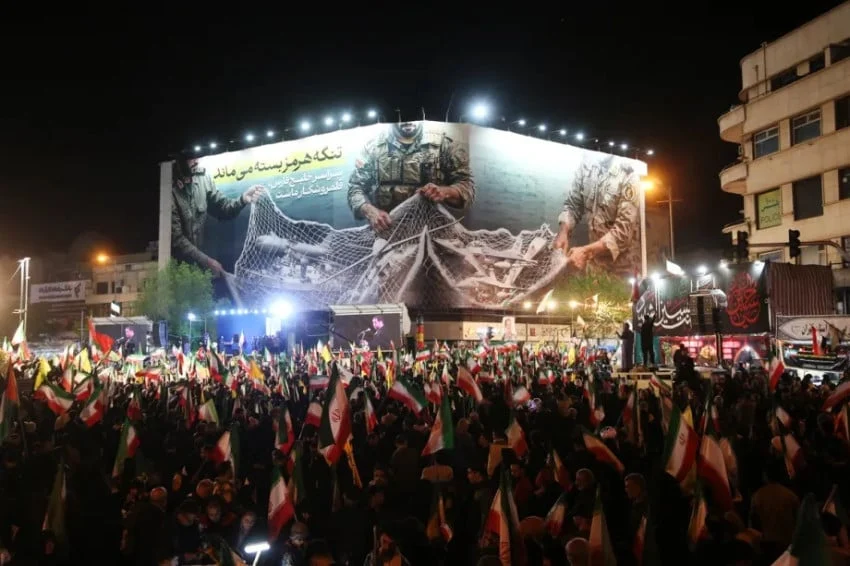
The photo accompanying the original article, depicting Iranians protesting the United States and Israel in Tehran on April 12, 2026, offers a glimpse into the domestic context. Public sentiment in Iran is complex and often divided. While there is a segment of the population that consistently supports the government’s anti-Western stance and its policies of resistance, particularly in the face of perceived external threats, another segment yearns for improved economic conditions and greater engagement with the international community.
Economic hardship, exacerbated by sanctions and internal mismanagement, has historically led to sporadic protests within Iran. However, the government has proven adept at suppressing dissent and channeling public anger towards external adversaries. Minister Momeni’s assurances about uninterrupted supply chains are likely aimed at assuaging domestic concerns about the economic impact of potential new pressures. The government’s narrative often frames any external pressure, whether sanctions or the threat of a blockade, as an assault on national dignity and sovereignty, thereby seeking to unify the populace against a common enemy. The success of this strategy in the face of a severe blockade, however, would depend heavily on the actual impact on daily life and the government’s ability to provide essential goods.
In conclusion, Iran’s steadfast dismissal of a US naval blockade threat underscores its deep-seated conviction in its strategic geographic advantages and its developed mechanisms for economic resilience. While the specter of a blockade and the overt pursuit of "regime change" by Israeli intelligence signal a continued era of heightened regional tensions, Tehran’s response emphasizes defiance, strategic diversification, and a commitment to maintaining its supply lines. The intricate web of geopolitical interests, the complexities of international law, and the significant risks of escalation suggest that any such blockade would be fraught with challenges and potentially destabilizing consequences for the entire Middle East and global energy markets.