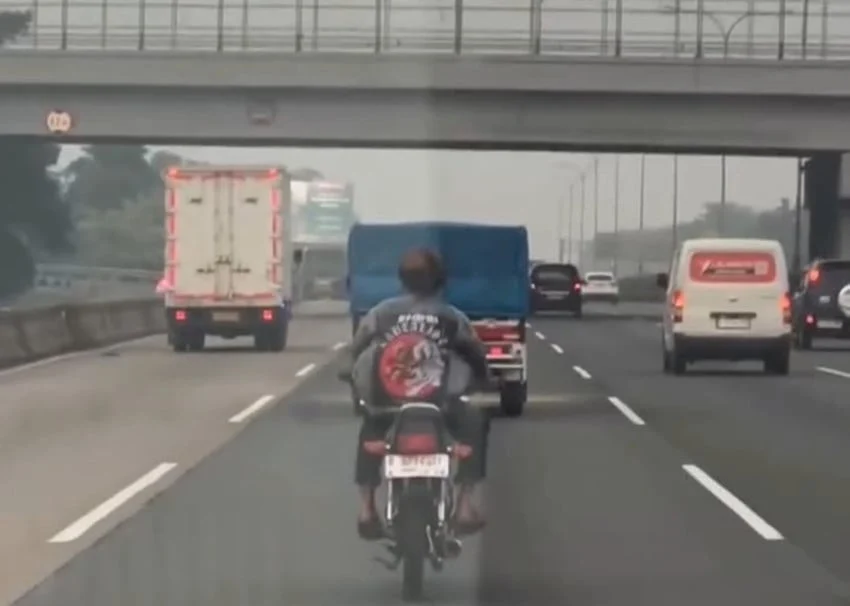
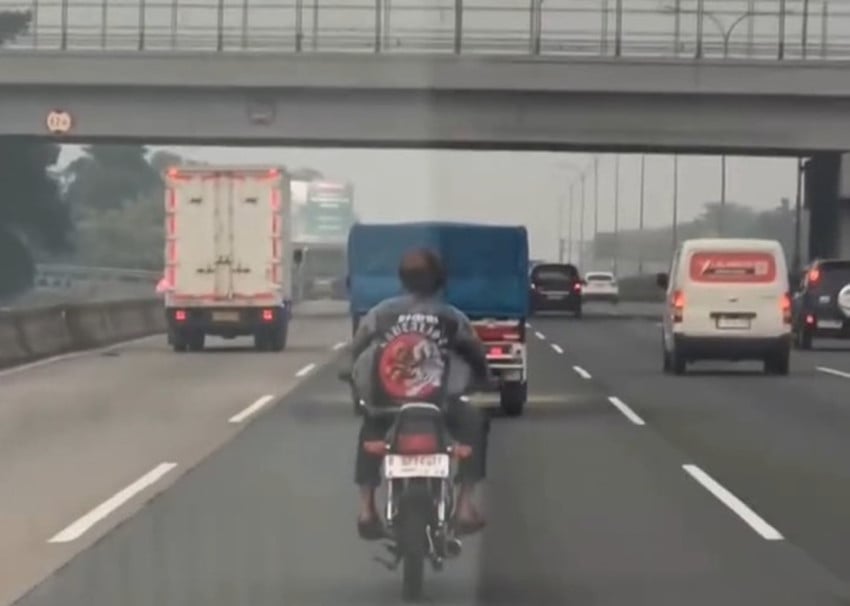
A startling incident unfolded on Sunday, July 19, 2026, when a 22-year-old motorcyclist, identified only by his initial S, was captured on video brazenly entering and traversing the Jagorawi Toll Road without the mandatory safety helmet. The footage, which quickly gained traction across social media platforms, depicted the rider on a Yamaha RX King motorcycle navigating the high-speed carriageway typically reserved for four-wheeled vehicles, posing significant risks to himself and other road users. The event occurred around 06:20 AM WIB at KM 25.500A, heading towards Cianjur, prompting immediate intervention from highway patrol units and a subsequent legal penalty.
The Incident Unfolds: A Breach of Toll Road Protocol
The viral video, disseminated widely across various social media channels, showcased the motorcyclist, S, in the midst of the Jagorawi Toll Road. What made the footage particularly alarming was not just the blatant disregard for the toll road regulations prohibiting two-wheeled vehicles, but also the rider’s visible lack of a helmet. This dual violation immediately highlighted severe safety concerns, as the motorcyclist was exposed to the inherent dangers of high-speed traffic without adequate protection, and simultaneously disrupting the flow and safety parameters of a highway designed for different vehicle dynamics. The Jagorawi Toll Road, a critical artery connecting Jakarta to Bogor, Ciawi, and beyond, is known for its heavy traffic volume and high-speed limits, making the presence of a motorcycle, especially an unprotected one, exceptionally perilous. The early morning timing of the incident might have been an attempt to evade detection, but the pervasive presence of dashcams and surveillance systems on modern highways, coupled with vigilant citizens, ensured the act did not go unnoticed.
Immediate Response and Legal Action
Upon receiving reports and visual evidence of the unauthorized entry, the highway patrol unit (PJR Jagorawi) swiftly mobilized. Kompol Jajuli, the Head of Induk PJR Jagorawi, confirmed that patrol officers successfully apprehended the motorcyclist shortly after the incident was reported. "Yes, all data is complete, he has been ticketed," Jajuli stated on Sunday, July 19, 2026, underscoring the prompt and decisive action taken by law enforcement. The motorcyclist, S, faced immediate legal repercussions in the form of a traffic citation (tilang). This enforcement action serves as a crucial reminder of the strict regulations governing Indonesia’s toll roads and the unwavering commitment of authorities to uphold road safety. The swift response also demonstrates the efficacy of a combined approach involving public vigilance (via social media) and proactive law enforcement in maintaining order on national infrastructure.
Understanding the Violations: Toll Road and Helmet Regulations
The motorcyclist’s actions constituted multiple violations of Indonesian traffic laws. Firstly, the most apparent breach was the unauthorized entry of a two-wheeled vehicle onto a toll road. Under Indonesian law, specifically Article 38 of Law No. 38 Year 2004 concerning Roads and Government Regulation No. 15 Year 2005 concerning Toll Roads, toll roads are designated exclusively for four-wheeled vehicles or more. This regulation is primarily rooted in safety considerations, as motorcycles, with their inherent vulnerabilities and different speed profiles, pose significant risks when sharing high-speed lanes with cars, buses, and trucks. The design of toll roads, including lane widths, emergency shoulders, and entry/exit points, is optimized for larger vehicles, making them unsuitable and hazardous for motorcycles.
Secondly, the absence of a safety helmet is a direct violation of Article 291 Paragraph 1 of Law No. 22 Year 2009 concerning Road Traffic and Transportation. This article mandates that "Every driver and passenger of a motorcycle traveling on the road must wear a helmet that meets Indonesian National Standard (SNI)." The helmet law is a fundamental component of motorcycle safety regulations worldwide, proven to significantly reduce the severity of head injuries and fatalities in the event of an accident. Forgoing a helmet, especially on a high-speed toll road, multiplies the risk of severe injury or death exponentially. The combination of these two violations painted a clear picture of reckless behavior that necessitated immediate legal intervention.
The Perils of High-Speed Roads for Two-Wheelers
The incident on the Jagorawi Toll Road vividly illustrates the profound dangers associated with motorcycles operating on high-speed, controlled-access highways. The fundamental design principles of toll roads prioritize high-speed travel and efficient movement of heavy vehicle traffic. This means:
- Speed Differentials: Motorcycles typically have different acceleration and braking characteristics compared to cars and trucks. When a motorcycle, potentially traveling at lower or highly erratic speeds, enters a lane filled with vehicles moving at 80-100 km/h, the speed differential creates extremely hazardous conditions, increasing the likelihood of rear-end collisions or sudden swerving maneuvers by other drivers.
- Lack of Protection: Unlike cars, motorcycles offer no protective cage in the event of a collision. A rider is directly exposed to impact forces, making any accident potentially catastrophic. Without a helmet, even a minor fall at speed can result in severe head trauma.
- Infrastructure Design: Toll road infrastructure, including rumble strips, drainage grates, and barrier types, is not designed with motorcycles in mind. These elements can pose stability challenges for two-wheelers, potentially causing loss of control. Furthermore, emergency services access and procedures are tailored for multi-wheeled vehicle incidents.
- Driver Expectation: Drivers on toll roads do not anticipate motorcycles, leading to potential blind spots, unexpected lane changes, and a reduced margin of error. This lack of expectation can translate into delayed reactions and increased accident risk.
According to data from the Indonesian National Police (Polri), motorcycles consistently account for the largest percentage of traffic accidents and fatalities in Indonesia. While specific data for toll roads is often aggregated, incidents involving unauthorized motorcycle entry invariably highlight the extreme vulnerability of riders in such environments. The lack of proper protective gear, as seen in this case, only compounds these risks, transforming a potentially dangerous situation into a potentially fatal one.
Broader Context: Indonesia’s Traffic Safety Challenges
Indonesia faces significant challenges in road safety, particularly concerning motorcycles. With millions of motorcycles on its roads, traffic accidents remain a leading cause of injury and death. Factors contributing to this include:
- High Motorcycle Penetration: Motorcycles are the most common mode of transport, making up a vast majority of registered vehicles.
- Varying Levels of Driver Education and Discipline: While licensing exists, adherence to traffic laws and safe driving practices can be inconsistent.
- Infrastructure Limitations: Despite ongoing improvements, many roads, especially secondary ones, lack adequate safety features.
- Enforcement Consistency: While efforts are continually made, consistent enforcement across the vast network of roads remains a challenge.
Incidents like the one on the Jagorawi Toll Road, though seemingly isolated, underscore a broader issue of traffic discipline and risk perception among some road users. The "viral" nature of such events, however, also serves as a potent tool for public education and reinforcement of safety messages. Toll road operators like PT Jasa Marga (Persero) Tbk, which manages Jagorawi, consistently run campaigns to educate the public about toll road regulations and safety. They invest in advanced surveillance systems, including CCTV and patrol vehicles, to monitor traffic and respond to emergencies or violations promptly. Despite these efforts, isolated incidents of non-compliance continue to occur, necessitating ongoing vigilance and enforcement.
The Role of Social Media in Enforcement and Awareness
The rapid spread of the video depicting S on the Jagorawi Toll Road highlights the increasingly significant role of social media in modern law enforcement and public awareness campaigns. What might once have gone unreported or taken longer to address, now, with a single upload, can reach millions within hours.
- Rapid Information Dissemination: Social media platforms act as real-time news channels, quickly informing authorities and the public about incidents.
- Public Scrutiny and Pressure: Viral content often generates public discussion and, in some cases, pressure on authorities to act, as seen with Kompol Jajuli’s prompt confirmation of enforcement.
- Deterrence and Education: The public display of consequences (like being ticketed) can serve as a deterrent for others contemplating similar violations. It also offers an opportunity for authorities and safety advocates to reiterate important traffic safety messages.
- Evidence Collection: Citizen-generated content, such as dashcam footage or smartphone videos, frequently serves as crucial evidence for law enforcement.
While the "viral" aspect can sometimes lead to misinformation or sensationalism, in cases like this, it demonstrably aided in the swift identification and apprehension of a traffic violator, reinforcing the notion that actions on public roads are increasingly subject to public oversight.
Preventive Strategies and Future Outlook
To mitigate such incidents in the future, a multi-faceted approach involving technology, education, and sustained enforcement is essential:
- Enhanced Surveillance: Continuous investment in advanced CCTV systems and ANPR (Automatic Number Plate Recognition) technology at toll road entry points can help detect and deter unauthorized entries more effectively.
- Increased Patrol Presence: Visible and frequent patrols by PJR units on toll roads act as a deterrent and enable rapid response to violations.
- Public Awareness Campaigns: Regular and engaging campaigns through traditional media, social media, and community outreach programs can educate the public about toll road regulations, the dangers of non-compliance, and the importance of protective gear. These campaigns should target specific demographics, including young motorcyclists who may be more prone to risk-taking.
- Collaboration with Community Groups: Partnering with motorcycle clubs and communities can foster a culture of responsible riding and self-regulation among enthusiasts.
- Clearer Signage: Ensuring highly visible and unambiguous signage at all toll road entry points reiterating the prohibition of motorcycles can serve as a constant reminder.
- Stricter Penalties and Enforcement Consistency: While penalties are in place, consistent and unwavering enforcement ensures that the consequences outweigh the perceived benefits of violating the law. This might include not only fines but also points on licenses, and in severe cases, temporary impoundment of vehicles.
The incident on the Jagorawi Toll Road serves as a stark reminder of the continuous need for vigilance on Indonesia’s roads. While individual acts of defiance against traffic laws will likely persist, the collective efforts of law enforcement, toll road operators, and an increasingly aware public, amplified by the reach of social media, are crucial in fostering a safer and more disciplined driving culture. The prompt action taken against S underscores that such dangerous and illegal acts will not be tolerated, reinforcing the paramount importance of adhering to traffic regulations for the safety of all road users.