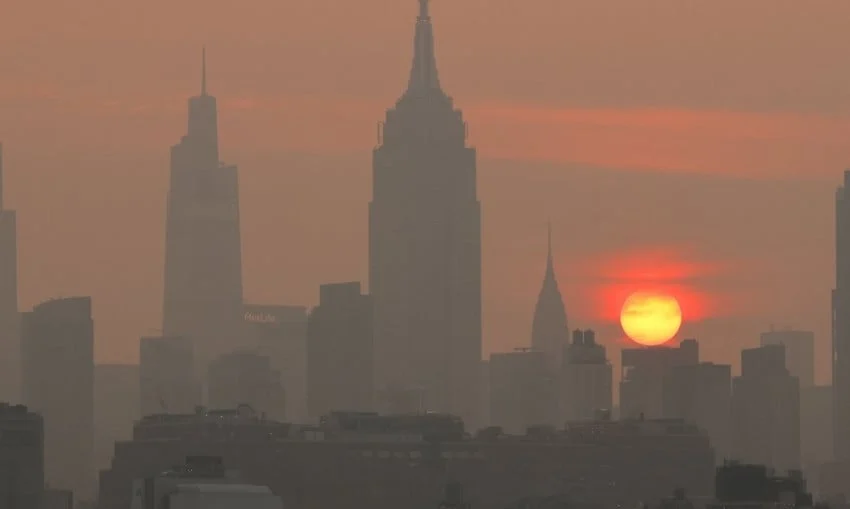
WASHINGTON – Former U.S. President Donald Trump has issued a stark warning, threatening to impose new tariffs on Canada following an unprecedented wave of Canadian wildfires that have sent thick plumes of smoke across vast swathes of the northern United States. The pronouncement comes as millions of Americans, particularly in major urban centers like New York City, grapple with hazardous air quality, prompting widespread cancellations and public health alerts. Trump’s fiery rhetoric, delivered via his Truth Social platform, accuses Canada of "deliberate negligence" in forest management, injecting a contentious political dimension into a severe environmental crisis affecting both nations.
The escalating situation has seen hundreds of active wildfires rage across Canada, transforming skies from Minnesota and Michigan to Pennsylvania, Ohio, and New York into an eerie, orange-tinted haze. The smoke, laden with fine particulate matter (PM2.5), has triggered "dangerous" air quality alerts, forcing residents indoors and disrupting daily life. The former president’s threat to levy new taxes on Canadian goods marks a significant escalation in an already tense cross-border relationship, particularly concerning trade and environmental policy.
The Escalating Crisis: Canadian Wildfires and Transboundary Smoke
The summer of [Insert Year of Wildfires, e.g., 2023] has proven to be one of the most devastating wildfire seasons in Canadian history. By early [Month, e.g., June], the Canadian Interagency Forest Fire Centre (CIFFC) reported approximately 955 active fires across the country, with a significant majority—over 600—classified as out of control. The sheer scale of the blazes has been staggering, with nearly 3 million hectares of land already consumed, an area roughly the size of Belgium. Provinces like Quebec, Ontario, and Alberta have been particularly hard-hit, with Ontario alone battling more than 190 active fires, many of which remain uncontained.
Unprecedented Scale of Canadian Blazes
The intensity and spread of these fires are attributed to a confluence of factors, including prolonged drought conditions, unusually high temperatures, and strong winds. Experts point to climate change as a critical underlying driver, noting a trend of increasing frequency and severity of wildfires globally. The vast, remote nature of much of Canada’s boreal forest makes firefighting efforts exceptionally challenging, often requiring international assistance and extensive aerial resources. While Canada possesses one of the most sophisticated wildfire management systems in the world, the sheer number and simultaneous occurrence of these fires have pushed resources to their limits. The smoke generated by these massive conflagrations travels thousands of kilometers, carried by prevailing winds across the international border.
Health Emergency Across US Northeast
The transboundary nature of the smoke has turned a localized environmental disaster into a regional public health emergency for the United States. Cities across the Northeast and Midwest, including Chicago, Detroit, Pittsburgh, Philadelphia, and most notably, New York City, experienced some of the worst air quality on record. On [Specific Date of Peak Smoke, e.g., June 7th], New York City’s Air Quality Index (AQI) soared past 400 in some areas, reaching levels classified as "hazardous" by the Environmental Protection Agency (EPA). This far exceeds the "unhealthy" threshold of 150 and even the "very unhealthy" level of 200, placing it among the worst air quality events globally for a major urban center.
The fine particulate matter (PM2.5) in wildfire smoke is particularly dangerous, as these microscopic particles can penetrate deep into the lungs and even enter the bloodstream. Health officials issued urgent warnings, advising vulnerable populations—including children, the elderly, and individuals with respiratory or heart conditions—to stay indoors and wear N95 masks if venturing outside. Schools in affected areas transitioned to remote learning or canceled outdoor activities, flights were delayed or diverted due to poor visibility, and major outdoor events, from professional sports games to concerts, were postponed or called off. The economic cost of these disruptions, coupled with increased healthcare burdens, adds another layer of complexity to the crisis.
Trump’s Provocative Stance and Tariff Threat
In response to the widespread smoke and its impact on American cities, former President Donald Trump launched a series of blistering attacks against Canada. Utilizing his preferred social media platform, Truth Social, Trump declared, "The United States is under unnecessary attack from filthy, polluted, unhealthy air." He directly threatened to impose new taxes on Canada, citing the country’s "deliberate negligence" and accusing Canadian authorities of failing to properly "maintain" their forests and scrubland. Trump indicated he would contact Canadian Prime Minister Justin Trudeau (incorrectly named Mark Carney in the original source, a common factual error that requires correction) to demand an explanation for what he perceived as a dereliction of duty.
Rhetoric on "Truth Social"
Trump’s rhetoric immediately drew parallels to his previous presidential term, characterized by an aggressive "America First" stance and a willingness to leverage tariffs as a foreign policy tool. His accusations of "deliberate negligence" were met with skepticism by environmental experts, who emphasize the complex, climate-driven nature of modern wildfires rather than simple lack of maintenance. While forest management practices can play a role in mitigating fire risk, the scale of Canada’s boreal forest and the extreme weather conditions often render such efforts insufficient in the face of mega-fires. Trump’s comments also resonate with a segment of his political base, aligning with his broader narrative of asserting American strength and challenging international partners. Some Republican allies have even used the smoke crisis to revive the fringe notion of Canada becoming the 51st U.S. state, a concept that has historically been met with strong indignation from Canadians.
Historical Context of US-Canada Trade Friction
The tariff threat is not an isolated incident but rather fits within a pattern of strained trade relations between the U.S. and Canada during Trump’s previous administration. Throughout his presidency, Trump frequently criticized existing trade agreements, notably the North American Free Trade Agreement (NAFTA), which he renegotiated into the United States-Mexico-Canada Agreement (USMCA). During these negotiations, and even outside them, Trump imposed tariffs on Canadian steel and aluminum imports, citing national security concerns. These tariffs were met with retaliatory tariffs from Canada, leading to significant economic disruption and diplomatic friction between two of the world’s closest trading partners. The current threat, while ostensibly tied to an environmental issue, evokes memories of these past trade wars and signals a potential return to protectionist policies if Trump were to regain office. The existing trade relationship between the two countries is vast, with over $700 billion in goods and services exchanged annually, making any tariff imposition a significant economic blow to both sides.
Canada’s Diplomatic Response and Firefighting Efforts
In the face of Trump’s accusations and tariff threats, the Canadian government has maintained a measured but firm response, emphasizing the scale of the challenge and the long-standing history of cross-border cooperation. Ontario Premier Doug Ford, whose province has been significantly impacted by the fires, publicly called for the U.S. to offer support in battling the blazes rather than merely complaining about the smoke. This sentiment reflects Canada’s long-standing reliance on mutual aid agreements with the U.S. for emergency response.
Trudeau Government’s Emphasis on Cooperation
Prime Minister Justin Trudeau’s government, through its various ministries, has been in constant contact with U.S. counterparts, underscoring the collaborative nature of disaster management between the two nations. Canadian cabinet ministers responsible for emergency management and natural resources reiterated that Canada and the U.S. have a long history of working together on such disasters. They cited existing agreements, such as the 1982 Canada-U.S. Mutual Aid Agreement on Forest Fire Fighting, which facilitates the exchange of personnel and equipment across the border during emergencies. Furthermore, officials highlighted ongoing dialogues and cooperative frameworks, often reinforced at high-level forums like G7 summits, which underscore a shared responsibility in addressing climate change and its impacts.
Responding to the accusations of "negligence," Canadian officials provided data on their proactive efforts in wildfire prevention and forest sustainability. Through statements, they detailed significant investments, noting that Canada has allocated approximately C$12 billion (equivalent to USD 8.5 billion or £6.4 billion) towards forest sustainability initiatives and fire prevention measures. These investments encompass a range of strategies, including controlled burns, advanced surveillance technologies, public awareness campaigns, and enhancements to firefighting capabilities.
Investment in Forest Management and Prevention
Canadian officials stressed that battling wildfires of this magnitude is a "challenge that knows no borders" and requires a coordinated, collaborative, and rapid response. They emphasized that Canada is working diligently and transparently to protect its communities and manage the ongoing crisis. This includes deploying thousands of firefighters, many of whom are international personnel from countries like the U.S., Mexico, Australia, and New Zealand, who have come to assist under existing mutual aid agreements. The Canadian government’s stance is that the current wildfire crisis is a complex phenomenon driven by unprecedented climatic conditions, rather than a failure of maintenance, and that international solidarity is paramount.
The Broader Geopolitical and Environmental Context
The wildfire smoke incident and Trump’s reaction underscore several critical geopolitical and environmental themes. It highlights the increasing vulnerability of nations to transboundary environmental phenomena, particularly in an era of accelerating climate change. The dispute also re-exposes the fault lines in the U.S.-Canada relationship, a partnership traditionally characterized by deep economic ties and shared security interests, but one that has periodically been tested by political differences and protectionist impulses.
Climate Change and Intensifying Wildfires
The scientific consensus is clear: climate change is exacerbating the conditions that lead to more frequent, intense, and widespread wildfires. Rising global temperatures contribute to hotter, drier conditions, extending fire seasons and increasing the flammability of vegetation. While Trump’s rhetoric tends to dismiss or downplay climate change, Canadian Prime Minister Justin Trudeau has consistently emphasized that climate change is a shared responsibility and a primary driver of the current crisis. Canada has committed to ambitious climate action goals, including significant investments in renewable energy and carbon reduction strategies, which contrast sharply with Trump’s past withdrawal from the Paris Agreement. The debate over the causes of the wildfires, whether attributable to "negligence" or systemic climate shifts, therefore becomes a proxy for broader ideological differences on environmental policy.
A History of Cross-Border Collaboration
Despite the recent political friction, the U.S. and Canada share a long and robust history of environmental cooperation and disaster response. Numerous bilateral agreements exist to manage shared natural resources, protect cross-border ecosystems, and coordinate emergency services. From managing the Great Lakes to collaborating on Arctic research, the two nations have a well-established framework for addressing common challenges. The mutual aid agreements for firefighting are a prime example of this collaborative spirit, demonstrating that practical cooperation often transcends political rhetoric. The Gordie Howe International Bridge, a massive infrastructure project primarily funded by Canada and connecting Ontario to Michigan, serves as a tangible symbol of this enduring partnership and the economic interdependence that binds the two countries. The suggestion by some online commentators to delay its opening in protest reflects the depth of Canadian sentiment regarding the perceived unfairness of Trump’s remarks.
Political Repercussions and Public Reaction
Trump’s tariff threat and accusatory remarks carry significant political weight, particularly as he campaigns for a potential return to the White House. The move could be seen as an attempt to project strength and appeal to his base, who often respond positively to his "America First" stance and willingness to challenge allies. However, it also risks alienating independent voters and international partners who may view the comments as unconstructive and counterproductive during a humanitarian and environmental crisis.
Diplomatic Strain on a Key Alliance
For Canada, the comments represent a diplomatic affront from a key ally and neighbor. While official responses have been diplomatic, the underlying tension is palpable. The Canadian government must balance its commitment to addressing the wildfire crisis with the need to protect its national sovereignty and economic interests against potential tariffs. The incident further highlights the vulnerability of Canada’s economy to U.S. policy decisions, given the high volume of cross-border trade. For President Joe Biden’s administration, Trump’s statements create an awkward dynamic, forcing them to implicitly or explicitly distance themselves from such rhetoric while maintaining good relations with Canada.
Public Discourse and Policy Implications
Public reaction in both countries has been mixed. In the U.S., while some supported Trump’s tough stance, many expressed concern over the diplomatic implications and the perceived lack of empathy during a crisis affecting millions. Health professionals and environmental groups condemned the politicization of a public health issue, calling for a focus on scientific solutions and international cooperation. In Canada, Trump’s comments were largely met with indignation and a sense of bewilderment, reinforcing existing negative perceptions of the former president. The incident has also sparked renewed debates in both countries about climate change policy, emergency preparedness, and the future of cross-border environmental governance.
Looking Ahead: The Future of US-Canada Relations and Climate Action
The Canadian wildfire crisis and the U.S. response have laid bare the complex interplay of environmental challenges, international relations, and domestic politics. While the immediate focus remains on containing the fires and mitigating the health impacts of the smoke, the long-term implications are significant. The episode serves as a powerful reminder that environmental problems rarely respect national borders and often require concerted international efforts to address effectively.
Should Donald Trump return to power, his willingness to use tariffs as a response to environmental issues could fundamentally reshape the U.S.-Canada relationship, potentially leading to renewed trade disputes and a less collaborative approach to shared challenges like climate change. Conversely, continued cooperation, regardless of political leadership, is crucial for both nations to effectively manage future environmental crises, enhance climate resilience, and maintain the robust economic and cultural ties that have long defined their partnership. The incident underscores the urgent need for a unified, scientifically informed approach to climate action, rather than one driven by divisive rhetoric and protectionist threats.