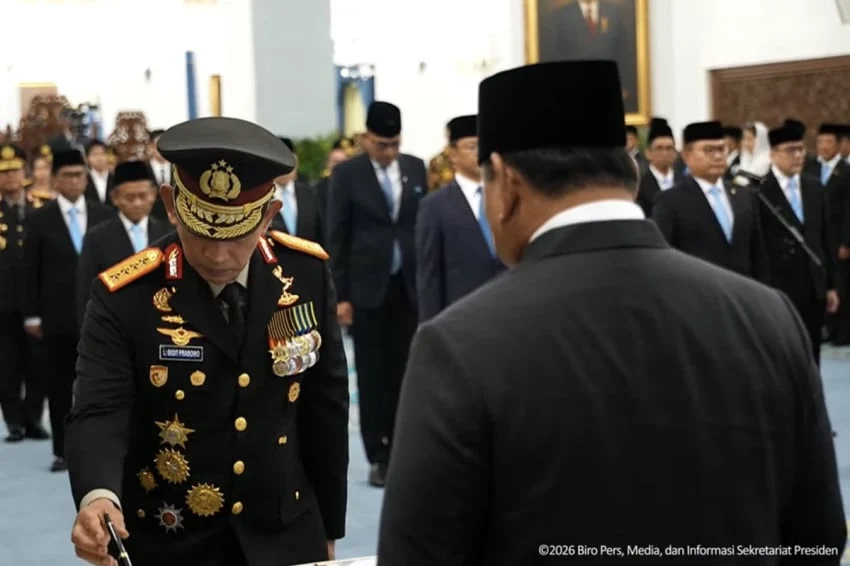
The Indonesian National Police (Polri) has officially enacted a new Peraturan Kepolisian (Police Regulation, or Perpol) designed to overhaul and modernize the institutional framework governing internal ethical proceedings. Signed by Chief of the Indonesian National Police (Kapolri) General Suyudi Ario Seto, the newly minted regulatory framework introduces sweeping procedural changes, most notably regarding the mechanics of the Komisi Kode Etik Polri (Police Code of Ethics Commission or KKEP) trials, appeal rights, and mandatory investigative audits.
While the regulatory updates apply broadly to the internal accountability mechanisms of the nation’s law enforcement agency, the leadership of Polri has explicitly acknowledged that the timing and specific provisions of the new Perpol serve as critical preparation for prospective high-profile ethical proceedings, including potential deliberations involving high-ranking officers of four-star general status, such as General Listyo Sigit Prabowo. The introduction of this legal umbrella signals a significant evolution in how the institution manages internal discipline, accountability, and transparency at the highest levels of command.
Structural Adjustments to the Code of Ethics Framework
The newly signed regulation effectively amends the foundational Peraturan Kepolisian Nomor 7 Tahun 2022 concerning the Professional Code of Ethics and the Police Code of Ethics Commission. For nearly half a decade, Perpol No. 7/2022 served as the definitive benchmark for handling police misconduct, insubordination, and ethical breaches. However, evolving institutional needs, jurisdictional complexities involving high-ranking officers (Perwira Tinggi or Pati), and the necessity for procedural efficiency prompted the leadership to introduce targeted revisions.
According to official statements released by the National Police Headquarters, the amendments focus on streamlining the adjudication process, eliminating administrative bottlenecks, and ensuring that appellate processes remain strictly centralized around the individual directly facing disciplinary measures. Furthermore, the regulation formally accommodates technological advancements by allowing ethical trials to be conducted digitally or through remote video conferencing platforms under specific conditions—a measure designed to address logistical hurdles and security considerations in high-stakes cases.
The overarching objective of the new regulation is to reinforce internal oversight while simultaneously providing a clear, unambiguous legal mechanism to process ethical infractions across all ranks, ranging from probationary patrol officers to senior four-star generals.
Key Modifications in the Revised Regulation
The newly enacted Perpol introduces several critical structural alterations to the pre-existing disciplinary code. Legal analysts and institutional watchdogs have closely monitored these changes, which fundamentally reshape the dynamics of internal police accountability.
1. Restriction of the Appeal Process
The first major alteration targets Pasal 1, Paragraph 6 of the original regulation, which previously provided an expansive definition of the parties eligible to file an appeal following a disciplinary verdict. Under the framework of Perpol No. 7/2022, the right to appeal an ethical decision was extended not only to the accused officer (pelanggar) but also to immediate family members, including spouses, children, and parents.
The newly enacted regulation strips away this extended familial scope. Head of the Public Relations Division of the Indonesian National Police (Kadiv Humas Polri), Inspector General Johnny Eddizon Isir, confirmed that the revised statute strictly limits the right of appeal solely to the primary violator.
"After the amendment, the provisions governing who may file an appeal have been restricted exclusively to the violator," stated Inspector General Johnny Eddizon Isir during a media briefing at the National Police Headquarters in Jakarta.
This modification addresses historical challenges where third-party family appeals frequently prolonged administrative proceedings, creating complex legal delays and complicating the finality of disciplinary verdicts. By restricting the appeal mechanism to the individual officer, the institution aims to expedite the legal finality of KKEP decisions and maintain institutional efficiency.
2. Mandatory Investigative Audits and Multi-Sectoral Case Conferences
The second pivotal adjustment involves the insertion of Paragraph (4a) into Pasal 15 of the regulatory text. This new clause mandates that the findings of any official investigative audit must be immediately followed by a formal case conference, commonly referred to as a gelar perkara.
Crucially, this mandatory case conference cannot be conducted in a vacuum; it requires cross-functional collaboration and oversight. The regulation stipulates that the proceedings must involve multiple internal divisions, specifically:
- Internal oversight and supervision units (fungsi pengawasan)
- Human resource management directorates (sumber daya manusia)
- Legal divisions (hukum)
- Professional security and internal affairs divisions (profesi dan pengamanan / Propam)
The inclusion of this multi-sectoral requirement is designed to eliminate unilateral decision-making, ensure comprehensive evidentiary review, and guarantee that any subsequent ethical trial is built upon an unimpeachable foundation of investigative findings and inter-divisional consensus.
Contextualizing the Timing: Preparations for High-Rank Scrutiny
The timing of the new Perpol’s issuance has generated substantial public interest and media commentary. National security observers have noted that the structural changes within the regulation directly address long-standing legal gray areas regarding how the force handles ethical and professional accountability for active-duty four-star generals (Perwira Tinggi bintang 4).
When questioned by journalists regarding whether the regulation was fast-tracked to accommodate potential proceedings involving former Kapolri and current high-ranking figure General Listyo Sigit Prabowo, the leadership of the national police force did not issue a denial. Instead, institutional representatives acknowledged that preparing for the distinct procedural demands of high-ranking officers was indeed a primary consideration in drafting the amendments.
"Yes, that was one of the primary considerations," affirmed Inspector General Johnny Eddizon Isir when asked about the direct link between the new regulations and the institutional readiness to handle high-profile ethical inquiries.
Handling a four-star general within an internal police tribunal presents unique legal and administrative complexities. Under traditional internal mechanisms, the hierarchy of command often complicates disciplinary oversight, as members of the KKEP panel must hold equal or superior rank to the defendant, or possess explicit statutory authorization to adjudicate officers at the apex of the institutional pyramid. The updated Perpol provides the necessary legal clarity and structural flexibility to conduct such high-level proceedings in a manner that adheres strictly to procedural due process while upholding institutional integrity.
Chronology of Institutional Reform Within the National Police
To fully understand the significance of the latest regulatory shift, it is essential to examine the chronological evolution of internal governance within the Indonesian National Police over the past decade.
- 2022: The issuance of Peraturan Kepolisian Nomor 7 Tahun 2022 marked a significant attempt to codify professional ethics and streamline the operations of the Police Code of Ethics Commission (KKEP). It established comprehensive definitions for violations, standardized punishment tiers, and introduced broad appellate rights for defendants and their families.
- 2023–2024: A series of high-profile institutional controversies and internal disciplinary cases tested the limits of Perpol No. 7/2022. Observers and legal experts highlighted administrative bottlenecks, particularly regarding the handling of senior officers and the lengthy duration of appeal processes involving extended family submissions.
- 2025: Discussions began within the National Police Headquarters regarding the necessity of amending internal regulations to enhance transparency, accelerate administrative workflows, and prepare for complex multi-jurisdictional and high-rank ethical reviews.
- Late 2026: Kapolri General Suyudi Ario Seto officially signs the new Perpol. The amendments specifically target the appellate framework under Pasal 1 and introduce mandatory cross-functional case conferences under Pasal 15, positioning the institution to address pending high-profile proceedings with enhanced legal certainty.
Implications of Remote Trials and Digital Adjudication
Beyond the modifications to appeals and investigative audits, the broader package accompanying the new Perpol introduces provisions for conducting ethical trials via digital means (daring). This technological modernization reflects broader shifts in Indonesia’s legal and administrative sectors toward electronic court systems (e-court) and virtual hearings.
In an institution as vast and geographically decentralized as the Indonesian National Police, conducting physical trials involving senior officers, expert witnesses, commission members, and legal counsel often incurs substantial logistical challenges and security considerations. By explicitly providing a legal basis for virtual hearings, the new regulation ensures that proceedings can move forward without unnecessary physical delays, while maintaining the solemnity and formal evidentiary standards required of a KKEP tribunal.
Legal analysts point out that digital trials also offer a layer of transparency and archival reliability, as digital proceedings can be systematically recorded and monitored by internal oversight bodies to prevent procedural irregularities. However, experts emphasize that stringent cybersecurity protocols and secure data transmission channels must be strictly enforced to protect sensitive investigative materials discussed during remote sessions.
Fact-Based Analysis of Broader Institutional Impact
The implementation of the new Perpol carries profound implications for the internal governance, public trust, and operational discipline of the Indonesian National Police. By refining the ethics trial mechanism, the leadership aims to project an image of uncompromising accountability, particularly in an era where public scrutiny of law enforcement institutions remains at an all-time high.
- Enhanced Institutional Credibility: By establishing clear, unyielding protocols for high-ranking officers, the force demonstrates that no member—regardless of rank or historical standing—is entirely exempt from internal scrutiny and ethical governance.
- Procedural Efficiency: The restriction of appeals exclusively to the primary violator removes a significant administrative burden from the KKEP secretariat, ensuring that disciplinary cases reach final resolution within a compressed timeline. This prevents prolonged legal limbo that historically plagued high-profile internal cases.
- Rigorous Evidentiary Standards: The mandatory requirement for joint case conferences involving internal oversight, legal, HR, and Propam divisions ensures that every disciplinary charge is thoroughly vetted from multiple institutional perspectives before a formal trial commences, thereby reducing the likelihood of procedural challenges or allegations of bias.
As the Indonesian National Police continues to implement these newly enacted regulations, domestic legal scholars and civil society organizations will closely monitor how the framework is applied in practice—particularly as the institution prepares to navigate the unprecedented procedural landscape of high-rank ethical deliberations under the leadership of General Suyudi Ario Seto.