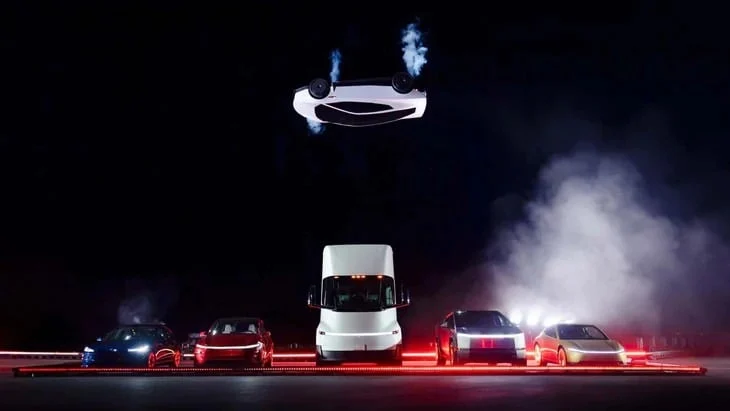
The intersection of high-performance electric vehicle engineering and marketing theatrics has once again ignited debate within the global automotive industry, as Porsche Chief Executive Officer Michael Leiters publicly criticized the aerial stunt presentation utilized by Tesla for its next-generation Roadster. Speaking at a prominent industry conference in Berlin, Germany, on November 11, the Porsche executive drew a sharp distinction between his company’s engineering-first philosophy and Tesla’s penchant for sensational product reveals. This critique follows a high-stakes autumn period where both luxury and performance automakers unveiled flagship battery-electric vehicles, choosing fundamentally divergent paths to capture consumer attention and market share.
The controversy centers on contrasting launch strategies executed on October 15, a significant date that saw both Porsche and Tesla command global headlines with their respective high-performance offerings. While Porsche chose a traditional, design-and-performance-focused unveiling for its cutting-edge Mission S concept, Tesla opted for a high-octane spectacle. During the Tesla event, the new Roadster appeared to execute dramatic airborne maneuvers, launching into a controlled hover and rotation before landing precisely on all four wheels. This cinematic display relied heavily on a sophisticated pneumatic propulsion system developed in collaboration with aerospace engineers from SpaceX, the rocket manufacturing company also helmed by Tesla CEO Elon Musk.
A Clash of Automotive Philosophies
Addressing industry leaders and international media in Berlin, Michael Leiters did not explicitly name Tesla in his opening remarks, though the context of his commentary left little room for misinterpretation. According to reports from Bloomberg, Leiters emphasized that Porsche strives to "completely avoid flashy effects and over-the-top shows," preferring instead to concentrate on technical substance, measurable track capabilities, and innovations that deliver tangible practical value to the driver.
Leiters asserted that Porsche’s development methodology prioritizes structural integrity, aerodynamic efficiency, thermal management, and repeatable track performance over short-lived marketing stunts. He argued that the primary objective of a luxury performance vehicle should be dynamic excellence on asphalt rather than the ability to replicate science-fiction tropes on a stage. Furthermore, the Porsche executive noted that the demographic and psychological profiles of consumers targeted by the Tesla Roadster and the Porsche Mission S diverge significantly, representing two distinct segments within the upper echelon of the automotive market. Traditional high-net-worth buyers of Stuttgart-engineered sports cars, according to Porsche’s market research, lean toward heritage, understated luxury, and engineering pedigree, whereas Tesla appeals to a tech-centric, disruption-oriented demographic.
Chronology of the Rivalry: From Prototypes to Production Promises
To understand the friction between Porsche and Tesla, one must examine the protracted development timelines of both automakers’ flagship electric vehicles. The rivalry over electric performance dominance has evolved across nearly a decade of shifting technological milestones, regulatory landscapes, and escalating performance benchmarks.
The saga of the second-generation Tesla Roadster began in November 2017, when Elon Musk shocked the automotive world by rolling out the prototype during a surprise product showcase. At the time, Tesla made staggering claims regarding the vehicle’s specifications: a 0-to-60 mph acceleration time of 1.9 seconds, a top speed exceeding 250 miles per hour, and an unprecedented 620-mile range from a 200 kWh battery pack. Originally slated for production in 2020, the vehicle faced numerous delays driven by supply chain disruptions, engineering bottlenecks, and Tesla’s strategic reallocation of resources toward scaling high-volume models like the Model Y and the controversial Cybertruck.
Nearly seven years after the initial prototype unveiling, the recent mid-October presentation marked the first substantial update on the production-intent Roadster. By integrating SpaceX cold-gas thruster technology—initially teased as a "SpaceX package"—Tesla sought to reinvigorate enthusiasm and justify years of postponed deposit collections from eager reservation holders.
Conversely, Porsche’s journey into high-performance electrification has adhered to a more conventional, serialized corporate timeline. Following the successful commercialization and global rollout of the Porsche Taycan sedan in 2019, the German manufacturer systematically built out its electric vehicle architecture. The introduction of the Mission S concept represents the next logical phase in Porsche’s electrification roadmap, aimed at bridging the gap between everyday luxury grand touring and uncompromising motorsport capability. Unlike Tesla’s protracted vaporware criticism regarding the Roadster, Porsche’s development cycles are closely tied to established homologation standards and rigorous durability testing at facilities like the Nürburgring Nordschleife.
Comparative Analysis of Engineering Approaches
The divergence in marketing strategies reflects a deeper ideological split in how traditional automotive engineering and Silicon Valley disruption approach the physics of speed.
Tesla’s engineering philosophy leans heavily on software-defined capabilities, vertical integration across unrelated technological sectors (such as aerospace and energy storage), and brute-force power delivery. The utilization of compressed-air thrusters derived from rocket technology on a road-legal passenger car represents an extreme manifestation of this ethos. While undeniably innovative in concept, automotive critics and traditional engineers frequently question the regulatory viability, safety implications, weight penalties, and maintenance complexity of incorporating rocket thrusters into a consumer vehicle.
Porsche, on the other hand, approaches performance through the lens of holistic vehicle dynamics. The brand’s focus remains centered on perfecting the kinetic chain: instantaneous torque vectoring, multi-speed transmissions designed for electric powertrains (as seen in the Taycan), advanced brake regeneration systems, and sustained thermal endurance. Porsche engineers maintain that true technological leadership is demonstrated when a vehicle can complete consecutive hot laps on a racing circuit without entering a thermal throttling state—a common challenge for high-output electric vehicles. By dismissing the theatrical elements of the Roadster launch, Leiters underscored Porsche’s commitment to verifiable metrics over theatrical novelty.
Market Implications and Consumer Reception
The public critique by Porsche’s CEO highlights a broader maturation phase within the global electric vehicle market. As legacy luxury automakers successfully transition their portfolios to electric propulsion, the competitive landscape has shifted from a race for mere existence to a battle for brand differentiation and philosophical alignment.
For years, Tesla enjoyed an uncontested status as the pioneer and undisputed leader of high-end electric mobility, often dictating the narrative of innovation without facing peer-level scrutiny from legacy giants. However, statements from executives like Michael Leiters signal a new era of aggressive, vocal competition where heritage brands actively challenge the validity of Tesla’s unconventional engineering choices.
Market analysts suggest that this rivalry ultimately expands the total addressable market for high-performance electric vehicles by appealing to bifurcated consumer psychographics. Buyers seeking disruptive technology, speculative value, and viral social media appeal continue to gravitate toward the Tesla ecosystem, buoyed by the brand’s cult-like following and software ecosystem. Conversely, legacy purists who demand rigorous build quality, established dealer support networks, and track-proven engineering pedigree find solace in Porsche’s steadfast refusal to compromise traditional standards of automotive craft.
Broader Industry Impact on Future Product Development
The exchange between Berlin and Silicon Valley is expected to influence how upcoming electric supercars are marketed and engineered over the remainder of the decade. As regulatory pressures mount globally and internal combustion engines face phase-out deadlines in major markets, performance brands must convince skeptical enthusiasts that electrification does not dilute driving engagement.
Tesla’s high-risk, high-reward marketing model forces traditional automakers to accelerate their public relations and digital engagement strategies, ensuring they remain relevant to younger demographics who consume automotive culture primarily through digital platforms and video-sharing networks. Meanwhile, Porsche’s disciplined, data-driven pushback reassures institutional investors and conservative buyers that the core tenets of automotive engineering—safety, reliability, and functional performance—remain paramount in the electric age.
As both the Tesla Roadster and Porsche’s upcoming production variants move closer to customer deliveries in the coming years, the ultimate arbiter of this philosophical dispute will be the consumer market. Whether the market rewards the rocket-boosted spectacle of Silicon Valley or the refined, track-focused precision of Stuttgart will determine the prevailing design language of elite electric mobility for generations to come.