The Provincial Government of Jakarta has officially announced a comprehensive urban transformation plan for the site of the former Pasar Taman Puring in South Jakarta, which suffered a devastating fire in late July 2025. Instead of reconstructing the traditional marketplace at its original location, the administration has decided to revitalize the area into a dedicated, fully accessible public green space tailored specifically for individuals with disabilities. This strategic decision marks a significant shift in urban planning priorities for the capital, emphasizing inclusive infrastructure, public safety, and environmental sustainability over commercial reconstruction in high-density zones.
Governor of Jakarta Pramono Anung confirmed the policy direction during a public engagement event in East Jakarta, emphasizing that the administration is simultaneously devising a relocation framework to safeguard the livelihoods of hundreds of merchants impacted by the disaster. The move highlights the delicate balancing act municipal authorities face when reconciling urban disaster recovery, spatial optimization, and socio-economic support for traditional micro-entrepreneurs.
Background and Context of the Pasar Taman Puring Fire
Pasar Taman Puring had long served as a prominent commercial landmark in South Jakarta, widely recognized across the metropolitan area as a bustling hub for footwear, sporting goods, vintage items, and various retail commodities. Located strategically near upscale residential neighborhoods and commercial strips, the market generated substantial economic activity and provided a vital source of income for hundreds of independent vendors and their employees.
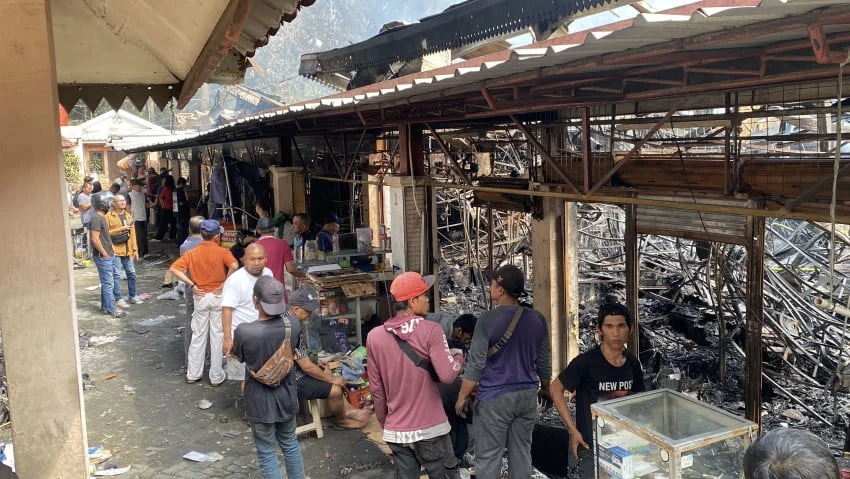
However, the high density of semi-permanent structures, narrow corridors, and heavy accumulation of combustible inventory historically rendered the marketplace vulnerable to fire hazards. These structural vulnerabilities culminated in a catastrophic disaster in late July 2025, when a massive fire swept through the complex. The blaze tore through the property with alarming speed, overcoming the initial response efforts of local merchants and security personnel.
Emergency response teams from the Jakarta Fire and Rescue Department deployed dozens of heavy fire trucks and hundreds of personnel to combat the inferno. Despite their concerted efforts, the intense heat and flammable materials caused widespread structural collapse. By the time the fire was fully extinguished, official post-incident assessments confirmed that approximately 500 shops had been completely gutted. The disaster resulted in total property losses for the vendors, wiping out inventory, equipment, and capital accumulated over decades of operation. Fortunately, rapid evacuation protocols prevented mass casualties, but the psychological and financial toll on the business community was immense.
Chronology of Events and Policy Evolution
Following the July 2025 fire, the site remained largely idle while municipal agencies conducted forensic investigations to determine the exact cause of the blaze and evaluated the structural integrity of the remaining foundations. Initial discussions among city planners, regional representatives, and merchant associations explored various rebuilding options. Some merchant factions advocated for immediate reconstruction of a modern, multi-story commercial complex on the exact same footprint to preserve the historical commercial identity of Taman Puring.
Concurrently, urban planners and environmental advocates urged the municipal government to reevaluate the zoning of the area. They argued that rebuilding a high-density, traditional market in a congested urban corridor presented ongoing fire safety risks and contributed to regional traffic congestion and a lack of public green infrastructure in South Jakarta.
The policy debate reached a definitive turning point in late October 2026. Governor Pramono Anung formally announced that the administration had evaluated the spatial requirements of the district and resolved to prioritize public utility over commercial restoration at the specific site. On Sunday, October 25, 2026, while addressing community concerns in East Jakarta, the governor stated unequivocally that the administration had approved the revitalization blueprint to convert the fire-damaged ruins into a dedicated public park.
Official Statements and Strategic Vision
Governor Pramono Anung elaborated on the rationale behind the transformation, stressing the urgent need for inclusive public spaces within Jakarta’s densely populated urban matrix. The proposed development is envisioned as a benchmark for universal design principles in Indonesian municipal architecture.
"In principle, I have approved that Taman Puring, which burned down at that time, will undergo revitalization and be utilized entirely as a park," Governor Pramono Anung stated.
The governor acknowledged that the transition carries profound economic consequences for the displaced business owners who depended on the location for their daily revenue. Consequently, the provincial administration has committed to a structured relocation program designed to resettle the vendors without disrupting their commercial continuity.
"The vendors must certainly be provided with a place so that they can continue to trade and so forth. Well, that is currently in the discussion phase, and for Taman Puring which is being revitalized, I want it to become a Taman Puring dedicated to people with disabilities," the governor added.
This dual-track policy—combining inclusive environmental development with administrative assistance for displaced merchants—reflects an evolving approach to governance in Jakarta, where urban renewal projects are increasingly scrutinized for their social equity impacts.
Supporting Data and Universal Design Framework
The decision to establish a disability-friendly park aligns with broader international standards for urban livability and municipal accessibility. According to demographic data from the Central Statistics Agency (BPS) and municipal planning boards, large metropolitan centers like Jakarta host hundreds of thousands of residents with varying degrees of physical, sensory, and cognitive disabilities. Historically, public infrastructure in Indonesia has lagged behind in providing universal access, leaving public parks, sidewalks, and transportation hubs difficult or impossible for wheelchair users, the visually impaired, and elderly citizens to navigate independently.
Urban design experts note that transforming a defunct commercial site into an inclusive green space addresses multiple urban deficits simultaneously. Key architectural and landscape features expected to be integrated into the revitalized Taman Puring include:
- Seamless Tactile Paving and Guidance Systems: Designed to assist visually impaired visitors throughout the park grounds.
- Graded Ramps and Handicap-Accessible Pathways: Eliminating steps and steep inclines to ensure effortless mobility for wheelchair users and parents with strollers.
- Sensory Gardens: Featuring fragrant plants, textured foliage, and acoustic water elements tailored for visitors with cognitive or sensory processing differences.
- Inclusive Playground and Exercise Equipment: Specially engineered fitness stations and play structures usable by children and adults of all physical abilities.
- Universal Restroom Facilities: Fully compliant sanitation units equipped with adequate turning radiuses, grab bars, and emergency alert systems.
Furthermore, expanding the inventory of public green open spaces (RTH) remains a critical environmental objective for the Jakarta Provincial Government. Urban green spaces play an essential role in mitigating the urban heat island effect, improving localized air quality, absorbing stormwater runoff, and enhancing the overall psychological well-being of the urban populace.
Economic Implications for Displaced Merchants
While the creation of an accessible public park offers significant civic and environmental benefits, the immediate economic displacement of approximately 500 shop owners and their workers remains a complex policy challenge. Traditional market vendors in Jakarta often operate within tight profit margins, relying heavily on customer foot traffic established over years or decades in a specific geographic cluster.
Representatives from local merchant associations have engaged in continuous dialogues with the Jakarta Provincial Government, specifically through the Department of Industry, Trade, Cooperatives, Small and Medium Enterprises (PPKUKM). The primary demands from the business community center on securing alternative locations that possess adequate commercial viability, affordable rental terms or retribution fees, and sufficient infrastructure to support retail operations.
Municipal authorities are currently reviewing several potential relocation sites across South Jakarta. Options under consideration include integrating displaced vendors into existing nearby municipal markets managed by PD Pasar Jaya, designating specific zones within existing commercial centers, or establishing a newly planned collective trading space nearby that meets modern fire safety and sanitation standards.
Economic analysts observe that the success of the Taman Puring revitalization project will ultimately be measured not only by the aesthetic and functional quality of the new disability-friendly park, but also by the effectiveness of the merchant resettlement program. Ensuring that micro-entrepreneurs are successfully transitioned to viable economic hubs prevents job losses and protects the informal economy that forms the backbone of Jakarta’s commercial landscape.
Broader Impact on Jakarta’s Urban Renewal Strategy
The transformation of the former Pasar Taman Puring serves as a microcosm of Jakarta’s broader urban transition. As the city prepares for its evolving role as a global economic and cultural center following the relocation of the national capital, municipal governance has increasingly prioritized resilient, sustainable, and inclusive urban planning.
Past urban disasters, such as major market fires across various districts, often triggered immediate, identical reconstructions that perpetuated systemic risks—including substandard electrical wiring, high spatial congestion, and inadequate emergency access routes. By breaking this cycle at Taman Puring and converting a high-risk commercial zone into a low-impact, highly accessible public amenity, the Jakarta Provincial Government has established a new precedent for disaster recovery zoning.
The project also underscores the growing influence of inclusive advocacy groups in shaping public policy. Urban planners anticipate that the success of the Taman Puring disability-friendly park will accelerate similar universal design mandates across future municipal infrastructure projects throughout the capital’s five administrative regions.
As the discussion phase regarding merchant relocation progresses and landscape architects finalize the detailed engineering designs for the park, public stakeholders, disability advocacy networks, and merchant associations will continue to monitor the implementation phases closely. The administration’s ability to balance the humanitarian imperative of supporting displaced workers with the progressive vision of an accessible, green metropolis will determine the ultimate legacy of the site’s transformation.