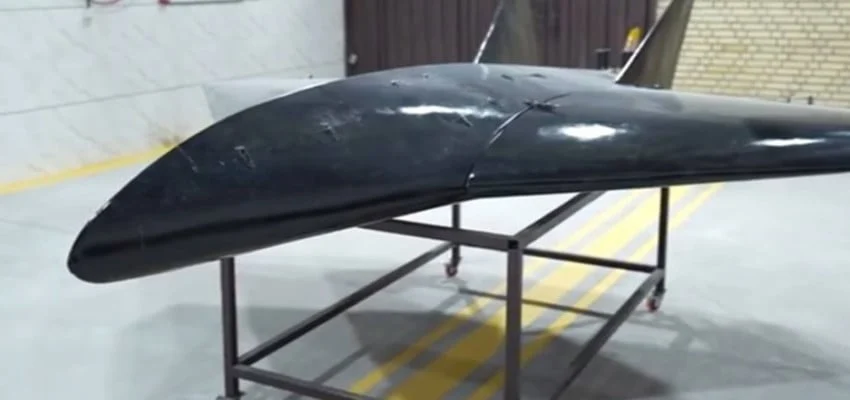
TEHRAN — In a significant display of its expanding indigenous military capabilities, the Islamic Republic of Iran Army officially introduced the latest iteration of its one-way attack drone family, the Arash-3. The unveiling took place during an inspection tour by high-ranking military officials, including Major General Amir Hatami, to a classified underground drone production facility. Released to the public on October 22, the broadcasted footage showcased production-ready airframes, highlighting Tehran’s continued reliance on domestic manufacturing to bolster its asymmetric warfare arsenal amid heightened regional tensions.
While comprehensive technical parameters of the Arash-3 remain officially unconfirmed by military authorities, the initial disclosures indicate substantial upgrades over its predecessors. The newly revealed loitering munition boasts double the explosive payload capacity of earlier variants, enhanced independent GPS navigation systems, and advanced artificial intelligence (AI)-assisted targeting capabilities. This strategic evolution underscores Iran’s persistent drive to modernize its unmanned aerial vehicle (UAV) inventory, making low-cost systems deadlier, more autonomous, and increasingly resilient against electronic warfare countermeasures.
The Emergence of the Arash Series in Iran’s Military Doctrine
The historical development of the Arash drone family is deeply rooted in Iran’s broader military doctrine, which emphasizes asymmetric deterrence to counter technologically superior adversaries, such as the United States and its regional allies. Developed primarily to offset the limitations of Iran’s aging conventional air force—which has suffered under decades of international arms embargoes—the domestic defense sector has pivoted heavily toward missile and UAV technology.
The Arash platform initially gained international prominence as a long-range, one-way attack drone designed to crash into stationary high-value targets, including radar installations, command and control nodes, and critical infrastructure. Over the years, the platform has undergone iterative design changes, transitioning from basic remote-controlled airframes to sophisticated loitering munitions capable of pre-programmed flight paths and terminal autonomous guidance.
The unveiling of the Arash-3 inside an underground production facility—often colloquially referred to by Iranian media as "drone cities"—is itself a strategic messaging tactic. By burying manufacturing and storage facilities deep beneath mountainous terrain, Tehran aims to protect its vital military infrastructure from preemptive airstrikes by hostile actors, thereby ensuring continuous production lines even during active armed conflict.
Technical Specifications and Key Enhancements of the Arash-3
Military analysts and defense observers have closely scrutinized the limited data released regarding the Arash-3. Based on the technical briefings provided during the October 22 facility tour, the new drone introduces several critical engineering upgrades that set it apart from the Arash-1 and Arash-2 models.
Carrying a 100-Kilogram Explosive Payload
The most pronounced upgrade in the Arash-3 is the doubling of its warhead capacity. While previous iterations typically carried approximately 50 kilograms of high explosives, the new model accommodates a formidable 100-kilogram payload.
According to statements made by an Iranian Army ordnance specialist featured in the launch footage, the combination of a heavier payload, refined explosive and incendiary compositions, and enhanced strike precision multiplies the targeted structural damage by roughly 2.3 times compared to older variants. Defense analysts note that this dramatic increase in destructive potential allows the Arash-3 to effectively threaten heavily fortified structures, hardened bunkers, and large naval assets—targets that previously required multiple drone strikes or heavier ballistic missiles to neutralize.
AI-Assisted Targeting and Independent Navigation
Modern warfare increasingly relies on electronic countermeasures (ECM), such as GPS jamming and spoofing, which have proven effective at disrupting basic autonomous and remote-controlled drones in recent conflicts. To counter these vulnerabilities, the Arash-3 incorporates advanced independent navigation systems coupled with AI-assisted target acquisition.
The integration of artificial intelligence at the terminal phase of flight allows the drone to identify, track, and lock onto targets even when external communications and satellite navigation links are completely severed. This autonomous terminal homing capability significantly increases the probability of a successful hit, reducing the drone’s susceptibility to modern air defense and electronic warfare systems deployed by adversaries.
Propulsion and Range Configuration
While earlier models of the Arash series relied heavily on piston engines, defense analysts evaluating the visual data of the Arash-3 suggest a diversification in propulsion methods, with certain configurations pointing toward jet-assisted or jet-powered variants. A jet-propelled one-way attack drone drastically reduces the time-to-target over long distances, limiting the reaction window for enemy air defense systems. The flexible configuration options also allow military commanders to tailor the drone’s speed, range, and payload capacity based on the specific tactical requirements of a given mission.
Geopolitical Context and Regional Implications
The public debut of the Arash-3 does not occur in a vacuum. It comes at a critical juncture marked by prolonged conflicts in the Middle East, where unmanned aerial systems have decisively shifted the nature of modern tactical and strategic combat. From Eastern Europe to the Middle East, cheap one-way attack drones have demonstrated their ability to saturate air defense networks, exhaust costly interceptor missiles, and inflict strategic damage on critical infrastructure at a fraction of the cost of traditional fighter jets or cruise missiles.
For Tehran, the expansion of the Arash series serves multiple strategic imperatives:
- Cost-Effective Deterrence: Maintaining a vast inventory of affordable loitering munitions allows Iran to project power regionally without committing expensive conventional military assets that are difficult to replace under sanctions.
- Industrial Resilience: By relying on a completely domestic supply chain for the airframes, guidance systems, and explosives, the Iranian defense sector insulates itself from foreign supply disruptions and international pressure.
- Export and Proliferation Potential: Iran has increasingly positioned itself as a major exporter of military drone technology. Advanced variants like the Arash-3 serve as both a deterrent shield and a diplomatic tool within its network of regional alliances.
International Reaction and Strategic Concerns
The advancement and proliferation of Iranian drone technology have long been a source of acute concern for Western governments, Israel, and Gulf Arab states. Regional defense analysts point out that the combination of a 100-kilogram warhead and AI-assisted guidance turns the Arash-3 from a simple nuisance weapon into a precision-strike asset capable of causing catastrophic damage to critical energy infrastructure, military bases, and urban centers across the Middle East.
Intelligence agencies in the United States and Israel are expected to conduct rigorous forensic analyses of the Arash-3’s components—particularly its guidance chips, sub-assemblies, and explosive chemical signatures—to determine the extent of foreign technological inputs and to develop more effective countermeasures. The incorporation of AI into loitering munitions highlights a worrying trend for regional security planners, as autonomous weapon systems reduce reliance on vulnerable radio-frequency links and make interception exponentially more difficult.
Future Outlook for Iran’s Unmanned Aerial Fleet
The unveiling of the Arash-3 signals that Iran’s military-industrial complex is far from static, continuously adapting its designs based on lessons learned from contemporary conflicts. As Tehran refines its manufacturing processes within its underground facilities, the mass production of these heavier, smarter, and faster suicide drones is expected to accelerate.
For regional stability, the operational deployment of the Arash-3 introduces new tactical challenges for air defense commanders. As asymmetric warfare continues to evolve, the ability of states to counter low-cost, AI-enabled swarming munitions will dictate the future balance of military power in the Middle East. For now, Iran’s latest defense milestone demonstrates Tehran’s unwavering commitment to advancing its missile and drone capabilities as the cornerstone of its national security and regional deterrence strategy.