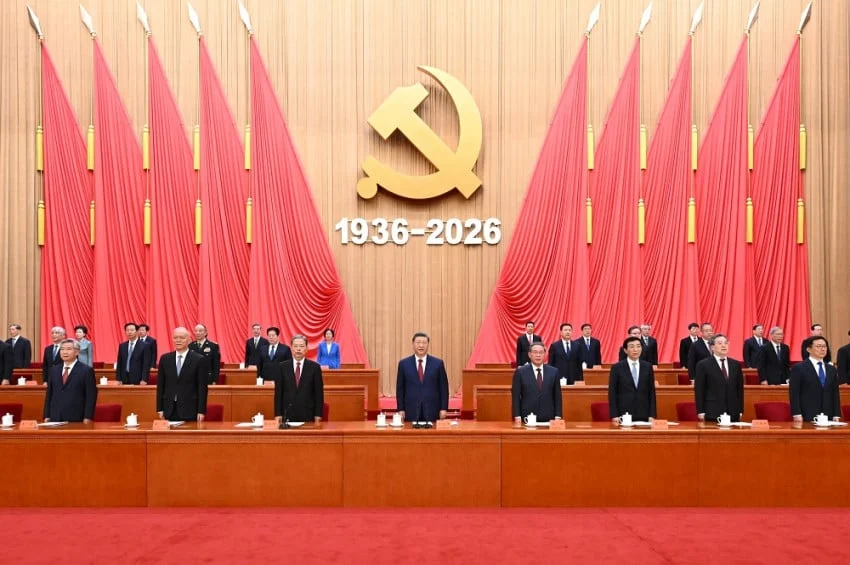
BEIJING — As the leadership of the world’s second-largest economy prepares for a high-stakes political gathering, the traditional script of Chinese economic planning is undergoing a noticeable shift. Top officials of the ruling Chinese Communist Party (CCP) are converging in Beijing for a critical closed-door political meeting that places internal party discipline, governance reform, and self-rejuvenation at the absolute center of the national agenda. Rather than unveiling the anticipated comprehensive roadmaps for economic expansion or financial restructuring, the proceedings underscore a profound pivot toward tightening ideological alignment, institutional control, and rigorous oversight across the vast apparatus of the state.
The meeting highlights the ongoing evolution of Beijing’s political strategy under current leadership, focusing heavily on systemic integrity and strict accountability. By prioritizing structural governance and the perpetual campaign against corruption over immediate economic output metrics, the ruling party is signaling a foundational hardening of its internal mechanisms. This policy direction not only seeks to purge administrative inefficiencies and systemic misconduct but also aims to fortify the political architecture well ahead of upcoming leadership transitions and national congress milestones.
Understanding the Political Architecture of CCP Plenary Sessions
To comprehend the significance of this gathering, one must examine the structured cadence of Chinese elite politics. Plenary sessions—or plenums—serve as pivotal milestones within the five-year political cycle of the Central Committee, an elite body comprising hundreds of top party officials, provincial leaders, and military generals. Historically, a standard leadership cycle incorporates approximately seven plenums, each bearing a distinct systemic function designed to steer national policy, economic planning, and ideological alignment.
Academic experts specializing in Chinese elite politics note that the sequencing of these plenums follows a relatively predictable historical pattern. Typically, the third plenum in a given cycle addresses structural economic reforms, while the fifth plenum traditionally focuses on formulating and approving the macro-level five-year socioeconomic development plans. However, the current political calendar has broken away from this conventional trajectory. The foundational work regarding the 15th Five-Year Plan was advanced out of sequence, allowing the current fifth plenum to concentrate almost exclusively on internal party governance, institutional discipline, and administrative compliance.
This strategic recalibration was formalized during an elite Politburo meeting where leadership reviewed and confirmed the submission of draft resolutions concerning comprehensive internal governance. By elevating party discipline above immediate economic forecasting for this specific session, Beijing is demonstrating that systemic durability and ideological cohesion are viewed as the fundamental prerequisites for sustainable national development.
The Persistent Anti-Corruption Campaign and Institutional Oversight
At the core of the current political agenda remains the relentless anti-corruption campaign, a defining hallmark of contemporary Chinese politics. Over the past decade, this sweeping initiative has targeted millions of officials across various administrative tiers, ranging from low-ranking local bureaucrats to high-profile political figures often referred to in state media as "tigers and flies." The continuation of this campaign reflects a deep-seated institutional concern regarding operational compliance, loyalty, and the eradication of systemic rent-seeking behaviors that could undermine state authority.
The enforcement mechanisms deployed by internal watchdog bodies—principally the Central Commission for Discipline Inspection (CCDI)—have grown increasingly sophisticated. Integrating advanced data analytics, digital surveillance of public assets, and streamlined reporting channels, the party has constructed a formidable apparatus designed to monitor the daily conduct of millions of card-carrying members.
Political analysts observe that maintaining such rigorous internal surveillance serves a dual purpose. Externally, it projects an image of uncompromising accountability and good governance to the domestic populace. Internally, it reinforces strict hierarchical compliance, ensuring that local implementation aligns seamlessly with the strategic directives issued from Beijing. As the party approaches critical political junctures, the imperative to eliminate internal dissent and administrative deviation becomes paramount, cementing centralized control over every tier of the state bureaucracy.
Translating Political Intent into Concrete Administrative Policy
A central challenge for any ruling political party of this scale is bridging the gap between high-level ideological declarations and practical implementation at the grassroots level. Research into Chinese political economy consistently highlights the crucial role that plenary resolutions play in translating broad ideological frameworks into enforceable administrative statutes and localized policy directives.
When the Central Committee ratifies decisions concerning internal governance, these documents do not merely serve as theoretical guidelines; they are rapidly translated into binding regulatory frameworks, evaluation metrics for local officials, and mandatory training curricula within party schools. Consequently, the outcomes of the current plenum will directly influence how provincial and municipal governments evaluate leadership performance, manage public resources, and enforce legal and regulatory standards.
This translation mechanism ensures that the party’s overarching philosophy regarding self-revolution and administrative rigor permeates every level of governance. By institutionalizing compliance standards and modernizing bureaucratic oversight, Beijing seeks to preemptively address potential vulnerabilities, economic friction points, and administrative bottlenecks that could otherwise impede national development goals.
Broader Implications and Regional Reactions
The strategic prioritization of internal governance over immediate economic announcements during a high-profile plenum carries significant implications for both domestic stability and international observation. For domestic observers and market participants, the focus on discipline underscores that economic policy is increasingly subordinated to political security and structural compliance. Businesses operating within the jurisdiction must navigate an environment where regulatory enforcement is rigorous, predictable in its adherence to party mandates, yet fundamentally uncompromising regarding legal and administrative standards.
Internationally, foreign governments and global financial institutions monitor these closed-door deliberations closely for insights into China’s long-term strategic trajectory. While the absence of a primary focus on new economic stimulus packages may temper immediate market expectations, the emphasis on institutional stability and anti-corruption signals a leadership firmly committed to long-term systemic consolidation.
Ultimately, the decisions emerging from this political gathering will shape the operational environment of the world’s most populous nation for years to come. By institutionalizing mechanisms of self-governance, reinforcing internal discipline, and ensuring the absolute authority of the central leadership, the Chinese Communist Party is actively preparing its administrative apparatus to confront complex domestic and global challenges in the decades ahead.