
The Indonesian Communist Party, historically known as Partai Komunis Indonesia (PKI), stands as one of the most polarizing and scrutinized political entities in modern Southeast Asian history, having evolved from a nascent colonial-era anti-imperialist movement into a dominant electoral powerhouse before its total annihilation and proscription in the turbulent wake of 1965. The trajectory of the PKI is not merely a localized political narrative; it is a complex tapestry of revolutionary zeal, ideological factionalism, geopolitical maneuvering during the Cold War, and a profound human rights tragedy that continues to reverberate through contemporary Indonesian sociopolitical discourse. Decades after its official dissolution, the shadow of the PKI remains a touchstone for discussions regarding state security, historiographical debate, historical transparency, and the delicate balance of transitional justice in the world’s third-largest democracy.
The Genesis of Leftist Politics in the Dutch East Indies
The foundational roots of the communist movement in the Indonesian archipelago stretch back to the early 20th century, emerging directly out of the anti-colonial awakening against Dutch rule. In May 1914, a small collective of Dutch socialists led by Henk Sneevliet established the Indische Sociaal-Democratische Vereeniging (ISDV), or the Indies Social Democratic Association. The ISDV initially operated as a modest intellectual circle within the colonial infrastructure, but it quickly recognized the potential of harnessing the burgeoning native nationalist awakening.
Sneevliet and his Indonesian comrades adopted a strategy of infiltration and radicalization within existing mass organizations, most notably the Sarekat Islam (Islamic Union), which was then the largest mass-based indigenous movement. This tactic, known locally as blok di dalam (bloc within), allowed radical leftist ideas to permeate the anti-colonial resistance. However, ideological friction between the Islamic base and the increasingly assertive Marxist faction eventually led to an inevitable schism.
By December 1920, during a congress in Semarang, the ISDV formally transformed into the Perserikatan Komunis di Hindia (PKH), subsequently renaming itself the Partai Komunis Indonesia (PKI) in 1924. Operating under the ideological umbrella of the Communist International (Comintern), the newly minted party sought to mobilize the burgeoning proletariat and the deeply impoverished agrarian peasantry against both feudal landlords and the Dutch colonial administration.
The radicalization of the party culminated in a premature and ill-prepared uprising in late 1926 and early 1927. Spanning parts of West Java and West Sumatra, the rebellion aimed to overthrow the Dutch colonial government through coordinated strikes and localized insurrections. However, severe logistical disorganization, a lack of widespread popular coordination, and swift, brutal retaliation by the colonial security apparatus doomed the revolt. The Dutch colonial authorities responded with iron-fisted repression, arresting thousands of suspected communists, executing leaders, and exiling hundreds of political prisoners to the notorious Boven Digoel concentration camp in the remote jungles of western New Guinea. This devastating blow effectively crippled the PKI, forcing its surviving leadership underground or into foreign exile, where they remained largely marginalized throughout the remainder of the Dutch colonial era and the subsequent Japanese military occupation during World War II.
The 1948 Madiun Affair and the Post-Independence Crucible
Following the collapse of Japanese occupation and the dramatic Proclamation of Indonesian Independence on August 17, 1945, the political landscape of the archipelago underwent a violent and chaotic realignment. The newly born Republic of Indonesia struggled to secure international recognition while simultaneously fighting a bitter military and diplomatic war of independence against returning Dutch forces. Amid this existential crisis, the PKI resurfaced, rapidly rebuilding its organizational networks and absorbing various splintered leftist and socialist factions.
The ideological tensions within the Indonesian nationalist movement reached a boiling point in late 1948. At the time, the leftist opposition was consolidated under the Front Demokrasi Rakyat (FDR)—a coalition comprising the PKI, the Socialist Party, the Labour Party, and various radical peasant and worker unions. Disillusioned with the diplomatic concessions made by the central government under Prime Minister Mohammad Hatta to the Dutch—such as the controversial Renville Agreement—and fearful of being suppressed by right-wing military factions, the radical left staged a desperate challenge for state power.
On September 18, 1948, armed clashes erupted in the East Java city of Madiun, accompanied by the proclamation of the "Soviet Republic of Indonesia" by leftist leaders such as Musso and Amir Sjarifuddin. The rebellion, however, severely miscalculated the balance of power and the loyalty of the regular Indonesian armed forces. President Sukarno, retaining immense popular prestige, mobilized the populace against the Madiun insurrectionists through a famous radio broadcast, urging citizens to choose between him and the communist leadership.
The Republican military, under the command of General Abdul Haris Nasution and Colonel Sungkono, moved swiftly and decisively to crush the uprising. Within a matter of weeks, the Madiun Affair was suppressed. Musso was killed during a skirmish, and Amir Sjarifuddin, along with dozens of other high-ranking leftist leaders, was subsequently executed. The 1948 revolt left deep psychological and political scars, branding the PKI in the eyes of the national military establishment as an existential threat to the unitary Republic of Indonesia and setting the stage for decades of unyielding institutional hostility.
Electoral Resurrection and the Rise under Guided Democracy
Despite the catastrophic setback of 1948, which decimated its first-generation leadership, the PKI executed one of the most remarkable organizational recoveries in modern political history. During the early 1950s, a new generation of pragmatic, highly skilled cadres—most notably Dipa Nusantara Aidit (D.N. Aidit), Njoto, M.H. Lukman, and Sudisman—took the reins of the party. Abandoning the adventurism of the past, Aidit and his contemporaries pivoted toward a legalistic, parliamentary strategy combined with massive grassroots organizing.
The revitalized PKI focused heavily on addressing the acute socio-economic grievances of Indonesia’s massive underclass. By championing land reform for impoverished tenant farmers (through the Basic Agrarian Law framework), organizing urban workers, and establishing vibrant cultural, youth, and women’s wings such as Pemuda Rakyat and Gerwani, the party successfully integrated itself into the fabric of everyday Indonesian society.
This painstaking grassroots mobilization bore fruit during the historic 1955 Indonesian legislative election—the first democratic national election in the country’s history. According to official data from the General Elections Commission (KPU), the PKI secured a staggering 6,179,914 votes, translating to 16.36 percent of the total national vote and capturing 39 seats in the People’s Representative Council (DPR). The party finished fourth overall, trailing only the Indonesian National Party (PNI), Masyumi, and Nahdlatul Ulama (NU). In the subsequent elections for the Constituent Assembly, the PKI expanded its footprint further, garnering roughly 6.23 million votes and securing 80 seats. The party was no longer a fringe movement; it had firmly established itself as a legitimate pillar of Indonesia’s parliamentary democracy.
As the political instability of the parliamentary system threatened to tear the young nation apart along ideological, regional, and religious lines, President Sukarno stepped in to dissolve the Constituent Assembly and introduce the era of "Guided Democracy" in 1959. This authoritarian turn centralized power heavily in the hands of the presidency, backed by an uneasy triangle of forces: the political left (anchored by the PKI), the nationalist movement, and the increasingly powerful Indonesian military, particularly the Army leadership.
To navigate this fraught political ecosystem, Sukarno formulated the socio-political doctrine of Nasakom—an acronym fusing Nasionalisme (Nationalism), Agama (Religion), and Komunisme (Communism). The doctrine aimed to unify the nation’s primary ideological currents under the overarching umbrella of state ideology, Pancasila. For the PKI, Nasakom provided a protective political shield. President Sukarno utilized the communists as a strategic counterweight against the growing political and institutional dominance of the military. By the early 1960s, the PKI claimed a membership running into the millions, making it the largest communist party outside the Soviet bloc and the People’s Republic of China, boasting immense influence within state apparatuses, cultural circles, and presidential advisory boards.
The Brink of Crisis and the 1965 Cataclysm
The meteoric rise of the PKI, however, exacerbated deep-seated structural and ideological antagonisms across Indonesian society. The most critical friction point existed between the communist movement and the Indonesian Army (Angkatan Darat). The military viewed the PKI not merely as a political rival, but as a revolutionary vanguard intent on subverting the state, particularly after the communists began advocating for the arming of workers and peasants as a "Fifth Force" independent of the traditional armed services.
Concurrently, fierce localized conflicts erupted across rural Java and Bali regarding the implementation of the Basic Agrarian Law. The PKI’s aggressive unilateral actions (aksi sepihak) to enforce land reform measures alienated rural Islamic elites, wealthy landowners, and conservative religious organizations, particularly the traditionalist Muslim mass organization Nahdlatul Ulama and its youth wing, Ansor. The political atmosphere grew increasingly volatile, characterized by vitriolic propaganda, escalating class warfare, and rumors of impending coups and counter-coups involving foreign intelligence agencies, domestic military factions, and leftist elements.
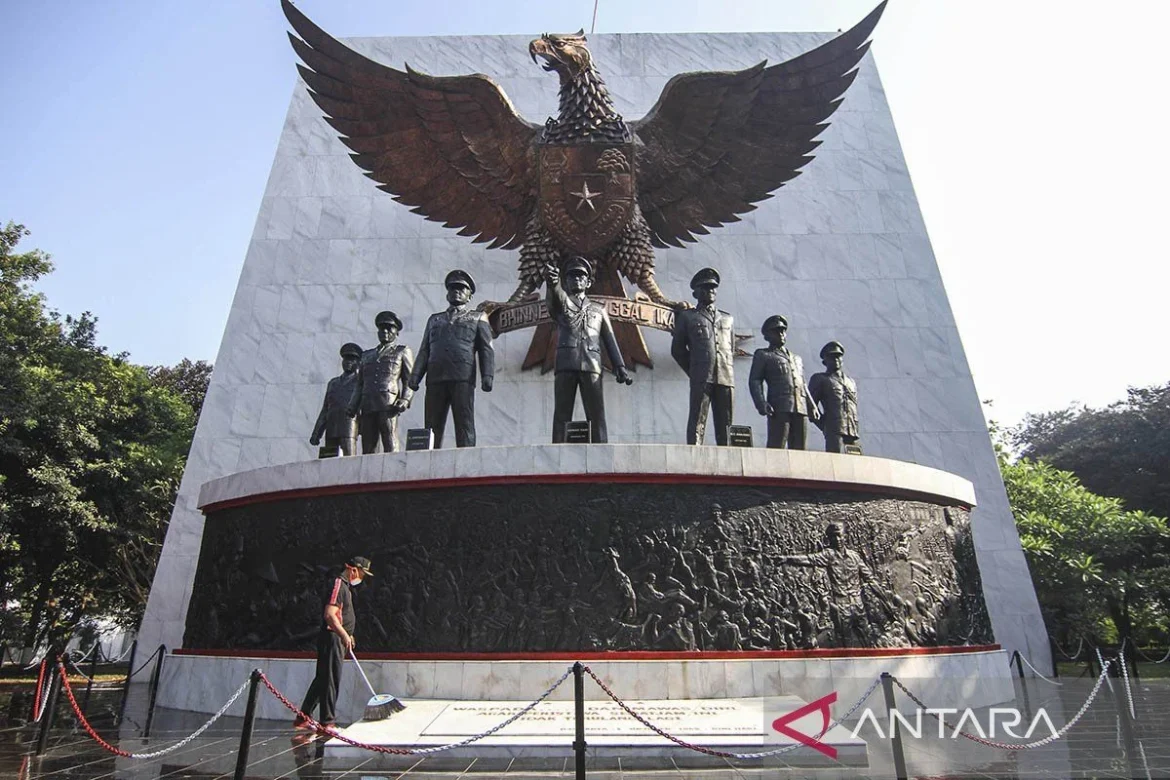
The boiling point was reached on the night of September 30 leading into October 1, 1965. A secretive faction within the military, calling itself the September 30 Movement (Gerakan 30 September or G30S) and led by Lieutenant Colonel Untung Syamsuri of the Tjakrabirawa (Presidential Guard), launched an operation to kidnap and assassinate top-ranking Army generals. Six general officers—including Army Commander Lieutenant General Ahmad Yani—were abducted and murdered, their bodies dumped in a disused well in the Lubang Buaya area on the southern outskirts of Jakarta.
The rationale, mechanics, and precise orchestration of the G30S remain among the most fiercely debated subjects in modern historiography. While the official narrative constructed during the subsequent New Order regime unequivocally cast the PKI as the singular mastermind behind the coup attempt aimed at overthrowing the state, contemporary historical research presents a multifaceted picture. Modern analyses point to a complex convergence of internal military factions, intelligence manipulations, personal ambitions within the officer corps, and opportunistic maneuvering by various political actors, with the party’s central leadership playing an ambiguous or localized role that fell short of a coherent national seizure of power.
The Fall, Mass Violence, and the Establishment of the New Order
The failure of the G30S triggered a cataclysmic transformation of the Indonesian political landscape. Major General Suharto, who quickly seized control of the military apparatus in the chaotic hours following the assassinations, used the crisis to orchestrate a systematic purge of the political left.
The aftermath unleashed an unprecedented wave of mass violence across the archipelago, predominantly concentrated in Central Java, East Java, Bali, and parts of Sumatra. From late 1965 through 1966, military units, operating in tandem with civilian paramilitary groups and religious youth organizations, launched systematic campaigns of arrest, detention, and mass extrajudicial killings targeting real and alleged members, sympathizers, and affiliates of the PKI, alongside trade unionists, educators, artists, and ethnic Chinese minorities.
Estimates regarding the human toll of the 1965–1966 violence vary significantly due to the lack of contemporary documentation and political sensitivities, with historical consensus generally placing the death toll between 500,000 and one million individuals, while hundreds of thousands more were incarcerated without trial in penal colonies such as Buru Island or subjected to lifelong civic disenfranchisement and severe systemic discrimination.
Institutional and legal structures were swiftly dismantled to cement this new reality. On March 12, 1966, General Suharto issued a presidential order—broadly legitimized by the Supersemar (Surat Perintah Sebelas Maret)—banning the PKI and all of its mass organizations, declaring them illegal entities. This executive action was formalized and elevated to constitutional permanence by the Provisional People’s Consultative Assembly (MPRS) through MPRS Decree No. XXV/MPRS/1966, enacted on July 5, 1966. The decree explicitly outlawed the PKI across the entirety of Indonesian territory and strictly prohibited the dissemination, teaching, or development of Marxist, Leninist, and communist doctrines.
Politically, the collapse of the PKI dealt a fatal blow to President Sukarno’s political base, effectively ending his grip on power. Through a series of gradual constitutional maneuvers, Suharto assumed executive authority, formally becoming acting president in 1967 and full president in 1968, inaugurating the authoritarian, anti-communist regime known as the New Order (Orde Baru), which would govern Indonesia with an iron fist for over three decades until its collapse in 1998.
Historiographical Legacy and Contemporary Discourse
Decades after the events of 1965–1966, the legacy of the PKI and its violent eradication remains a deeply sensitive and complex issue within Indonesian society and statecraft. For generations under the New Order, the official narrative of the G30S was institutionalized through compulsory school curricula, state-sponsored historical monuments, annual commemorative rituals on October 1 (celebrated as Hari Kesaktian Pancasila or Pancasila Sanctity Day), and mandatory cinematic screenings of propaganda films depicting the communist movement as inherently treacherous and anti-religious.
Following the fall of Suharto in 1998 and the advent of the Reformasi era, intellectual and public spaces opened up, allowing historians, human rights advocates, and victims’ families to challenge the monolithic state narrative. Investigations by institutions such as the National Commission on Human Rights (Komnas HAM) have documented the systematic nature of the human rights violations committed during the purge, classifying them under international humanitarian standards as gross human rights abuses.
At the same time, archival research has expanded globally. Institutions such as the National Archives of the Republic of Indonesia (ANRI) have actively curated and released comprehensive collections of historical source materials—incorporating diplomatic, military, and intelligence archives from Indonesia, the United States, Japan, and Western Europe—to encourage evidence-based academic research rather than ideological polemics. ANRI’s ongoing efforts underscore the necessity of distinguishing between documented historical fact, official state decrees, and the evolving interpretations that continue to populate academic debates.
Despite these intellectual openings, the legal framework established in the 1960s remains largely intact. MPRS Decree No. XXV/MPRS/1966 has not been formally revoked, and the dissemination of communist ideology remains legally prohibited under Indonesian criminal law. Periodic public anxieties regarding real or perceived revivals of leftist symbols—often amplified by social media misinformation or leveraged for contemporary political mobilization—demonstrate that the trauma of 1965 continues to cast a long, complex shadow over the nation’s political consciousness.
Ultimately, the history of the Partai Komunis Indonesia serves as a profound cautionary tale within the annals of modern state-building. It illustrates the volatile interplay between ideological radicalism, socioeconomic inequality, institutional fragility, and the high human cost of political polarization. As Indonesia continues to mature as a democratic republic, confronting the historical realities of the PKI era remains an essential, albeit delicate, component of national reconciliation, historical integrity, and the enduring defense of human rights.
